Sampleson Aeronaut Review
Sampleson Aeronaut is a $29 spectral freeze plug-in that claims to builds cinematic pads and drones. How well does it work? Let’s find out…
Sampleson, a small developer from Sheridan, Wyoming, has based most of their offerings on what we would call “Smear Effects,” namely algorithms that take an audio source and smudge them into oblivion. Each one of their plug-ins take a slightly different approach to Smearing, but the results are similar in many ways. Before we get into it, we need to state that Sampleson publishes no manual, spec sheet or changelog for their products. Thus, every technical claim we make is based on its product page and what we’ve been able to surmise from our experiences up to version 1.0.5.
Aeronaut is the latest of Sampleson’s lineup of ambient tools. Scaper arrived in May 2024 as a generative soundscape plug-in, allowing your to drop in a WAV, OGG or AIFF file, split it into particles, modulate the pitch and speed with six parameters, and then feed it into a four-pole low-pass filter. Tactile followed in June 2025, pairing a spectral freezer with two granular processors under an X-Y grid, and it shipped as VST3, AU and AAX plug-ins, as well as a standalone application. Both tools worked from audio files. Aeronaut, which arrived in June 2026 as a VST3 and AU plug-in, takes the same spectral thinking and puts it into a DAW workflow.
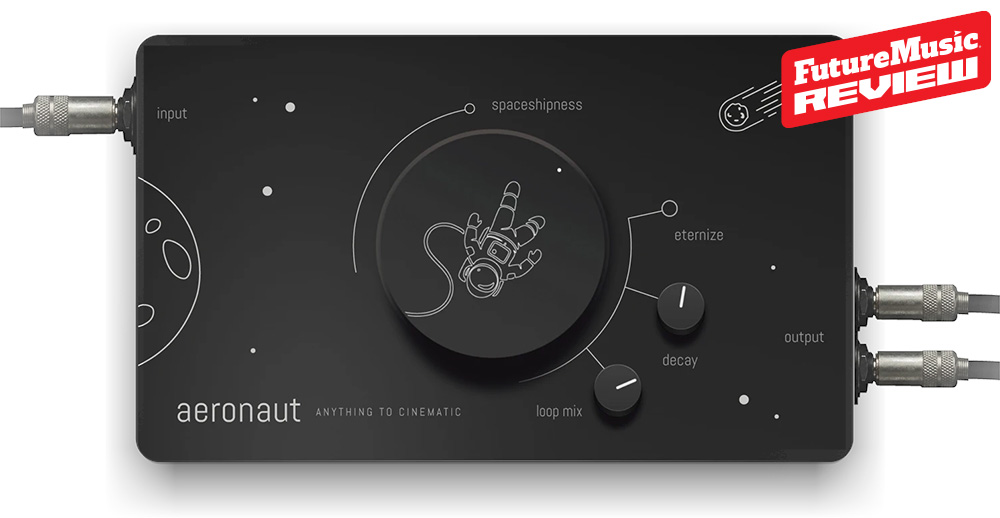
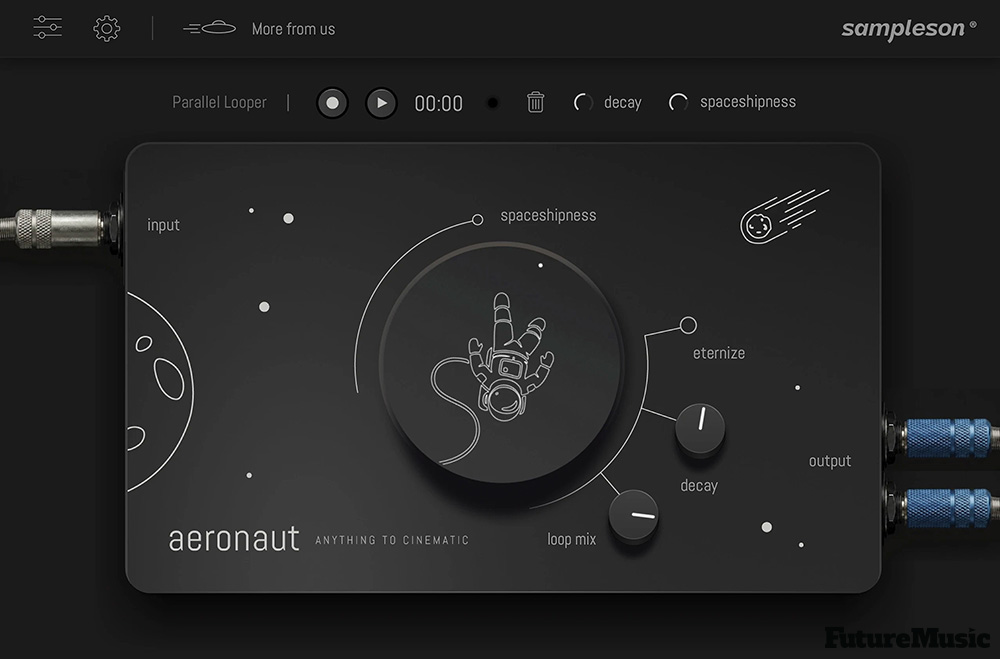
Aeronaut is effect that you insert on an audio or instrument track and analyzes the incoming signal. Two parameters carry most of the work. Spaceshipness governs how far the sound is transformed, and Decay sets how long the generated material lingers. A Freeze button locks the current spectrum into a sustained pad, and Eternize captures a spectral snapshot that keeps sounding while you play over it. A built-in ten-second looper runs on its own parallel path. Both the live and looper paths each have their own freeze mix and decay. The interface is very basic and after using it, we all felt that the plug-in was clamoring for an Advanced tab were you could get under the hood. Sampleson doesn’t publish any latency specs and it’s clearly hard to ascertain the delay in smear effects, but it didn’t cause a problem for our evaluators. Although, Aeronaut runs natively on Apple Silicon and on Intel Macs, there is a CPU tax to pay, which “is a consideration.”
What separates Aeronaut from other smear effects is the way it stores sound. Aeronaut analyzes the input with a short FFT window, saves the frequency content rather than the waveform, and rebuilds the sound with new phases on every frame. Discarding the waveform is what lets a frozen moment sustain as a smooth wash instead of a repeating sharp fragment, which is why you hear a continuous, click-free, loop-free playback. The frozen texture is assembled from the source’s own harmonic content, allowing it to stay in the same key and have the same tonal quality of the source material. This is one of Aeronaut’s greatest strengths, since you don’t have to dicker with key clashes when creating your own soundscapes.
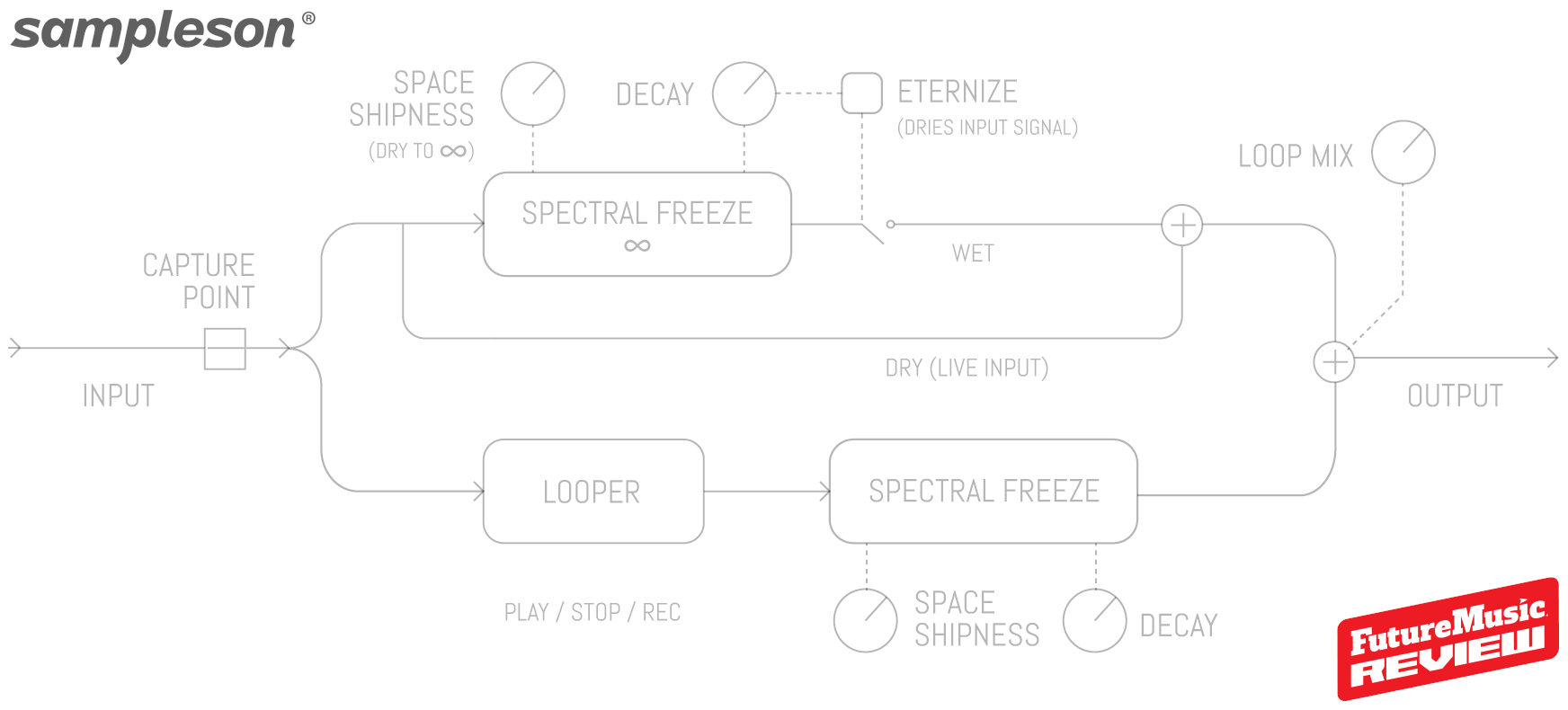
But there’s another distinguishing feature, which sets Aeronaut apart, and something our testers which they had more granular control over. The live path, the frozen layer and the looper run concurrently, so you can hold a frozen bed, loop something underneath and solo on top without muting or switching modes. A reverb builds its tail from delayed copies of the waveform and a looper repeats the waveform, which is why Sampleson places it somewhere between granular resynthesis, a spectral hold and a reverb/delay blender. The end result is mostly a shimmer-style granular reverb that can freezes the sound and reinsert it back into the mix, but with more layering. The issue is the ability to precisely control that layering is not available, and something Sampleson should think about adding in a future update.
Aeronaut requires macOS 10.13+ or Windows 10+ and asks for 4 GB of RAM and 200 MB of disk space. ProTools is not supported.
But deep layering control is not the only thing that Aeronaut leaves things on the table. A short FFT window favors time response over frequency detail, despite Sampleson promoting pristine spectral resolution from the engine. Sampleson does not say how actually long the FFT window is, and you cannot change it. Rebuilding phase on every frame should also blur attacks and rhythmic detail in the held layer, which is the point for pads and drones and a limit for anyone hoping to keep a source’s definition to some degree. The other weaknesses resolve around the other parts of Aeronaut’s value proposition. There is no manual, no spec sheet and no changelog, and the support page is an email address and a promise to reply within 24 hours.
One odd exclusion is that an AAX build is not available, although Tactile, which came out a year earlier does support the ProTools standard. For a plug-in that touts a cinematic pedigree, it’s a weird omission.
Sampleson Aeronaut Review
LinnStrument Sale
Roger Linn has put his LinnStrument on sale! (He never does this…) Learn More About LinnStrument
Sampleson Aeronaut Features and Specs:
- Features
- Real-time spectral freeze engine
- Works with any live input: guitar, vocals, synths, drums, field recordings
- Built-in looper: freeze a moment and play melodies on top
- Hollywood-grade cinematic textures from a single note
- Continuous, click-free, loop-free spectral playback
- High-resolution User Interface
- VST3 and AU plug-in
- macOS (Apple Silicon & Intel) and Windows
- macOS Requirements
- Supported on Apple Silicon (Native) and Intel Macs
- 64-bit VST3 and AU
- Works on macOS 10.13 or later
- 200 MB HDD / 4 GB RAM
- Windows Requirements
- Windows 10 or later
- 64-bit VST3 included
- 200 MB HDD / 4 GB RAM
Read Next: Telepathic Instruments Orchid Review
Judged as hardware engineering, the Telepathic Instruments’ Orchid is merely good. Judged as a songwriting tool, it’s excellent, and it would be genuinely outstanding if the next revision spent its effort on removing walls rather than adding rooms… Telepathic Instruments Orchid Review
For pros, the biggest deficit is Aeronaut’s depth, or lack there of. The two-knob front panel should stay as it is for hobbyists, but an optional advanced panel with window size, variable looper length and other precise controls would open up the plug-in for users who want to get into the details.
Conclusion
As a smear effect, Aeronaut sounds quite good and it’s ability to maintain the tonal quality and key of the source material is a big win. The easy to palette price, which can get even lower thanks to sales and bundles, makes it almost a no-brainer if you are interested in creating your own drones, ambient washes and spacing out material that needs an ethereal quality without having to chain several plug-ins together. Recommended.
Sampleson Aeronaut costs $29 and is available now.
Price Note: Prices are as of November 2026, quoted in US dollars and are different in other countries and geographical locations.
Pricing Sampleson often has sales and bundle opportunities, so if you’re on the fence, check back to their site for a promotion that works for you.

Cheers:
+ Turns live input into evolving cinematic texture with two main controls, Spaceshipness and Decay
+ Freeze and Eternize hold a spectral snapshot while you keep playing
+ Live path, frozen layer and looper run at the same time
+ Phase rebuilt every frame is designed for continuous, click-free, loop-free playback
+ Output stays tied to the key and tone of the source
+ Quality processing makes it useful on a wide variety of material.
Jeers:
— Zero ability to get under the hood to make changes to the parameters
— Latency and CPU claims are never quantified
— No AAX build, so Pro Tools is not supported
— No standalone application is listed, unlike Scaper and Tactile
— The looper is locked to ten seconds with no ability to change it.
— A short FFT window sits awkwardly beside the claim of pristine spectral resolution, and the window size is not disclose
— No manual, spec sheet or changelog, and support is by email only
— No presets
The Future: In a next version we would like to have the ability to tweak all parameters individually. That alone would make the plug-in so much better. The ability to store you own presets (and have some available as foundations) would be a nice addition. The ability to store freezed snapshots that users could morph between, so a held chord could drift into the next one instead of being replaced by it. Per-band freezing, so a low drone could sit under a still-live top end, MIDI control over frozen layers so a pad could follow a chord progression without being replayed, and a width control for the frozen layer so it could spread wider than the source. A looper that you could control the length of as well as locks to the host tempo would help rhythmic material.
Off The Record: Solid offering out of the gate, but this plug-in could be so – much – more.