Telepathic Instruments Orchid ORC-1 Review
Long-Term Test
The Telepathic Instruments Orchid, (ORC-1) began as a fond memory Kevin Parker had from his youth. The songwriter and producer known as Tame Impala, grew up toying with his father’s Casio keyboard and discovered something that stayed with him for decades. The little chord section on the Casio allowed him to stumble into progressions he would never have discovered himself without knowing music theory, and it left a profound impression.
He carried that vibe with him for roughly ten years without consciously acting on it. However, when he stopped touring during the pandemic, something finally clicked. Parker sent an Instagram message to Tom Cosm, a New Zealand musician and Ableton Certified Trainer whose production tutorials he had religiously watched online. He pitched Cosm on the concept, and if he was interested in trying to build something that would equate to what the Casio did, but as a modern standalone instrument for Parker to experiment with during the downtime.
What was meant to be a one-off personal instrument became a company after Chris Adams floated the idea of actually selling it. Parker’s wife, Sophie Lawrence Parker, introduced the group to Charl Laubscher, who came aboard as Managing Director, and Laubscher brought in the industrial designer Ignacio Germade to turn a working prototype into a manufacturable product. Those five names constitute Telepathic Instruments, and the Orchid is the only hardware they have shipped, aside from a carrying case and some dedicated cables.
The rollout was unusual, and deliberately so. The first batch, one thousand units, went on sale in January 2025 and sold out in minutes. The company was candid that this run functioned as a live beta, and those units landed with artists including Fred Again, Gracie Abrams, and Murda Beatz. A second batch of three thousand followed in May 2025, sold out just as quickly, bringing the installed base to roughly four thousand players before the instrument had ever reached a shop. Telepathic announced a proper worldwide release on September 30, 2025, and opened sales globally on October 10, 2025 at $649. That third revision folded in a substantial amount of community feedback, adding pre-programmed beats designed by Parker, a dedicated cutoff filter, quantization, drum effects with rhythmic controls, the ability to modify and save sounds directly on the device, and ten new Parker-designed presets. A translucent limited edition called Clear Orchid: Arctic, capped at three thousand units, arrived on May 11, 2026.
The Orchid has kept evolving through firmware, which is delivered through a slightly unusual browser-based updater rather than a desktop installer. The published changelog begins with v3.04 in March 2025 and moves through v3.21 in May and v3.32 in July of that year. Version 3.60, on September 17, 2025, was the most substantial single release, adding ten new sounds, MIDI clock output, quantization, a cutoff effect, drum effects with reverb and saturation controls, additional time signatures, and the ability to long-press and save a sound together with its performance mode and effects as a user preset. Version 3.63 followed on October 10, 2025, opening the door to the companion plug-in, Pistil. The most consequential update for working musicians was v3.84 on February 20, 2026, which finally introduced loop saving and loading alongside additional chord combinations reachable through button presses and a visual indicator showing where a voicing splits. Version 3.90, released April 17, 2026, brought ten further sounds, MIDI channel controls including the ability to switch channels off, a restructured options menu, better loop tracking, smoother delays, and a fix for a phaser that “could run away” at extreme settings. Seven documented releases across roughly fourteen months is a cadence that is rare at any price and genuinely rarer at this one.
The hardware itself is compact and unmistakable…
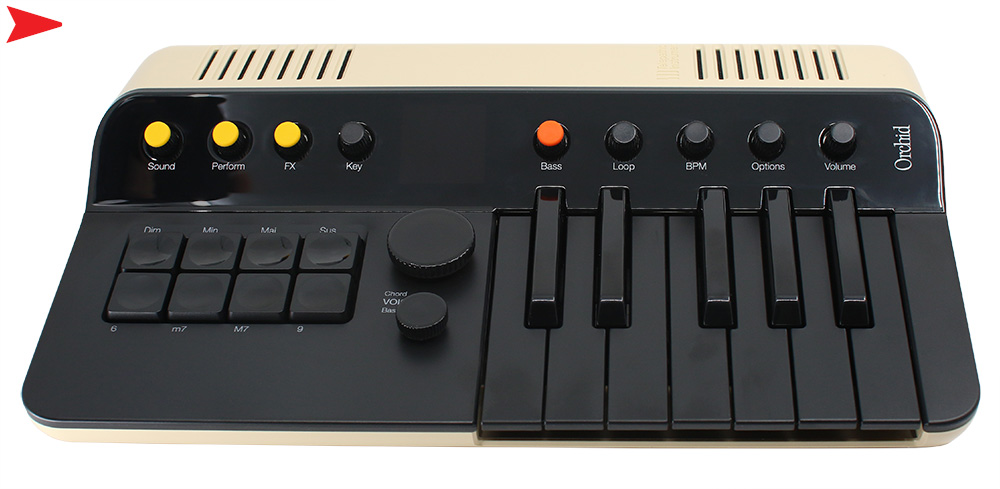
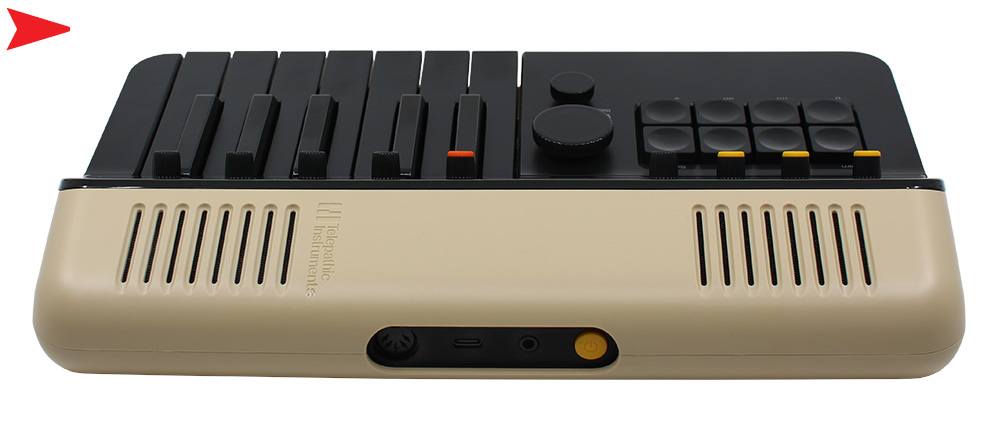
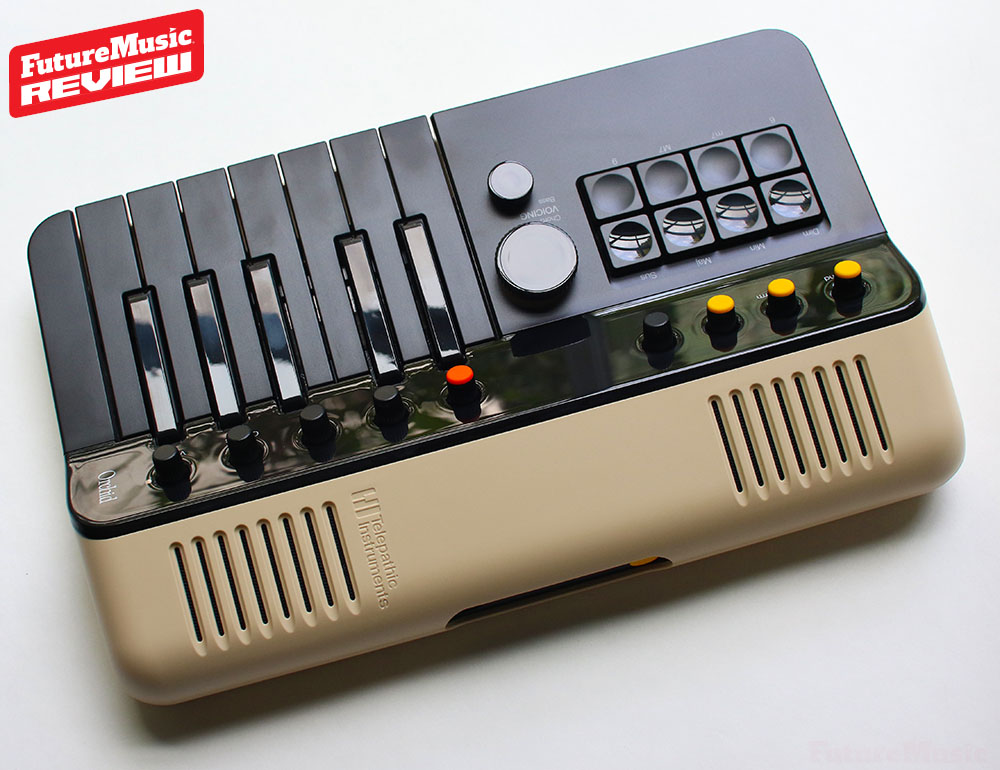
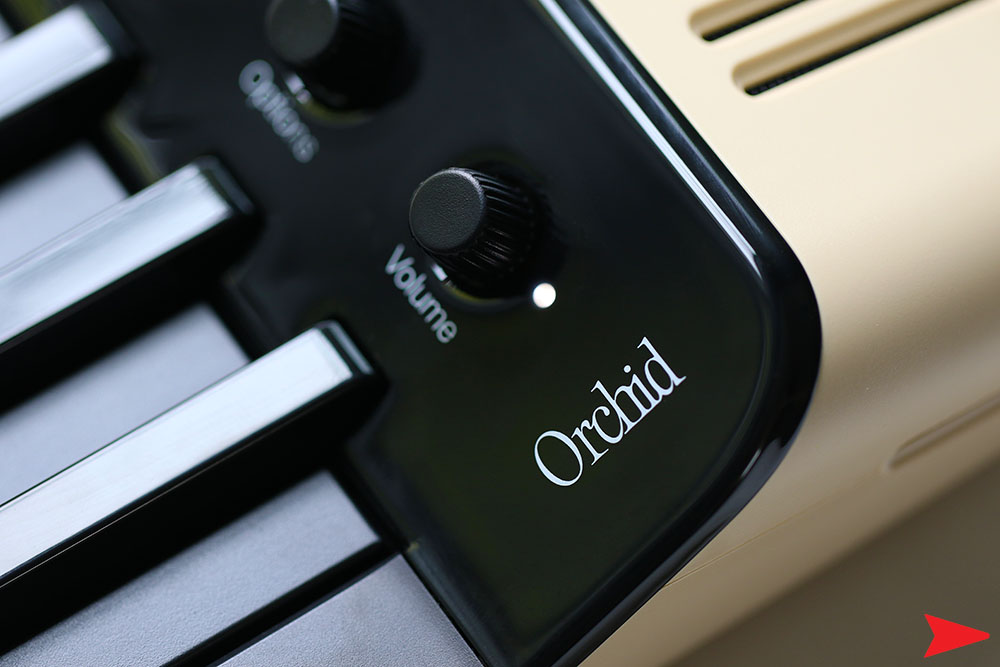
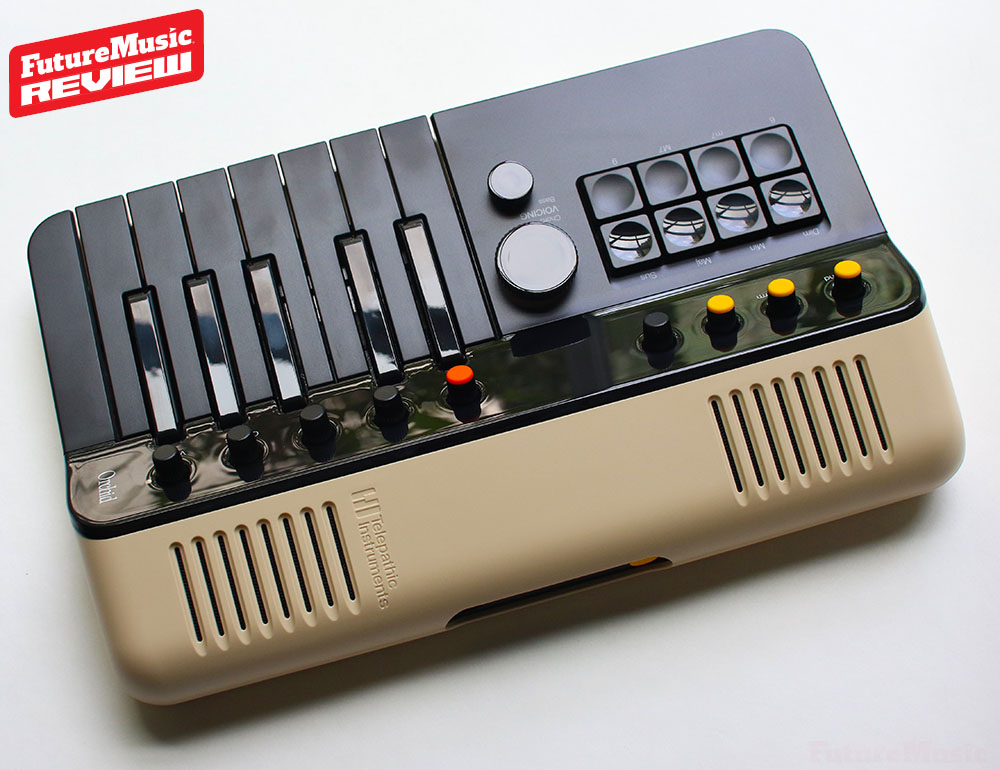
The hardware itself is compact and unmistakable. It measures 305mm by 190mm by 50mm, weighs 1.8 kilograms, and runs off an internal rechargeable battery through a pair of onboard stereo speakers, with an OLED display handling feedback. Twelve velocity-sensitive keys give you one chromatic octave, which is not a keyboard for playing in any conventional sense, plus a bank of root note selectors. The harmonic intelligence sits to the left, in two rows of four buttons. The top row sets chord quality across diminished, minor, major, and suspended. The bottom row layers extensions, offering sixth, minor seventh, major seventh, and ninth. Three complexity tiers named Simple, Advanced, and Free progressively widen what those combinations are allowed to produce, and a Key Mode will constrain everything to a chosen scale so that no key on the instrument yields a wrong answer. The signature control is the Voicing Dial, trademarked and marked patent pending by the company, which spins a held chord through inversions and octave spreads in real time.
Telepathic Instruments Orchid ORC-1 Review
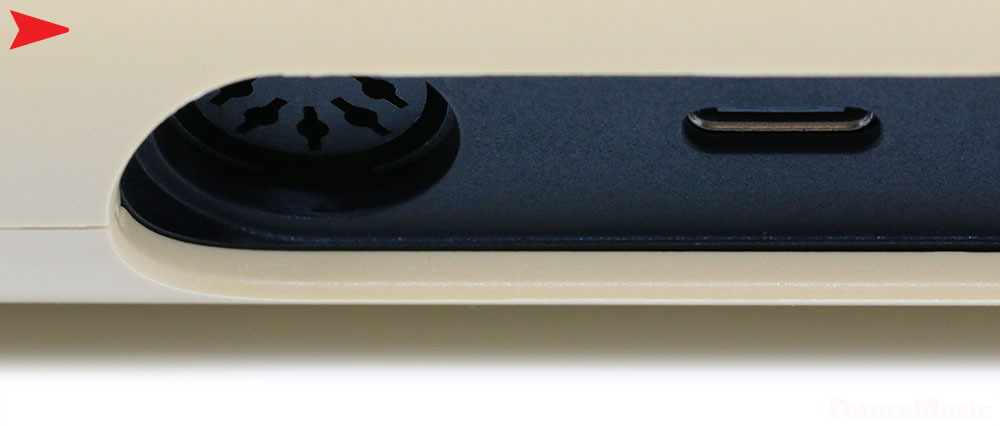
Underneath sits a sixteen-voice engine spanning three synthesis models, described as virtual analog, FM and a vintage reed piano. Current firmware carries 70 chord presets, grown from 50 at launch through two rounds of ten additions, alongside a separate bank of twelve bass sounds. That monophonic bass voice runs beneath the chords with its own follow and solo behavior and its own transposition dial. Five performance modes reshape how a held chord is articulated, covering Arpeggiator, Strum, Slop, Pattern and Harp, with eleven preset rhythmic patterns available in the last of those, and a beat engine supplies twenty pre-programmed drum patterns. Effects run to reverb, chorus, delay, flanger, phaser, overdrive and the later cutoff addition, arranged in three slots whose contents are assigned per preset. You control how much of each you want rather than which one occupies a slot, and a lock function will hold a set of effects in place as you audition other sounds. Connectivity is USB-C for MIDI, power and firmware, five-pin DIN MIDI out and a 3.5mm stereo jack. As of April 2026 there is also Pistil, a companion plug-in that exposes the deeper parameters of all three engines, including four oscillators, LFOs, envelopes and filters, with two-way sync to the hardware. It will set you back $99, requires macOS 13.0 or Windows 10 or later in 64-bit form, and carries 70 presets from Parker’s library.

So what makes it distinct in a market that is not short of chord tools? Assisted harmony is hardly new territory. The Suzuki Omnichord and the autoharp got there generations ago, a healthy population of software plug-ins will generate progressions inside a DAW for a fraction of the money, and a long list of modern controllers and grooveboxes include chord banks as a feature among many. The Orchid’s separation comes from refusing to treat harmony as a feature at all. It is the entire premise, and every control on the panel exists to serve it. That focus buys two things a general-purpose instrument cannot easily match.
The first is the Voicing Dial, a physical, continuous control over inversion and spread that turns re-voicing from a menu operation into a gesture, and it is the single element our evaluators returned to most consistently as the “instrument’s best idea.” The second is the way the Orchid distributes what it generates: chord, bass, and performance data can be routed out on separate MIDI channels simultaneously, so one hand on one octave can conduct an entire rack of hardware or a stack of software instruments at once. Add battery power, onboard speakers, and a form factor that genuinely fits in a bag, and you have a harmonic sketchpad that works on a plane, in a hotel room, or on a sofa, which is precisely where many songs actually start. The cultural pull of Parker’s involvement has done the rest, drawing buyers into hardware ownership who would never otherwise have walked down a synth aisle, helped along by a tongue-firmly-in-cheek marketing sensibility comfortable enough with itself to cast Matt Berry and Jemaine Clement in the instrument’s own tutorial film.

The easiest way for electronic musicians to get their music onto Spotify, Apple Music, iTunes, Amazon Music, Tidal, Instagram, Facebook, TikTok, Pandora, Twitch & much more! Click the banner above or the Go Button to save 7% off of your signup! GO!
Spend a week with the Orchid and a pattern emerges quickly. This is not an instrument that rewards study. It rewards focus and momentum. Hold a key, thumb the Voicing Dial, and the chord you were vaguely imagining usually resolves into something better than you had in mind, and quickly. That speed is the whole proposition, and on that specific measure the Orchid delivers more consistently than anything else at the price. FutureMusic’s staffers spent a few months with the Orchid, their impressions in quotes.
The consensus among our evaluators is broadly warm and considerably more textured than what you would gather from Telepathic’s marketing endeavors. One tester characterized it as a “harmonic idea generator that happens to make sound,” spotlighting a layout that “encourages exploration rather than muscle memory.” Another, singled out “flexible chord voicings,” a useful Key Mode, and “battery life that holds up through long sessions.” A reviewer who bought the unit at full retail rather than receiving our review unit described it as “an inspiring ideas machine that trades technical theory for intuitive workflow” and reported “no regret about the purchase.” A beatmaker, who warned that “someone who can’t hold their attention maybe challenged by the experimental aspect [of the Orchid]” but if you devote enough time, it’s “an endless source of ideas.”
An endless source of ideas…
The performance modes are “where the Orchid stops being a chord generator and starts being an instrument.” Strum gives you the guitar-adjacent spread that makes a static triad feel played, with a two-octave variant for more drama. Harp cascades a voicing into something closer to a flourish, with a single knob governing speed. The arpeggiator runs continuously, syncs to tempo, and does something genuinely interesting in that its timing shifts according to how many notes are in the chord, so adding an extension changes the rhythm as well as the harmony. Slop is the one nobody expects to love, but our reviewers did, introducing small timing inconsistencies to each key press so that “repeated chords stop sounding machine-stamped,” and it varies with every press rather than cycling a fixed pattern. Pattern mode offers eleven preset rhythms that hold their timing as you thicken the chord underneath them.
Telepathic Orchid Features and Specs:
- Polyphonic Chord Generation:
- 8 chord buttons in two rows of four: Top Row – diminished, minor, major, suspended / Bottom row adds extensions: 6th, minor 7th, major 7th, 9th / Combinable for extended and jazz voicings
- Voicing Dial, trademarked and patent pending, for inversions and octave spread
- Chords auto-inverted to stay within one octave, with no option to widen or disable
- Key Mode locks to a scale; major and minor only
- Three play-style tiers: Simple, Advanced, Free
- Additional chord combinations via button combos, but cannot enter or record a user-played chord voicing
- Sound Engine:
- 16-voice polyphony* (not officially announced)
- Three synth engines: virtual analog, FM, vintage reed piano
- 70 chord presets
- 12 bass presets
- Separate monophonic bass voice with Follow and Solo modes and its own transposition dial
- User Sound saving (v3.60): stores sound, performance mode and effects together
- No on-device editing of oscillators, envelopes or filters
- Performance Modes:
- Arpeggiator, tempo-synced, with up, up/down and two-octave variants; timing scales with the number of notes in the chord
Strum, plus a two-octave strum - Slop, applying timing variation that changes with every keypress
- Pattern, offering 11 fixed patterns, not user-programmable
- Harp
- Performance lock, holding a mode across preset changes
- No latch or hold function
- Effects:
- Reverb, chorus, delay, flanger, phaser, overdrive, and a cutoff control
- Three slots, with contents assigned per preset
- Intensity adjustable per slot; slot contents are not user-selectable
- FX Lock holds effects in place while browsing presets
- Drum FX with reverb type and mix, saturator type and mix
- Drum Machine:
- 20 pre-programmed drum beats designed by Kevin Parker
- Beats continue during loop playback
- Adjustable metronome and beat volume
- Looper:
- MIDI looper, not audio, with overdub and undo
- Free recording or fixed bar length with count-in
- Quantize since v3.60, loop save and load since v3.84
- Single section only, no verse/chorus arrangement
- Connectivity:
- USB-C for MIDI, power and firmware updates
- 5-pin DIN MIDI out
- 3.5mm stereo output, doubling as headphone jack
- No audio over USB
- No DIN MIDI input
- MIDI clock output since v3.60; no clock input
- Chord, bass and performance data assignable to separate MIDI channels
- MIDI channels can be switched off since v3.90; chord channel now defaults to off
- USB MIDI note input reaches the synth engine on channel 1 and bass engine on channel 2 only, bypassing chord generation and performance modes; officially undocumented
- Physical Specs:
- Dimensions: 305 x 190 x 50 mm
- Weight: 1.8 kg
- All-plastic enclosure, black top surface
- OLED display
- Two built-in stereo speakers
- Internal rechargeable battery, charged over USB-C / No charging cable supplied
- Ships with quick-start guide and paper notebook; case inclusion has varied by batch
Read Next: Audeze LCD-5S Headphones Review
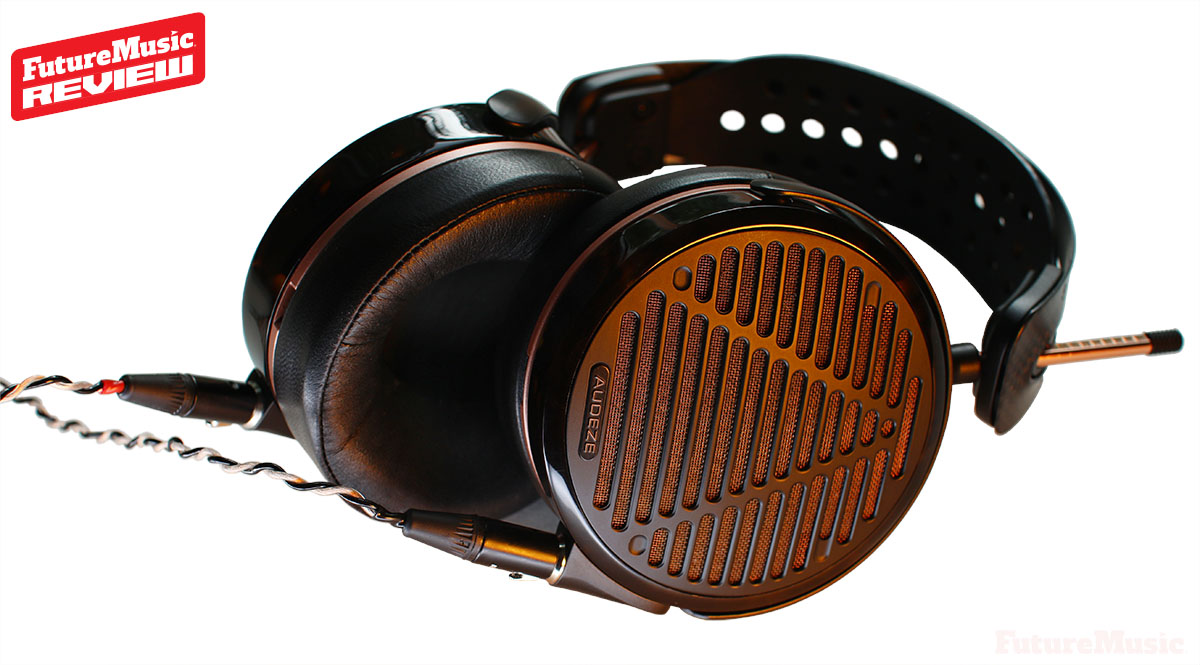
The Audeze LCD-5s makes a strong value case at $4,500, delivering flagship-grade resolution, very fast transients, and thanks to the new SLAM technology, a deeper and more physical bass than the original LCD-5, as well as improved comfort… Audeze LCD-5S Headphones Review
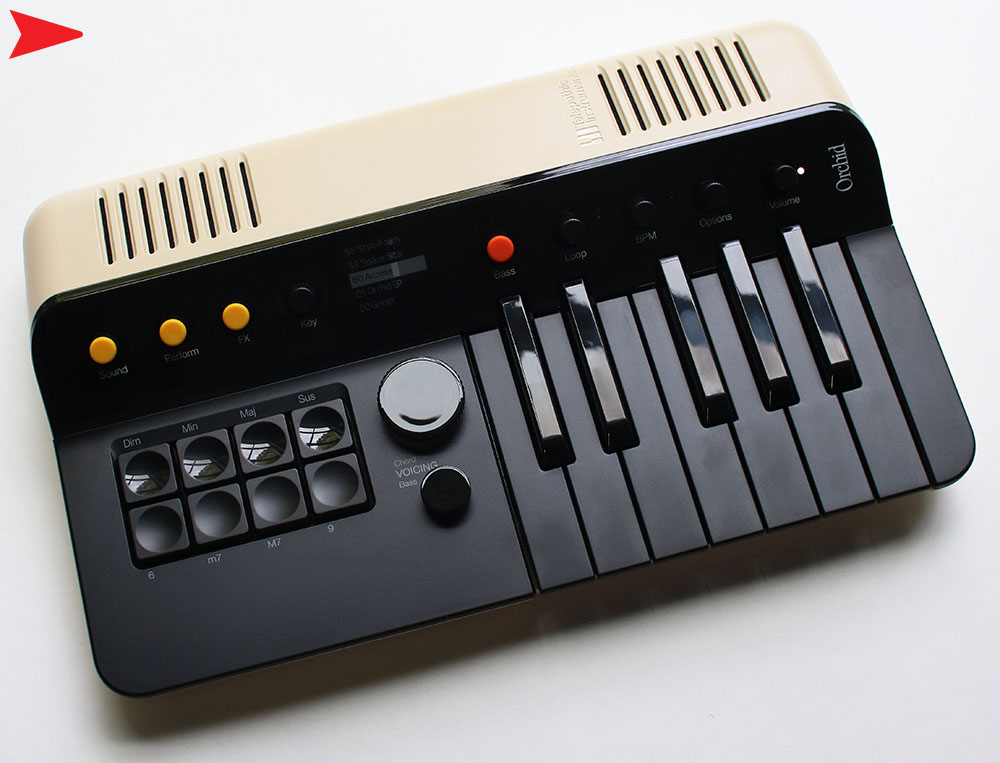
In natural light, the display can appear dim and difficult to read.
Where the instrument “makes an impression” is as a MIDI brain. Routing chords, bass, and performance data to separate channels “elevates the Orchid’s core competency from merely a noodling device into something that lays down the foundation of a new track.” But it gets better, our testers who plugged it into the other synths in their studios via the MIDI output found that the combination “immediately outclassed” either box alone. This means that even if you’re not into the Tame Impala sound, you can use the Orchid’s brain for outboard synth you own. That capability justifies “keeping it on the desk” even for players who never touch the internal engines. MIDI clock output arrived in the September 2025 firmware, closing a major gap that early adopters had flagged.
Routing chords, bass, and performance data to separate channels “elevates the Orchid’s core competency from merely a noodling device into something that lays down the foundation of a new track.”
The internal sounds are where the picture gets somewhat contested by our reviewers, even though all were fans of Parker. Most rated the presets quite highly, with one calling them among “the best he had heard in a compact chord instrument,” noting that “essentially every one is usable” and there were “no outright duds.” That said, one felt that the sounds were a “bit brash” and “too bright” and wanting “more nuance.” Like most hardware synths, the factory effects are mixed generously, which flatters a preset in isolation, but “starts to smear once you layer parts”, so producers “building a track finds themselves dialing reverb and delay back rather than leaving well alone.” The lock function that holds effects in place across presets is a savvy response to address this problem, though the reverb has historically been less obedient to it than the other slots.
That gap between auditioning and tweaking recurs elsewhere. The sound bank has no on-device access to envelopes, oscillators, or filter shaping beyond the cutoff effect added in late 2025, “which isn’t going to impress anyone,” so what you hear is what you get until you buy Pistil, the companion plug-in. The chord engine keeps every voicing packed inside a single octave by inverting it, which is a defensible musical decision that keeps things tidy and an occasionally frustrating one when a progression wants “to break out of octave jail,” and there is no setting to widen the spread or switch the behavior off.
The screen’s brightness complaint is well corroborated by all of our testers. Three separate reviewers, working months apart on different firmware and from completely different backgrounds, independently described the OLED as “too dim to read comfortably in a bright room.” The most recent added that the display “also suffers visibly in motion” and that “longer chord names get squeezed and stretched” to fit the fixed layout. On an instrument whose job is telling you what chord progression you just unleashed, a display you have to “shade with your hand” is a “real ergonomic tax” rather than a cosmetic deficit.
Judged against current firmware rather than launch firmware, the Orchid is a significantly better instrument than its earliest coverage describes, and anyone reading older assessments should go by mid 2026 and later reviews.
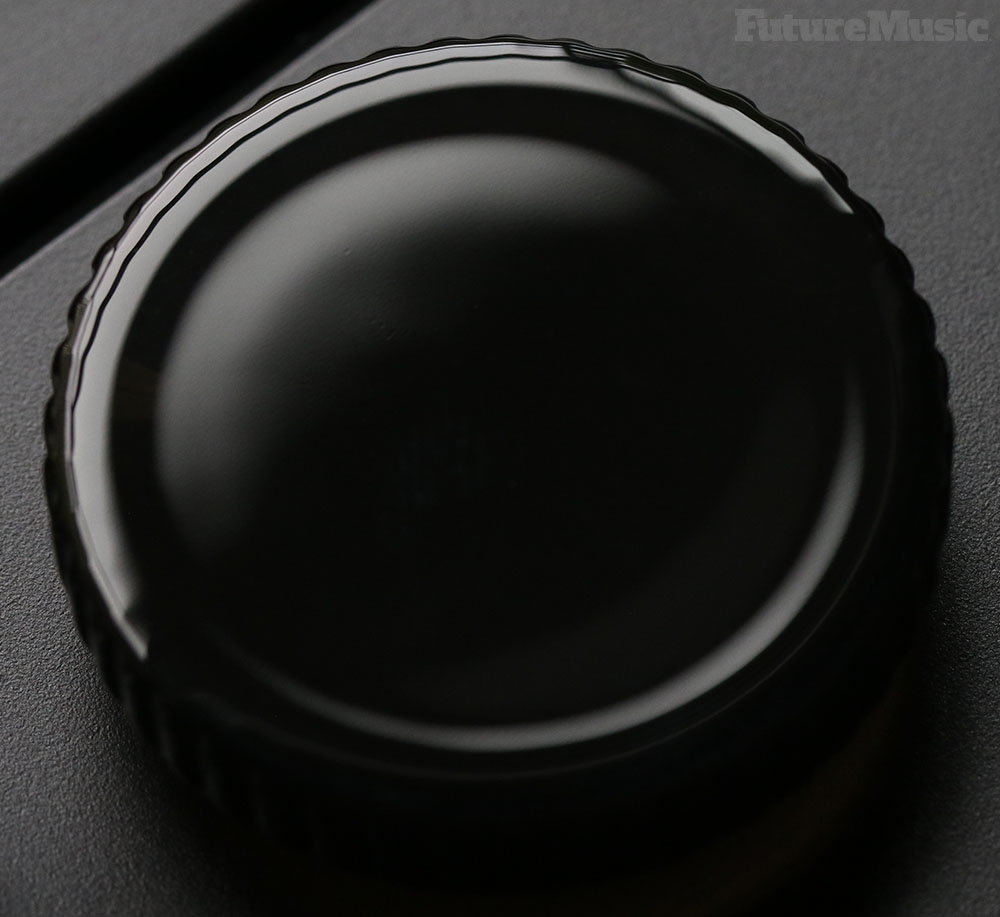
Build quality draws criticism in a narrower sense than the word usually implies in our reviews for one reason. The enclosure itself is generally described as solid, even though it’s all plastic, but the “black top surface collects fingerprints like a 12 year-old kid collects Pokemon cards.” The moving parts also got dinged. The encoders wobble, the keys have a “spongy touch,” and several assessments used near-identical language about things “feeling cheap” under the fingers. “For a product that’s $649, Telepathic should have stepped up.” Worse, quality control was demonstrably imperfect on early runs with some buyers openly lamenting their purchase with keys that did not respond and other technical issues. These types of misses certainly rang alarm bells for interested musicians, and certainly must have been a disappoint for an instrument in this price class. That said, Telepathic is quick to address buyer’s issues , but also demonstrates that the young company does have additional work in terms of quality control. Our review unit didn’t suffer from any technical issues, even when passed along to different evaluators, played in studios and on airplanes, and generally knocked about.
The counterweight to anyone having hardware issues is the firmware record, which turns out to be outstanding. Specific faults that testers documented in mid-2025, including notes left hanging on the chord MIDI channel, strum and harp phrases failing to send note-offs correctly, bass notes leaking onto the chord channel, and unreliable undo while overdubbing, appear by name in subsequent release notes as fixed. Loops could not be saved at all until February 2026, which meant an idea captured at midnight was gone by morning, and the instrument shipped with a paper notebook that “was its only reliable storage.” Judged against current firmware rather than launch firmware, the Orchid is a significantly better instrument than its earliest coverage describes, and anyone reading older assessments should go by mid 2026 and later reviews.
There is one more observation worth noting because it brushes against the marketing. The Orchid is sold as an answer to not knowing music theory, and it does lower the entry barrier considerably. But our beatmaker who honestly admits to not knowing much theory reported that the gap still limited him, and concluded that knowing theory makes the Orchid substantially more powerful rather than redundant. That rings true with our other evaluators.”
Key Mode will keep you inside a scale, but deciding to borrow a chord from outside it, which is where most interesting progressions take place, still requires knowing that the option exists and what it will do. The instrument removes the mechanical difficulty of playing a voicing and supports experimentation. What it does not remove is “the need to have an idea about harmony.
What has not softened from the jump is the value proposition, and it actually has sharpened with a price increase. At $549 the Orchid was a considered indulgence with some even saying “frivolous.” At the current $649, or $699 for the version bundled with a case, it is a serious purchase competing against instruments built with high grade components and more functionality. Our beatmakers shown the instrument without knowing the price guessed at roughly half what it costs. The skeptics’ argument that a tablet running a capable chord app alongside any decent controller could approximate the harmonic assistance for less money is not wrong on paper, and it misses something in practice, because the Orchid’s advantage was never the chords themselves but the absence of a screen, a mouse, and a menu between the idea and the sound. Whether that absence is worth the premium is the honest question every buyer has to answer, and musicians, and certainly the Internet, land on both sides of it.
What has not softened from the launch is the value proposition, and it actually has sharpened with a price increase…
A limitation that the marketing never mentions is that musicians cannot play their own chord. Outside Key Mode the keyboard will give you single notes, and the only way to produce a chord is to select one of the four types and let the engine voice it. There is no facility for entering a voicing by hand. Testers described exactly the moment where this bites, which is arriving at a progression you like and wanting to resolve it with something you heard in your head, possibly something you could not name, and having no way to tell the instrument what it is. An idea machine that will not accept your own ideas has drawn a strange boundary around itself, and widening it would actually cost the company nothing conceptually.
Close behind sits the absence of a latch or hold function for the arpeggiator and pattern modes. Every evaluator of the instrument raised it in their assessments; the workaround is to play legato and hope your timing holds, and no firmware release in more than a year has addressed it. This is the single cheapest fix available to Telepathic and probably the highest ratio of player satisfaction to engineering effort anywhere on the list. Being able to lock a pattern running and then explore sounds, extensions, and voicings with both hands free is precisely the kind of accidental discovery the whole instrument exists to deliver.
The harmonic vocabulary is narrower than it should be by now. Key Mode offers major and minor and nothing else. There are no modes, no harmonic or melodic minor, nothing exotic, which means an instrument sold on the promise of escaping conventional progressions confines you to the two most conventional scales in Western music. The eleven rhythmic patterns are likewise fixed, with no way to program your own, which is a missed opportunity given that rhythm is at least as generative as harmony when you are hunting for ideas.
Even with after all the time the Orchid has been available and the firmware updates, “the MIDI implementation still comes up wanting.” You cannot play the chord engine from an external keyboard. The Orchid will accept MIDI notes over USB-C, and it will sound them, but they land on the raw synth engine and the bass engine only. Send it a single C and you get a single C. You do not get C major. The chord generator sits untouched, and so do Strum, Slop, Harp, Pattern and the arpeggiator. What you are controlling is a sound module that happens to live inside a chord instrument, and the two are not connected in any manner. Worse, this limitation was uncovered by our evaluators rather than announced, and the company’s own support documentation still doesn’t address it. The reality is that a player with a favored controller can use it to trigger the Orchid’s presets, but nothing else, while the one feature worth buying the instrument for stays locked behind twelve small keys. Wiring incoming notes to act as root note triggers for the chord brain would be the highest-value change on our entire list of grievances.
The looper’s history is befuddling. An instrument marketed as an idea machine shipped with a looper that could not retain a single idea past power-down, a limitation that persisted through both 2025 drops and the worldwide release. Loop saving arrived only with v3.84 in February 2026, more than a year after the first units reached customers. Telepathic deserves credit for fixing it, but the looper remains a sketchpad rather than an arranger, and this is being generous. There is no meaningful way to build a verse against a chorus, so the moment a promising loop wants to become a song, you are exporting to a DAW. For a device whose pitch is keeping you inside the creative moment, that handoff definitely arrives earlier than it should.
The looper’s history is befuddling. An instrument marketed as an idea machine shipped with a looper that could not retain a single idea past power-down, a limitation that persisted through both 2025 drops and the worldwide release…
Several smaller decisions by Telepathic compound the friction. There is no audio over USB, so capturing sound rather than MIDI means running the 3.5mm output into an interface, and that jack needs a splitter to reach a pair of quarter-inch inputs. The onboard speakers, adequate for auditioning chords and “better than expected,” cannot deliver low end well enough to evaluate the bass engine honestly, which undercuts a feature the company likes to tout. The display is too dim and too jittery for an instrument that communicates almost entirely through it.
Accessories have been inconsistent too. No charging cable is included, nor any breakout cables. The “very orange case” that early owners praised and is certainly necessary if you want to take the unit on the road, since there is nothing on the market to protect the fragile interface, is currently soldout and appears to be batch-dependent, rather than a standard offering.
Conclusion
The Orchid is a genuinely original instrument carrying a longer list of self-imposed limits than its reputation suggests. It loses real points for a chord engine that will not accept a chord you invented yourself, for a missing latch function, for a harmonic vocabulary stuck at major and minor, and for a display that is sometimes too dim to read. It loses more for a chassis that does not feel like $649. It earns most of it back through conviction and follow-through. This instrument does one thing faster and more pleasurably than anything else available, and the company behind it has spent eighteen months visibly fixing what users complained about, which is rarer than it actually should be in 2026. Judged as hardware engineering the Orchid is merely good. Judged as a songwriting tool, which is the only judgement that matters here, it remains excellent, and it would be genuinely outstanding if the next revision spent its effort on removing walls rather than adding rooms. Recommended.
Telepathic Instruments Orchid ORC-1 costs $649.
Price Note: Prices are quoted in US dollars and are different in other countries and geographical locations.
Carry Case costs $50 when purchasing the Orchid.
Telepathic’s Pistil companion software costs $50 when purchasing the Orchid, but $99 standalone.
Cheers:
+ Chord logic that genuinely works, pairing an eight-button matrix with a patent-pending Voicing Dial to put sophisticated harmony within reach of players without theory training
+ The Voicing Dial itself, a continuous physical control over inversion and octave spread that no menu-driven competitor matches for speed
+ 70 chord presets voiced specifically for chords rather than for demonstration, plus twelve dedicated bass sounds, with most testers rating them highly enough to use untouched
+ Five performance modes covering Arpeggiator, Strum, Slop, Pattern, and Harp, with an arpeggiator whose timing responds to chord density and a Slop mode that varies with every keypress
+ A separate monophonic bass voice with follow and solo behavior, plus twenty pre-programmed beats, enough to sketch a complete idea unaided
+ MIDI output that splits chord, bass, and performance data across separate channels, turning one instrument into a conductor for an entire rig
+ An effects lock that holds a reverb, delay, or drive setting in place while you audition other presets
+ Real portability at 1.8 kilograms, with internal battery, onboard stereo speakers, and long battery life
+ An exceptional firmware record with seven documented releases between March 2025 and April 2026 adding loop saving, MIDI clock output, quantization, on-device sound saving, a cutoff control, drum effects, and twenty additional presets, while fixing named bugs testers had documented
+ Responsive customer support, including a same-issue fix supplied directly to an owner whose unit arrived faulty
+ Distinctive industrial design and a unique brand voice
Jeers:
— You cannot play or record a chord voicing of your own, which caps an instrument sold as an idea machine at the ideas its engine already contains
— No latch or hold for the arpeggiator or patterns, raised by essentially every evaluator and unaddressed after more than a year of updates
— Key Mode supports only major and minor, with no modes or less common scales
— Chords are always inverted to fit inside a single octave, with no way to widen the spread or disable the behavior
— The eleven rhythmic patterns are fixed and cannot be user-programmed
— The chord engine cannot be driven from an external keyboard; the MIDI note input that does exist reaches only the raw synth and bass engines and remains undocumented by the company despite being known to users since mid-2025
— The OLED display is too dim to read comfortably in bright rooms, a complaint independently repeated by testers thirteen months apart, and the most recent adds visible tearing and distorted type
— Build quality draws consistent criticism for wobbly encoders and a light, inexpensive-feeling keybed
— Pricing has climbed from $549 to $649, or $699 with a case, without a corresponding improvement in materials, and testers shown the unit blind guessed at roughly half that…
The Future: The next incarnation that would be hard to argue with is not a reinvention but a settling of well-documented debts. Let players enter their own chords, so that the instrument can accept an idea as well as supply one. Add a latch, which is the cheapest fix on this list and probably the most transformative, because a pattern running hands-free turns sound browsing into genuine exploration. Open Key Mode beyond major and minor, and let people write their own rhythmic patterns rather than choosing among eleven.
Formalize MIDI input and route it to the chord brain instead of just the raw voices, “so any controller in the room can drive the thing on the highway.” Fit a brighter, steadier screen, since almost every interaction depends on reading it. Give the looper enough structure to hold a verse against a chorus so a good idea does not have to leave the instrument the moment it starts becoming a song. Put it all in a chassis with encoders that feel like the price on the box, add audio over USB, and build enough of them that ownership is a decision rather than a lottery. None of that would compromise what the Orchid is. It would simply let a genuinely original instrument stop apologizing for the parts that have not yet caught up to its idea.

Off The Record: The reality is that the Orchid gets a lot of slack because of Parker’s affiliation, the excellent branding by Love And Money, and the aura of limited availability. If the Orchid was released by Arturia at this same price point and available at retailers worldwide, the public’s response would be significantly less enthusiastic — maybe even hostile.