Akai MPC Sample Review
Long-Term Evaluation
The MPC Sample arrived the way modern gear increasingly does, which is to say stumbling through the back door. In early March 2026, an American retailer uploaded images and a $399 price tag to eBay roughly three weeks before Akai intended anyone to see the Baby MPC, and the internet did the rest. The company responded by pinning a release date to the leak and shipping in March of 2026, at exactly the price everyone had already seen: $399 / £349 / €399. The first batch sold out on day one, and stock stayed thin worldwide for months, with availability beginning to improve by the summer.
Akai’s MPC Sample, and the persuasive argument for doing more with less…
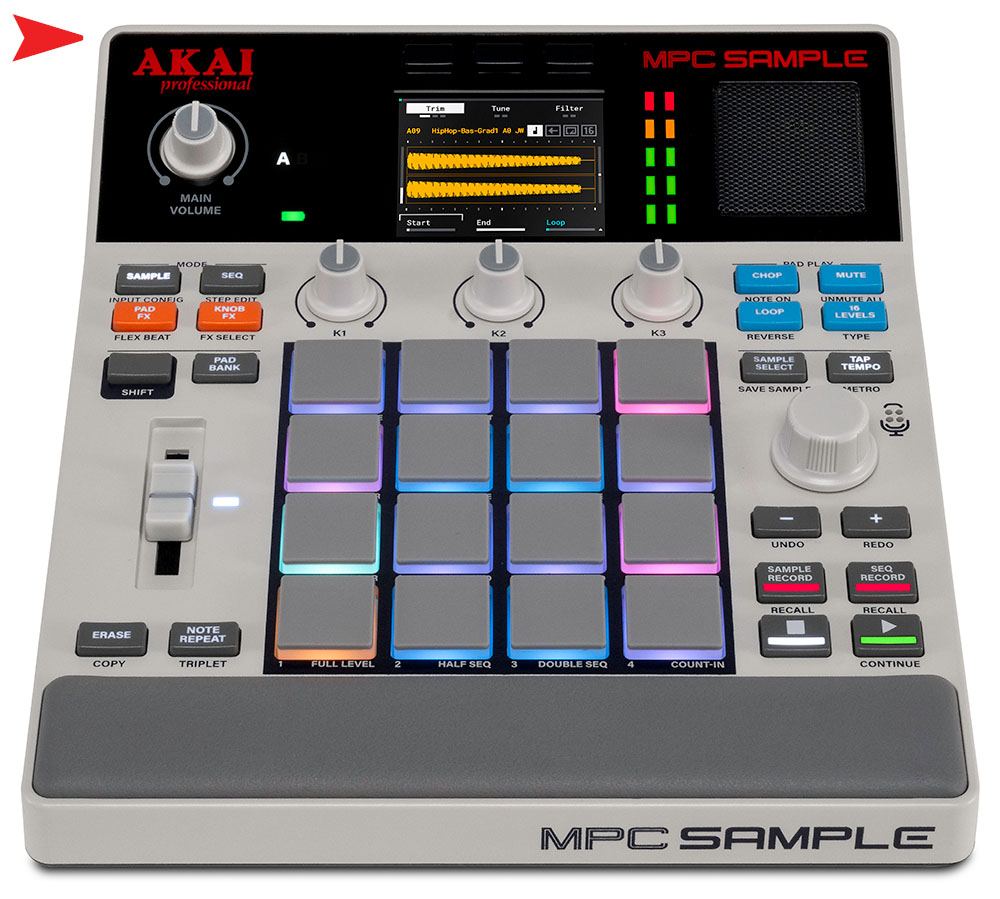
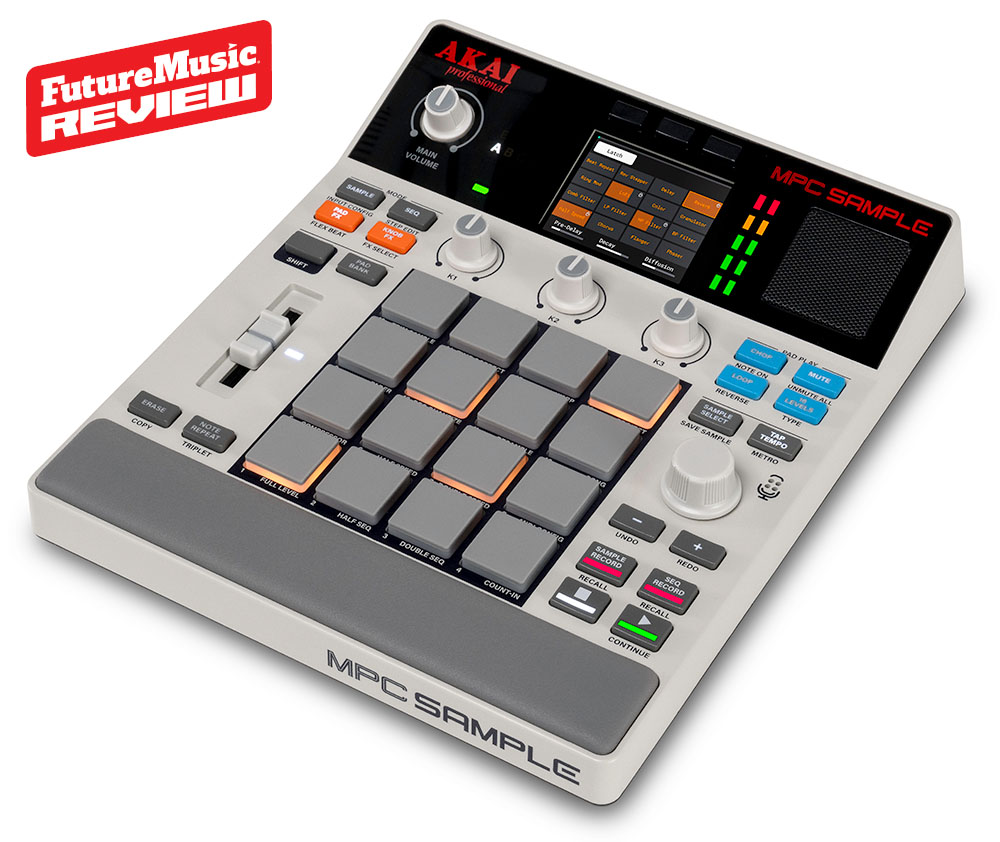
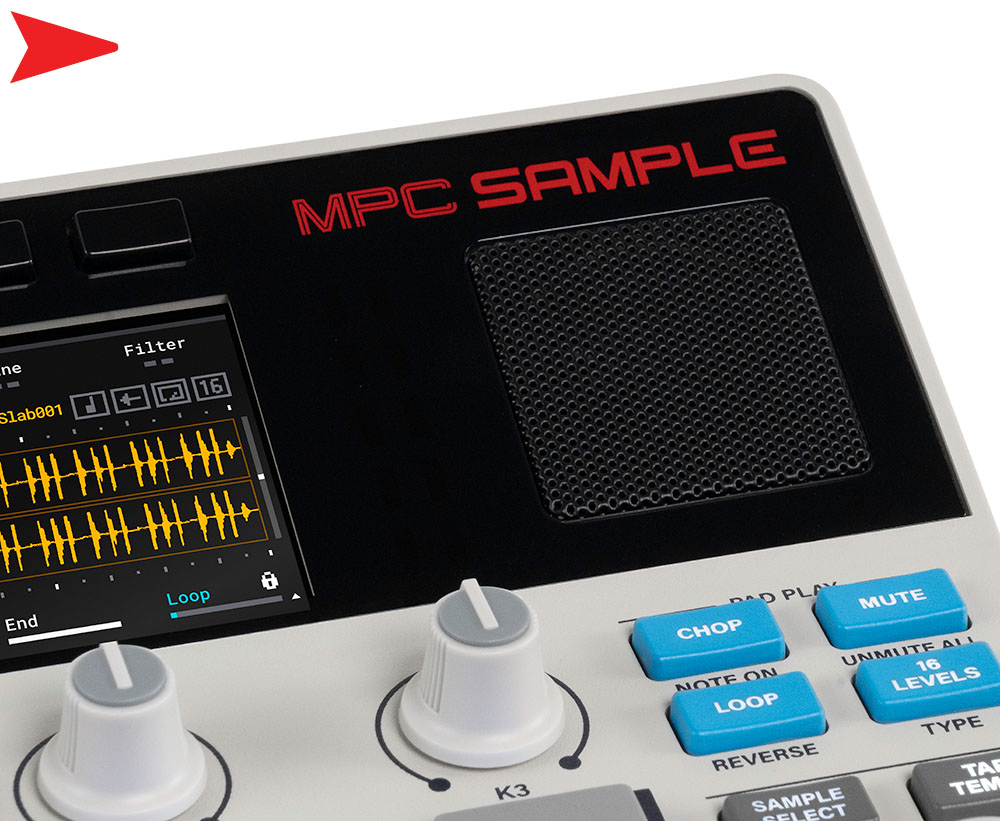
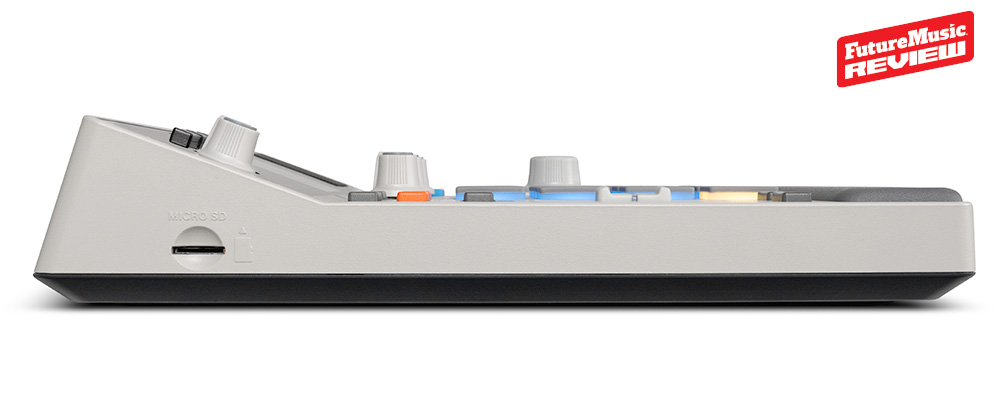
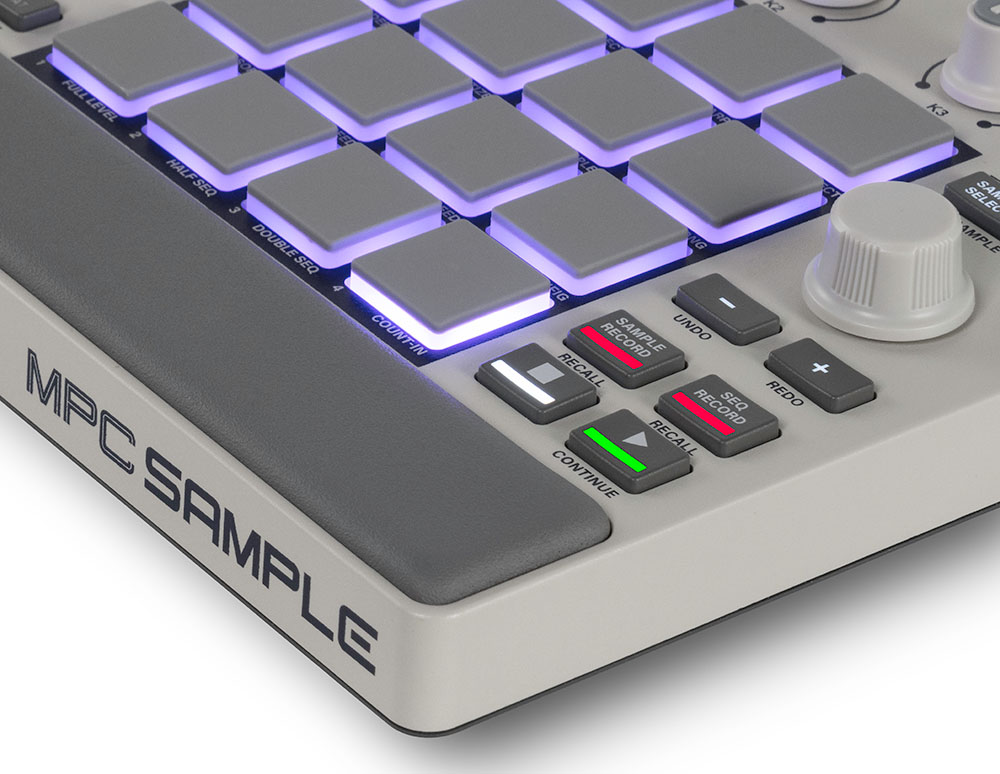
Physically, the Sample looks like it was hit by a shrink ray. The light gray scheme, angled profile, parameter fader and padded wrist rest hark back to Roger Linn’s original MPC60, right down to the “old school” Akai logo. But that’s where the vintage vibe ends and the 2026 tech begins. You get sixteen RGB velocity-sensitive pads with polyphonic aftertouch, 32 stereo voices with disk streaming, 2GB of RAM, 8GB of internal storage with microSD expansion, a 2.4-inch full-color display, three real-time knobs and the legacy fader. Akai’s own documentation caps a project at 128 samples across eight banks and 128 sequences, one sample per pad, with patterns running to 128 bars and a sequencer clocked at 960 PPQN with real-time swing and parameter automation. There is no step sequencer, but there is Step Edit for adjusting individual recorded events even though sequences are primarily recorded in realtime.
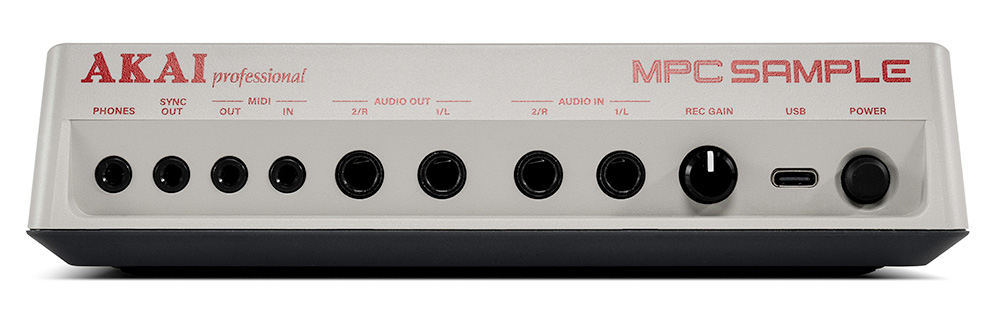
Four effect engines cover sixty types, split between sixteen Pad FX (up to four at once), 28 Knob FX assignable to one pad, several pads or all of them, sixteen Flex Beat patterns, and a master Color Compressor. Connectivity is sophisticated for the device: two quarter-inch TRS inputs and outputs, eighth-inch headphones, TRS MIDI in and out, a dedicated Sync Out (CV), USB-C for charging, file transfer, MIDI and two channels of audio. The MPC Sample does not have a physical Sync In jack.
Firmware has steadily moved forward since launch. The unit unfortunately required a day-one update right out of the box, delivered through a browser over USB-C with no companion app to install. Version 1.2.0 and 1.2.1 added SD Card Access, Export Song to Sequence and per-pad Loop Lock. Version 1.3.0, released on April 13, 2026, added sample normalization to 0dB and three knob takeover modes, Pickup, Scaled and Instant, configurable separately for standard operation, Knob FX and the fader. That last item mattered more than it sounds, because Akai fitted potentiometers rather than endless encoders, and the original pickup-only behavior was the single most common complaint of the first three weeks.
Akai made some strategic moves to position the Sample as more than an MPC gateway drug. MPC 3.8+ added compatibility for MPC Sample Projects, allowing a session created on the Sample to be opened on compatible MPC Hardware or in the MPC 3 desktop software. Going the other direction, Akai explicitly says MPC 3 Projects should not be exported to the Sample. The same update also gave the entire MPC line five of the Sample’s effects, including a tape and vinyl emulator and the color compressor. The result of the update is significant: A $399 sketchpad that hands its work cleanly to one of its larger MPC siblings or an MPC 3 workstation is a different proposition from a $399 toy, which is why Akai’s shrewdest move here was commercial, not necessarily musical.
Which brings us to the competition. Teenage Engineering’s EP-133 K.O. II at $329. It offers six stereo or twelve mono, 128MB of system memory, a sample-based workflow rather than a dedicated synth engine, six master effects and twelve punch-in effects and a multifunctional fader, 46.875kHz 16-bit sampling, and runs on four AAA batteries in a chassis just 16mm thick. The MPC Sample counters with almost everything else. Its pads are proper MPC pads with polyphonic aftertouch rather than clicky buttons. It has 2GB of RAM versus the EP-133’s 128MB, expandable storage, a color waveform display, quarter-inch balanced I/O instead of minijacks, a rechargeable battery instead of AAAs, and a sequencer with the swing pedigree that made the format famous. And as mentioned above, your Sample session opens in the rest of the MPC ecosystem.
Roland’s SP-404 mkII is the rival Akai was looking at the most, and the two machines are good at opposite things. The SP has been a fixture of the sample-based beatmaking world since 2021, lists at $499 against the Sample’s $399, and has the benefit of years of free OS updates that the Akai cannot match yet. Its four effect buses let processing sit on individual samples rather than passing through one global slot, its 16GB of internal storage holds 160 samples across sixteen projects, and version 5.0 turned it into a pre-mapped Serato controller. What it lacks is a built-in microphone and a speaker. It also runs on six AA batteries with no internal rechargeable cell, and that’s a difference in real world use and expense. The Sample makes noise the second you press power. The SP wants headphones and a fresh pack of alkalines first. Then there are the pads. Roland’s seventeen pads are velocity-sensitive and perfectly playable, but Akai’s sixteen add polyphonic aftertouch and the response the MPC built its name on. Roland wins on effects routing, capacity and maturity. Akai wins on feel, immediacy, sequencer resolution and price.
The first ten minutes of use tell you most of what Akai got right…
The first ten minutes of use tell you most of what Akai got right. You press the power button, the machine wakes into a demo project, and you are ready to rock. Unless you want to load your own samples, there is nothing to set up. The 2GB factory library has you making beats within seconds, and the one-sheet Quick Start Guide is the only reading required. Triggering, muting, sequence switching and overdubbing are close to self-explanatory even with no MPC experience at all. In an era where half of new hardware demands a companion app, hours of watching YouTube videos and asking chatbots to solve workflow issues before you can do anything, this is a real feature.
Of course, with any MPC, the pads are the heart of it, and they are actually better than the price suggests. Despite lacking the advanced MPCe expression of the flagship models, they are quite responsive and compare well with the previous generation of full-size MPC pads. That matters, because MPC swing has never been purely a quantization setting. It is a physical relationship between a hand and a gray rubber square, and Akai has preserved it at a fraction of the original’s footprint.
Akai MPC Sample Review
Sampling is where the machine feels most confident. You can capture from vinyl, through an appropriate phono preamp, hardware, USB or the built-in mic, then trim, tune, pan, shape with an attack and decay envelope, and process through a multimode resonant filter with its own envelope. The Chop function slices by transient threshold, into four, eight or sixteen equal regions, or manually, and a zoom function rescues fine editing from the coarse resolution of screen and knobs. That zoom, incidentally, is printed nowhere on the panel and mentioned nowhere in the quick start guide, which is a small documentation failure with an outsized effect on first impressions.
The cleverest feature is the one nobody leaked. The Sample keeps a rolling 25-second buffer, so if you play something good while not recording, Sample Recall captures it as audio and Seq Recall captures it as MIDI. Anyone who has ever nailed a fill and immediately lost it will understand why this is worth more than another reverb algorithm.
Sequencing sits somewhere between a vintage MPC and a modern groovebox. Recording is realtime only, quantized or not, with knob and fader movements captured as automation, a Step Edit page for individual note timing and velocity, Shift-and-pad shortcuts for halving or doubling length and tempo, and a Song Mode that chains sequences and bounces the result to audio. In fact, the micro-timing tools are good enough to do convincing J Dilla-style displacement. When recording is not quantized, the Step Edit page exposes single notes, and 960 PPQN is fine enough resolution that a nudge reads as feel rather than a stumble. Push a snare late while the hats rush and you get the lopsided quality J Dilla built into an MPC3000, drums that sound drunk on first listen and completely deliberate by the tenth.
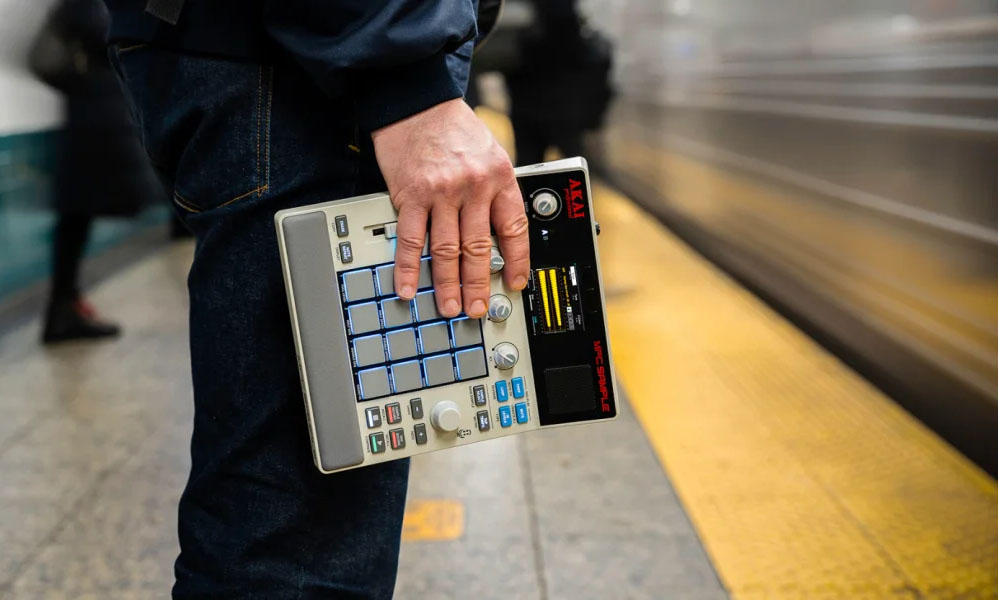
When you unbox the MPC Sample, it’s actually far smaller than the box leads you to believe or the product photographs prepare you for. The second surprise is the screen. It is barely three fingers wide, but it is high resolution and full color, allowing small fonts and detailed waveform views to be read with ease. Not only does it rate far above the display on the EP-133, but it actually “makes Roland’s TR-1000 look totally lame.” The panel logic falls into place fast. A mode section moves between sample triggering, sequence launching and the two effect styles, a row of blue buttons covers the pad modes, Sample Select opens the browser, and the transport gives audio recording and sequence recording separate buttons of their own. Everything else hides under Shift plus a pad. Three buttons above the screen cycle through control sets for trimming, tuning and filtering, and the three knobs below them do the editing. A new project opens as a grid of empty pads, and the factory kits are simply pre-configured projects rather than a separate file type, which keeps the mental model pleasingly small.
Dreamtonics Instrument X
Known worldwide for revolutionary vocal tools like Synthesizer V and Vocoflex, Dreamtonics steps onto the scoring stage with Instrument X – a breakthrough platform powering 15 orchestral Instrument Expansions with neural physics. Be the conductor, not the programmer: sculpt authentic articulations, morph physical timbre, and place your instruments directly into a 3D studio sound-field. Experience hyper-realistic performance with zero sample-playback bloat by downloading the free core host engine and exploring our discounted launch bundles today. Learn More About Instrument X!
Loading a sound is a tap of Sample Select and a spin of the push encoder through the internal drive or a card, and you can employ memory cards up to a terabyte without trouble. Recording one is quicker still. Press Sample Record, pick the input, set the level on the rear gain knob and hit whichever pad should hold the sound, or arm a threshold and let the signal start the machine for you.
There is some friction when it comes to the knobs. As previously mentioned, Akai fitted potentiometers rather than encoders, so the physical position rarely matches whichever parameter you have just navigated to, and the constant twisting to pick up a value was the worst thing about the launch machine before the takeover modes arrived. Everything else rewards speed. Pad Play keeps Mute, Loop, Reverse and 16 Levels one button from Chop, mute groups stop your hats from tripping over each other, and the two warp modes, Pitch and Time Stretch, let you drag a loop to project tempo or deliberately wreck it. Sequence Mode turns the pads into pattern launchers, and because both the pads and the sequencer transmit MIDI, you can sketch a line for an external synth and sample the result straight back in the Sample.
One of the savviest workarounds to emerge is to route a phone into the USB-C port and treat its apps as external instruments, sampling them in as though they were plug-ins, which quietly answers the complaint that the Sample has no synth engine of its own. On battery stamina, the quoted five hours actually punches above its weight with our reviewers driving sessions up to six hours. Of course, your mileage may vary. The little speaker was better than our evaluators’ initial impressions, and the internal mic proved fine for sketching out ideas and beatboxing, but “if you’re looking to record a real vocal or instrument, use the rear inputs.” Newcomers should also budget an evening for Akai’s tutorial series, because while the workflow won’t cause the Sample to end up on Facebook Marketplace due to frustration, it may seem “only obvious to people who already speak MPC.”
One of the savviest workarounds to emerge is to route a phone into the USB-C port and treat its apps as external instruments…
Effects ended up being the most divisive area for our evaluators. Pad FX are held down like Teenage Engineering’s punch-ins and respond to velocity and aftertouch, which makes them great for live performance. Knob FX apply a single processor to chosen pads, covering delays, reverbs, filters, compressors, limiters, amp simulation and vinyl and tape emulation. Flex Beat handles DJ-style rhythmic mangling, beat chops, gates and reverses. All of it sounds good, but the frustration is in the plumbing. Akai’s FAQ states that effect adjustments can be recorded into a sequence, while the live, momentary Pad-FX performance is a more limited affair. The result is that the effects feel more like performance tools and resampling sources than fully automated insert effects.
Akai MPC Sample Features and Specs:
- Sampling and Sequencing:
- Polyphony: 32 stereo voices
- Sequencer: MPC sequencer with real-time swing, 960 pulses per quarter note
- Maximum sampling time: 20 minutes per sample
- Number of factory kits: Over 100
- Recordable data: 128 samples/128 sequences (16 samples x 8 banks per project, 16 sequences x 8 banks per project)
- Disk streaming
- Sample editing features: Chop mode, lazy-chopping, auto-snapping, real-time looping, warping, Re-Pitch
- Supported file import formats: .WAV, .MP3, .aif/.aiff, .snd, .s1s, .s3s, .flac, .ogg
- Pads + Controls:
- Pads: 16 RGB-lit velocity-sensitive pads with poly aftertouch
- Display: 2.4″ full-color LCD
- Control knobs: Three real-time effects knobs
- MPC parameter slider
- Effects:
- 60 effects
- Four Internal effects processors
- Master compressor
- Effects routing: Main output, input, per-pad, internal, real-time external input processing
- Input record knob FX
- Connectivity:
- Audio inputs: 2 x 1/4″ TRS (mic/line)
- Audio outputs: 2 x 1/4″ TRS
- Headphone output: 1 x 1/8″ TRS
- MIDI I/O: 1/8″ TRS In/Out (MIDI-through capability, adapter sold separately)
- Sync out: 1/8″ TRS CV (configurable sync rates)
- USB port: USB Type-C (power and data, MIDI I/O, audio in/out, file transfer)
- Internal microphone
- 3W Built-in speaker
- External storage: microSD card – Up To 1TB
- Memory + Power
- Internal storage: 8GB eMMC (approx. 2GB factory content)
- RAM: 2GB
- Battery: Internal rechargeable lithium-ion (5+ hours continuous playback)
- Can be USB-C powered
- Size:
- Dimensions: 9.29″ x 7.64″ x 1.97″
- Weight: 2.03 lb
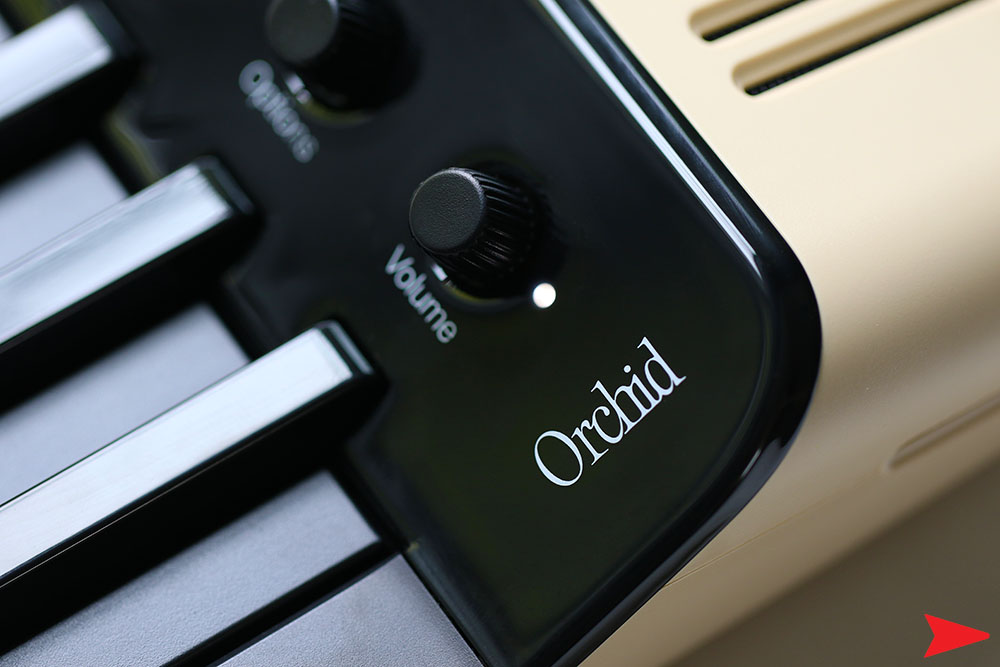
Read Next: Telepathic Instruments Orchid Review
Judged as hardware engineering, the Telepathic Instruments’ Orchid is merely good. Judged as a songwriting tool, it’s excellent, and it would be genuinely outstanding if the next revision spent its effort on removing walls rather than adding rooms… Telepathic Instruments Orchid Review
The single biggest design decision, and the most consequential, is that the MPC Sample is functionally one track. The machine corresponds to one Drum Program of a conventional MPC, so once a kit is loaded you cannot load a second kit alongside it. You can add individual samples to free pads, but building a multi-sample bass on top of an existing drum kit is tedious. This is defensible as a simplicity argument, and Akai clearly made it deliberately. It is also the ceiling on the whole instrument, and it is the reason the Sample remains a sketchpad rather than a finishing tool. Give it three program slots and the Sample becomes something truly special. Drums on one, bass on the second, a melodic voice on the third, and the Sample stops being something you have to leave in order to finish anything. That is not a hardware request either. The pads and the 32 voices are already there. What is missing is permission to point them at more than one program at a time.
The single biggest design decision, and the most consequential, is that the MPC Sample is functionally one track…
Chopping has a related soft spot. Unlike its larger siblings, the Sample cannot convert a chopped sample into a new kit. Slices can be extracted individually to new pads, but there is no one-command convert-chops-to-kit workflow. chops also stay inside the parent sample slot until extracted, meaning the original chopped material shares its pad-level pitch and filter treatment. For a machine whose marquee feature is the word Chop printed on a button, this is the wrong place to compromise.
Getting work out is the other weak link, and it is the one that will age the worst. The Sample can only send its stereo master over USB-C, not individual stems. There is no easy DAW export and no stem output, with soloing and recording tracks one by one as the workaround. The MPC 3.8 project bridge is a win, but it only helps people who already have access to an 3.8-compatible MPC workflow. Everyone else is left bouncing and bouncing and bouncing.
Then there is the modulation ceiling. There are no LFOs and no extra envelopes beyond the pre-routed amp and filter, and while tuning, filter and envelope parameters can be automated, sample start and end points and loop length cannot. The timestretch engine also drew fire, described as basic and in some cases “not all that good sounding.” Timestretch quality is firmware, not silicon, and it is the most obvious candidate for a free fix.
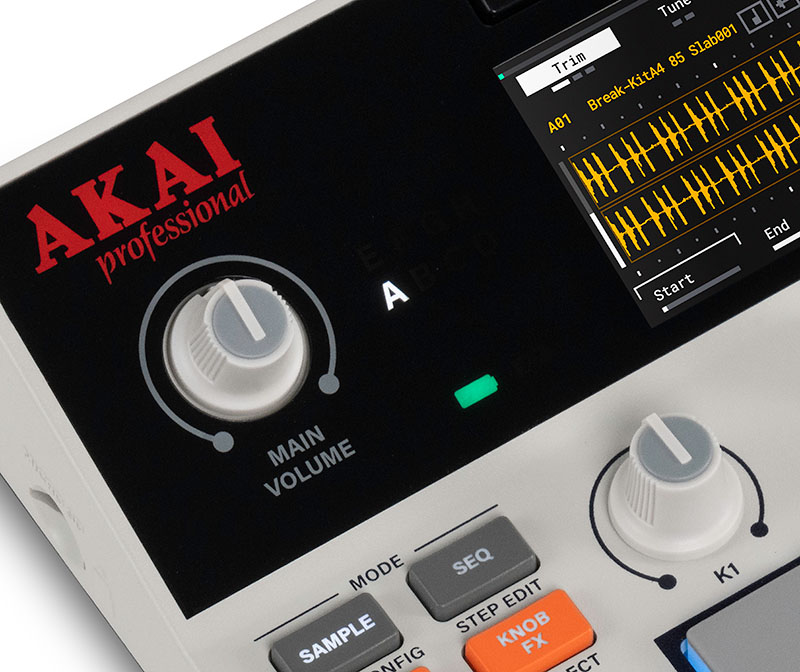
Fitting potentiometers where encoders belong created a problem that firmware 1.3 had to partially solve three weeks later…
Finally, there is some small stuff that tarnishes the Akai vibe for no reason. Shipping a product that requires a day-one firmware update is a bad first impression on a device sold on immediacy. Hiding the zoom function from both the panel and the quick start guide is a documentation choice, not an engineering constraint. And fitting potentiometers where encoders belong created a problem that firmware 1.3 had to partially solve three weeks later. The response was admirably fast but the correction never should have had to be made.
Conclusion
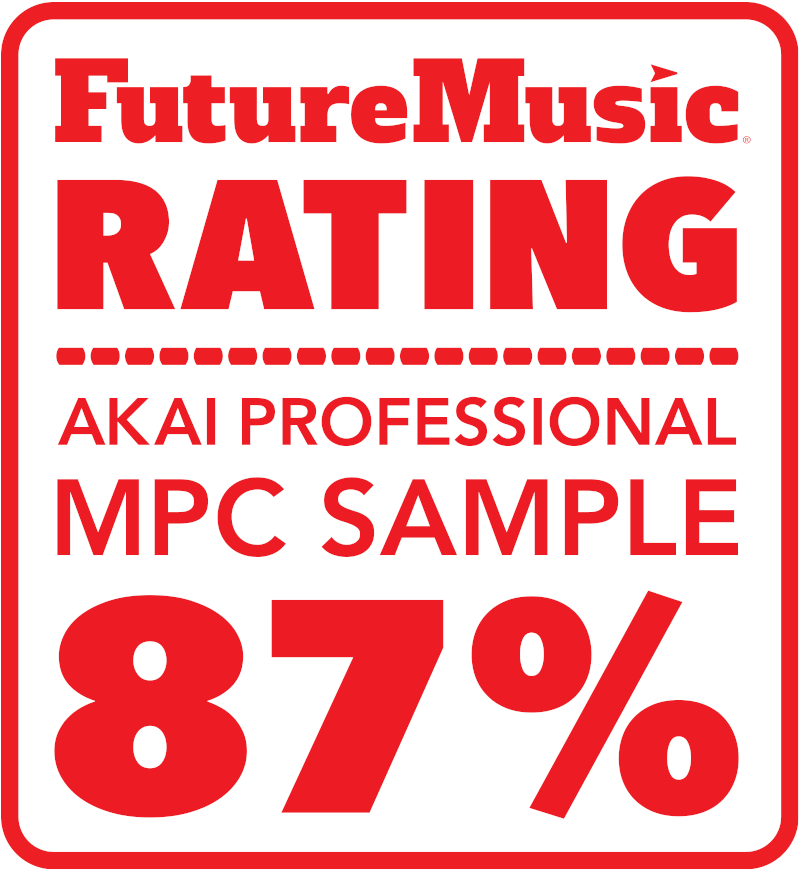
The MPC Sample earns its high marks in the places that determine whether an instrument gets used: the pads, the speed, the sampling path, usability and the price. It loses points for a set of restrictions that feel like product positioning rather than physics, chiefly the single-kit limitation and the awkward road from finished idea to finished track. A superb instrument for what it is, with a clearly drawn boundary you will meet sooner than you would like. Recommended.
Akai’s MPC Sample costs $399.
Price Note: Prices are quoted in US dollars and are different in other countries and geographical locations.
Accessories There are no options from Akai for a much needed carrying case or a protective cover.
Cheers:
+ Excellent pads with velocity and polyphonic aftertouch, the best in this price class by a clear margin
+ Fast, legible, low-menu workflow that gets beginners productive in minutes and experienced users out of their own way
+ Instant Sample Chop with transient, equal-division and manual slicing, plus a zoom for precise edits
+ Sample Recall and Seq Recall from a rolling 25-second buffer, a small feature with a large payoff
+ Sixty effects across four engines, with Pad FX and Flex Beat that sound genuinely good rather than merely present
+ 960 PPQN sequencer with authentic real-time swing, parameter automation, Step Edit and a Song Mode that bounces to audio
+ Strong I/O for the size, with quarter-inch TRS in and out, TRS MIDI, Sync Out, and USB-C carrying power, MIDI, audio and files
+ Built-in 3W speaker and microphone, plus a rechargeable battery, making it truly self-contained
+ Over 100 factory kits and 2GB of onboard content, with 8GB internal storage and microSD expansion
+ Responsive customer support, including a same-issue fix supplied directly to an owner whose unit arrived faulty
+ Project compatibility with MPC hardware and desktop software from version 3.8 onward
Jeers:
— Effectively a single track, with no way to load a second kit alongside an existing one
— No one-command conversion of chops into a new kit, and slices require individual extraction to become independent samples
— PAD FX performance is limited as a recordable sequence automation source
— Stereo master only over USB-C, with no stem or multitrack export
— No wireless connectivity
— Timestretch quality is the weakest part of the audio engine
— No LFOs, no spare envelopes, and no automation of sample start, end or loop length
— Potentiometers instead of encoders, mitigated but not eliminated by the 1.3 takeover modes
— Requires a day-one firmware update straight out of the box
— Zoom function undocumented on the panel and absent from the quick start guide
— No step sequencing and no dedicated physical sync input
— Plastic build and a look that invites the word toy, fairly or not
The Future: The MPC Sample II does not need to be bigger, faster or more expensive, and Akai should resist every instinct pushing that way. It needs a few more program slots so a bass kit can live beside a drum kit without a scavenger hunt for free pads, a proper convert-chop-to-kit command so slices become independently tunable and filterable sounds, and a rewritten timestretch algorithm that holds together on melodic material. It needs Pad FX that can be performed into a pattern and resampled live, because a performance effect you cannot capture is a demo feature rather than a production one. It needs stem export over USB-C, Bluetooth and ideally Wi-Fi, so that a machine built for capturing ideas anywhere can also release them anywhere. Add an LFO, a sync input and automation of sample start, end and loop length, and Akai would have something rarer than a good sampler: a small machine that never makes you go and get the big one.

Off The Record: Akai’s MPC Sample is the one bit of kit that ate 2026. Whether Andy Mac intended to leak the Sample – along with every other new product offering from Akai in the last few years – is up for debate, but it did build a hype that couldn’t be denied. The MPC Sample pretty much sold out worldwide in a week.
What the MPC Sample really does demonstrate is a market need for simpler, easier-to-use gear.