Sonicware Liven Ambient Ø Review
Long-Term Review
Sonicware is a small Japanese company built around the convictions of one engineer, Dr. Yu Endo, whose philosophy has been that digital synthesis should stop apologizing for not being analog and embrace the digital realm. The company introduced itself at NAMM in 2018 with the ELZ_1, a multi engine desktop synth, then found its commercial identity with the Liven series: flat plastic boxes that all share a chassis, a 27 note button keyboard, a small display, a built in speaker and battery power, each one built around a single focused sound engine rather than a general purpose one. Liven 8bit warps came first through Kickstarter, followed over the next few years by XFM, Bass & Beats, Lofi-12, Texture Lab, Lofi-6 and Mega Synthesis. We had four different evaluators put the Liven Ambient Ø to the test; their comments in quotes below.
The Liven Ambient Ø, revealed at the start of July 2024, was the eighth entry in that line and the first organized around a genre instead of a technology. It went to preorder at $239 dollars, the first production batch sold out almost at once, and the second batch began shipping on 30 July 2024. Today Sonicware goes for $279 dollars direct with the power supply as an optional add-on, which is “just sad.”
The engine is called Blendwave Modulation Synthesis, developed specifically for this instrument. Sonicware describes it as wavetable based, and the important architectural detail is that each Wave contains 128 harmonic tables, so moving through a wave is a journey from simple waveforms into progressively denser harmonic territory rather than a crossfade between two static shapes. Six Structures are spread across the three tonal layers, and each has a different oscillator count and modulation circuit. Drone 1 uses two oscillators and modulates detune. Drone 2 uses two and modulates harmonics. Pad 1 and Pad 2 both use three oscillators modulating harmonics. Atmos 1 is a single oscillator with ring modulation applied at its output, and Atmos 2 is a two-oscillator frequency-modulation design that modulates pitch. Sound design happens through four knobs offering eight parameters, and the standard polyphony is ten voices shared across everything, meaning a three oscillator pad chord will eat that allowance quickly. That is the single most important thing to understand about the instrument’s limits.
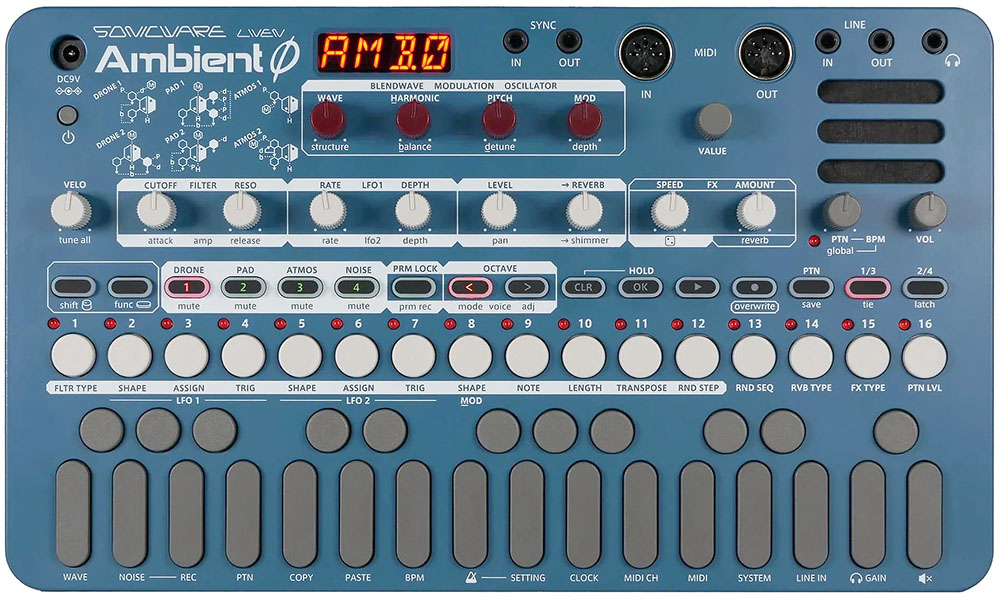
The fourth layer, Noise, is the organic counterweight and the one that gives the Ambient Ø its particular flavor. It contains eight curated nature recordings across one structure, plays them looped or one shot, mixes in white noise, and offers pitch adjustment and modulation. It also samples, capturing up to eight seconds of 16 bit 32kHz stereo audio from the line input with crossfade settings from one to four seconds and an auto start function triggered by input level. Sonicware is explicit in the specifications that direct audio file import from a computer is not supported, and that sample slots move in and out via MIDI SysEx, so getting your own field recordings onto the machine means running them through the company’s browser based NOISE Sample file converter and sending the result as SysEx. “Importing your own sounds into Ambient Ø, is such a cumbersome affair, that I’ll never do it again,” stated one tester. “They completely butchered the ability to import your own samples,” stated another, “it’s such an idiotic methodology for 2026.”
Every layer, Noise included, carries its own envelope, filter and two assignable LFOs. The envelope is attack and release only, with no decay or sustain stage, which is a deliberate simplification that mostly suits the material and occasionally does not. The filter offers low-, high- and band-pass modes. Effects are pretty generous for the price: nine reverbs organized as Small, Large and Infinity, each in low, medium and high brightness variants, with independent reverb send and shimmer send per layer, followed by a master section holding tape delay, reverse delay, overdrive, bit and rate crush, tilt EQ and stereo chorus. All of it can be applied to external audio arriving at the line input.
The sequencer runs four tracks, one per layer, up to 64 steps per pattern, with step lengths from 1/1 down to 1/32 and long values from breve to maxima….
The sequencer runs four tracks, one per layer, up to 64 steps per pattern, with step lengths from 1/1 down to 1/32 and long values from breve to maxima. It supports real time recording, overwrite recording, direct step entry with playback running or stopped, tied notes, transpose, step and track copy, duplication to extend a sequence, per track level and pan, pattern chaining with looping, per pattern or global BPM, note probability from 25 to 100 percent per step, a random playback order mode, parameter locking for knob movements and sound locking for whole sound settings per step. Storage runs to 128 sound pattern palettes.
Physically there are 15 control knobs plus a single encoder for fine adjustment, and two details there deserve emphasis because they contradict the usual complaint about small synths. There is an optional Latch function that prevents value jumps when a knob’s physical position does not match the stored parameter, and a dot on the display indicates whether a value currently matches the saved one. Connectivity is five pin MIDI I/O, sync in and out compatible with Teenage Engineering Pocket Operators, stereo line in and out on 3.5mm and a headphone jack. There is no USB port of any kind. Power is six AA cells, rated at roughly six hours on alkaline and ten on lithium, or a 9V supply of the same EIAJ-03 type used by Korg Volcas, which Sonicware explicitly notes as compatible. The adapter is not included, which is “a total miss” and “makes the company just look cheap.”
Sonicware Liven Ambient Ø Review
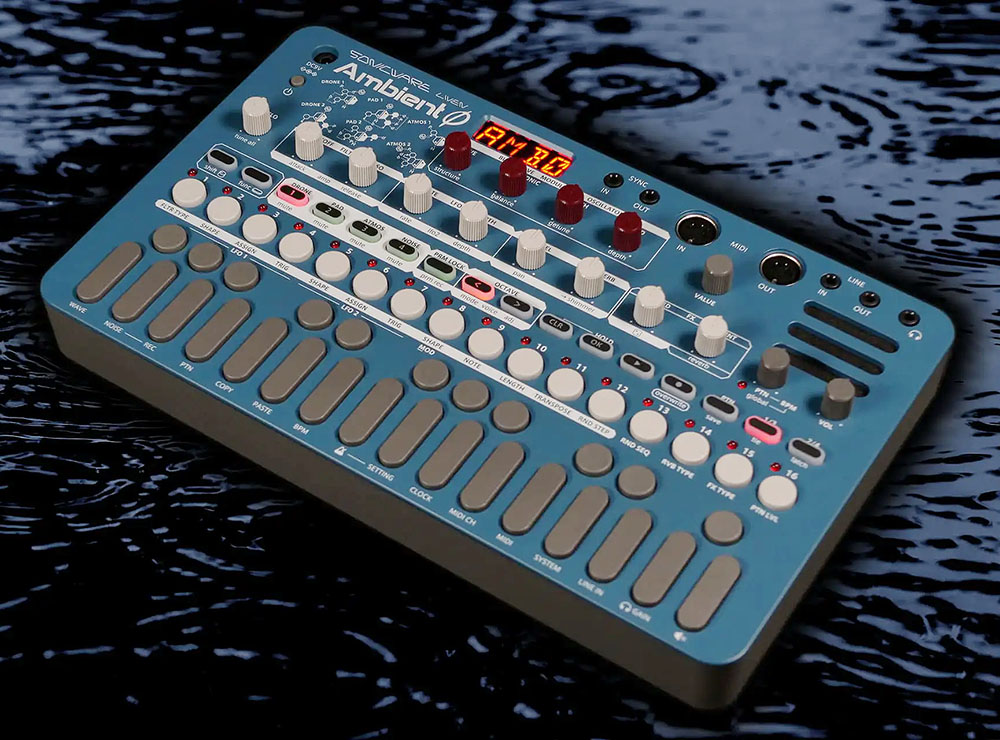
Two firmware releases matter. Version 1.1.26 in January 2025 fixed a genuinely audible fault, namely the shrill artifacts that fast low-pass filter movements could produce, along with problems in legato and unison voice modes. Version 1.5.45, released on 14 March 2025, is the one that changed the instrument’s character. It introduced seven selectable temperaments per pattern covering pure intonation in major and minor, Pythagorean tuning sharp and flat, Solfeggio frequencies and standard equal temperament, with master tuning now settable in hertz from 410 to 470 in addition to cents. It doubled the factory content to 64 preset pattern palettes, 32 of them new sounds and patterns and 16 of them forming a Sound Healing Vibes collection. It added a Relaxation playback mode that arranges chosen patterns with repeat counts and fade outs, and improved pattern switching so transitions no longer interrupt the audio when sound settings match. It made Line In selectable as the Noise layer source, so external audio can be filtered, modulated and sequenced alongside the internal voices. It added three slow LFO shapes and oscillator level as a modulation destination, exposed a pitch bend range setting, reallocated oscillator usage so the Noise layer consumes one voice while Atmos 2 consumes three, and fixed MIDI CC problems. It also moved firmware updating from the old SysEx librarian routine to a Chromium based web updater, though a USB to MIDI interface is still required to get data into the machine.
Give the Ambient Ø five minutes and you hear a competent digital polysynth with a very good reverb. “Give it an hour with the hold function engaged and one hand slowly turning the Wave knob, and you start to understand what Sonicware actually built here.”
The defining quality of the Blendwave engine is that its harmonic movement is neither smooth nor abrupt. Because a Wave spans 128 harmonic tables, traveling through one produces partials that arrive and depart unevenly, so “a held chord never quite settles.” Stack two structures, detune them slightly, let the two LFOs work at different rates on different destinations, and the beating between layers generates the slow undulation. Sonicware’s marketing language about undulating and fluctuating tones is one of those rare cases where the copy describes something real rather than decorating something ordinary. The company also chose its three tonal characters shrewdly. Drone structures do the low, heavy, harmonically dense work. Pad structures do the lush chordal work and cost the most polyphony. Atmos, particularly the ring-modulated first structure, produces the glassy, slightly inharmonic, transparent tones that give an ambient arrangement its foreground detail, and those are the sounds that keep a track from turning into an undifferentiated wash.
The reverb section is the load-bearing wall of the entire design…
The fidelity question, which arose several times when our editor was reviewing our evaluators feedback, deserves an honest answer. Its tonal quality sits somewhere “near a 1990s ROMpler drowning in reverb.” Ambient music has a long and honorable relationship with slightly cheap digital sources, and the Ambient Ø’s “underwhelming detail” is a large part of why its “pads sound nostalgic rather than clinical.” It also explains why Sonicware devoted a lot of Ambient Ø’s resources to effects, which “mask the sound engine’s deficits.”
The reverb section is the load-bearing wall of the entire design. There are nine algorithms at your disposal, but Sonicware’s decision to allow independent reverb and shimmer sends per layer, showcases their commitment to putting reverb front and center. That lets you bury a drone in an Infinity tail while keeping an Atmos pizzicato line dry and forward, which is the difference between a soundscape with depth and a soundscape that is simply loud with reverb. The master effects are less glamorous and better judged than they look. Tilt EQ in particular is a smarter inclusion than another filter would have been, because it darkens or brightens an entire mix without strangling anything, and “tape delay feeding an Infinity reverb is most of the ambient production toolkit in two controls.”

The easiest way for electronic musicians to get their music onto Spotify, Apple Music, iTunes, Amazon Music, Tidal, Instagram, Facebook, TikTok, Pandora, Twitch & much more! Click the banner above or the Go Button to save 7% off of your signup! GO!
Version 1.5 changed the instrument’s identity more than the modest version number implies…
Version 1.5 changed the instrument’s identity more than the modest version number implies. Microtonality had been the most requested feature since launch, and its arrival transformed a drone box into something closer to a tuning laboratory. This matters more here than it would on most synths. When your notes sustain for forty seconds, the beating that equal temperament bakes into every interval simply takes everything over. Pure intonation removes it and produces a stillness that is difficult to achieve any other way. Pythagorean tuning does the opposite where you want tension, generating dissonances equal temperament cannot reach. For an instrument whose entire premise is slow harmonic evolution, per-pattern temperament becomes one of its defining features.”Line In routing through the Noise layer is the other sleeper addition,” and one of our reviewers used the Ambient Ø as a live multi-effects processor for guitar washes.”
What ends up “being overly cumbersome” is everything structural: the sequencer, the secondary functions, saving and recalling, and understanding what state the machine is currently in.”
Sound design on this instrument is genuinely easy. Sonicware’s own suggested first move, hold a note and turn knobs until you like what you hear, works exactly as advertised. But as far as usability, that’s where the party ends. What ends up “being overly cumbersome is everything structural: the sequencer, the secondary functions, saving and recalling, and understanding what state the machine is currently in.” One reviewer admitted that Sonicware’s user interface for the Liven series “never clicked for her” and was “just daunting with text overwhelming the unit.” Her confusion with panel labeling and with the underlying logic of the workflow was also reiterated by another tester, who “found the user manual to be befuddling.”
The optional Latch mode, which was mentioned earlier, prevents parameter jumps when a knob’s position does not match the stored value, and a display dot indicates whether the current value matches the saved one. Both are valuable usability improvements, but they should have been present at launch rather than arriving months later in a firmware update.
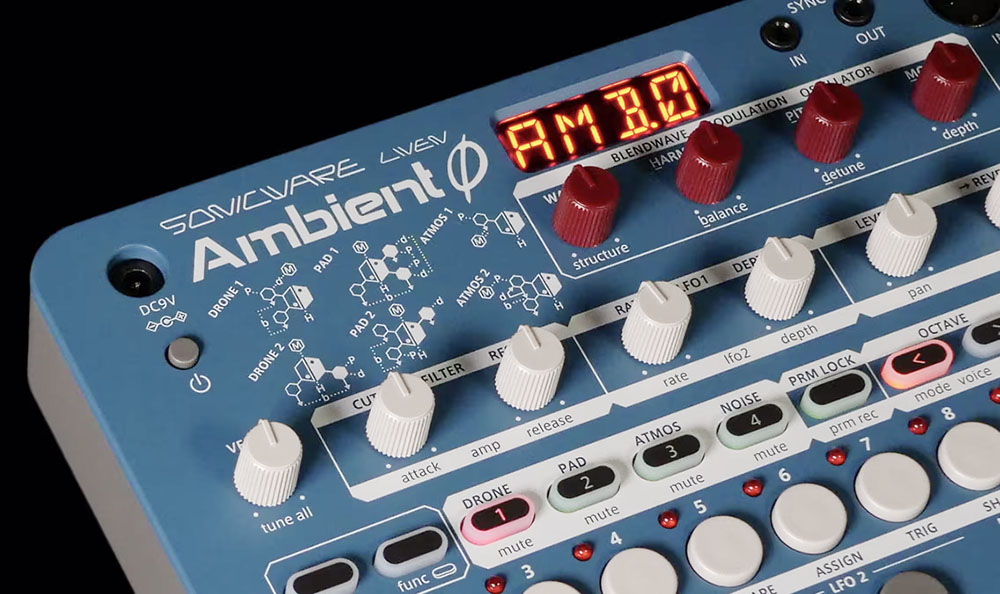
The Ambient Ø’s “biggest problem is state ambiguity across layers.” This is a four-layer instrument in which every layer carries an envelope, a filter, two LFOs and structure-specific parameters, and in which most physical controls do one thing normally and something else with a modifier held. Our reviewers describe two separate secondary function buttons, one governing knobs and one governing buttons, which is a clever way to keep both hands productive but also doubles the number of things a control can mean. What the player needs at every moment is simultaneous, glanceable confirmation of three facts: which layer has focus, which parameter page is active, and what the knob under their hand is currently doing. The display can convey roughly one of those at a time. Everything else must be read from LED color states or held in memory, and in a genre where people work in low light with a drone running and their attention on listening rather than looking, holding it in memory is precisely the thing you came here to avoid. That is why the same instrument reads as effortless to someone tweaking one layer and as bewildering to someone managing four.
But that isn’t the end of it. One behavioral complaint that kept surfacing was that parameter recording can turn erratic when layers are switched partway through a capture. “Smooth knob gestures going in, unpredictable automation coming out.” Whether that is a bug or a consequence of ambiguous focus, it is far harder to diagnose on a machine that will not plainly show you what it thinks you are editing. The fix for the next hardware revision is not a redesign. It is a screen. A proper LCD showing focused layer, parameter page, parameter name, current value and stored value at once.
Sample transfer runs over MIDI SysEx with a browser converter as the intermediary, and direct audio file import is officially unsupported
The next significant miss is connectivity, and it is the easiest one to fix. The Ambient Ø has no USB port at all. Firmware updates require a USB-to-MIDI interface, and Sonicware maintains a list of specifically tested interfaces because not all of them can successfully achieve the transfer. Sample transfer runs over MIDI SysEx with a browser converter as the intermediary, and direct audio file import is officially unsupported. At best you can label this an eccentricity, but for an instrument built around an eight-second sampler that owners will obviously want to fill with their own recordings, it is “friction with no upside.” A single USB-C port would deliver updating without extra hardware, class-compliant MIDI, direct sample transfer, USB audio so that capturing a two-track ambient piece does not need an interface, and possibly power. Sonicware’s newer products already update over USB, so the company plainly knows how to do this, but as one reviewer joked, “for some unspeakable hatred towards their users, they chose this path.”
The next miss is modulation depth, raised repeatedly by our reviewers who wanted a modulation matrix and more sources than just two LFOs and one two-stage envelope per layer. Version 1.5’s slow LFO shapes and the addition of oscillator level as a destination were a great start, but the routing model remains fixed rather than free. For an instrument whose entire purpose is slow evolution, the absence of a free running random source per layer, of LFOs able to modulate each other, and of an envelope follower fed from the line input represents a genuine shortcoming.

Read Next: The TRS MIDI Debacle
FutureMusic Special Report: How the music technology industry abandoned 40 years of interoperability, let manufacturers run wild, and turned a simple connector swap into a crisis of confusion, incompatibility, and lost trust… The TRS MIDI Debacle
Beyond these issues, there is also no undo, which is unnerving on a machine that offers randomization. There is no per-layer output routing, so everything arrives as a single stereo mix (on a 3.5mm minijack. —Ed.) and any post processing applies to all four layers equally. The keyboard is not velocity sensitive. And the fact that the most effective onboarding material for this instrument is a series of third party YouTube tutorials, valuable as they are, should tell Sonicware that the first thirty minutes of ownership have not been designed with anything like the care lavished on the sound engine.

Support Ambient Music
StretchMetal and the Atmospheric Music Alliance are raising $5000 to support ambient music events taking place across the United States, and virtually with the Atmospheric Music Alliance. Contributions will go directly toward artist and venue fees, production support and the continued development of AMA. Please consider donating today!
Conclusion
Sonicware’s Ambient Ø is a decent instrument with a bad front end. The Blendwave engine, with each Wave spanning 128 harmonic tables across six structures, produces the restless harmonic drift that ambient music promises, and the effects section doesn’t come up wanting: nine reverbs with independent reverb and shimmer sends per layer, plus tape delay, reverse delay, overdrive, crush, tilt EQ and chorus at the master output. Firmware 1.5 added seven per pattern temperaments, doubled the factory palettes to 64, opened the Noise layer to line input and improved pattern transitions, but let’s be honest, this should have been included at launch.
The problems are structural rather than sonic. The display is too small to show which of four layers is being edited and what the knob under your hand is doing, so the panel leans on two modifier buttons and on the player’s memory. Ten voices are shared across all four layers, so three oscillator pad structures run out fast. Envelopes stop at attack and release, modulation stops at two LFOs with fixed routing, and there is no undo, no per layer outputs and no USB port of any kind in 2026. The sound engine is the hard part of building an instrument like this and Sonicware made the right moves. However, the interface is “a bit of a train wreck” and significantly drags the Ambient Ø into the abyss. Worth A Look.
Sonicware Liven Ambient Ø costs $279
Ambient Ø Power Supply: $20
Price Note: Prices are quoted in US dollars and are different in other countries and geographical locations.
Cheers:
+ Blendwave Modulation Synthesis produces genuinely restless harmonic movement, with each Wave spanning 128 harmonic tables, which suits long-form ambient work far better than conventional wavetable morphing
+ Nine reverb algorithms across Small, Large and Infinity types with independent reverb and shimmer sends per layer
+ Four fully independent layers, each with its own envelope, three-mode filter, two assignable LFOs and dedicated sequencer track
+ Well chosen structure characters, with Drone for weight, Pad for lushness and the ring-modulated Atmos for glassy foreground detail
+ Noise layer combining eight nature recordings with eight seconds of stereo sampling, auto-start recording and adjustable loop crossfade
+ Version 1.5’s seven per-pattern temperaments
+ Line In selectable on the Noise layer, effectively turning the unit into a four-layer effects processor for external instruments
+ Solid sequencer with parameter locks, sound locks, per-step probability, random playback order, pattern chaining and tied notes
+ Genuinely portable with a built-in speaker, six hours on alkaline cells and ten on lithium, plus Volca-compatible power and Pocket Operator-compatible sync
Jeers:
— Small display cannot represent the state of a four-layer instrument, forcing reliance on two modifier buttons and “muscle memory”
Real learning curve on everything structural
— Documentation clarity is weak enough that owners lean on third-party video tutorials
— Parameter recording can behave unpredictably when layers are switched mid-capture
— No USB port, so updates need a specific tested USB-to-MIDI interface
— Sample transfer runs over MIDI SysEx, and there is no USB audio
— Fixed modulation routing with only two LFOs per layer and no modulation matrix
— Envelopes offer attack and release only, with no decay or sustain stage
— Ten voices shared across four layers, so three-oscillator Pad structures exhaust polyphony quickly
— No undo, no per-layer outputs and no velocity-sensitive keys
— AC adapter is not included
— Headphone jack can produce unwanted noise
— Fragile thin plastic construction that makes even the Behringer TD-3 seem robust
The Future: Here’s what we’d like to see in an Ambient Ø successor. Give it a real display, one that shows focused layer, parameter page, parameter name, current value and saved value together, because nearly every complaint logged against this machine traces back to not knowing what state it is in, and the Latch function proves Sonicware already thinks carefully about this class of problem. Give it a USB C port, which single handedly solves firmware updating, sample transfer, class compliant MIDI and stereo recording while removing the most anachronistic thing about the product. Open up modulation with a small assignable matrix, a free running random source per layer, LFOs capable of modulating one another, an optional decay and sustain stage for players who want more than attack and release, and an envelope follower fed from the line input so that external audio can shape the synthesis rather than merely pass through it. Add an indo, add per layer outputs or at minimum a stereo pair plus a send, and either raise the voice count or let layers borrow polyphony more gracefully, since ten voices across four layers can choke the Ambient Ø.