The TRS MIDI Debacle
FutureMusic Special Report
How the music technology industry abandoned 40 years of interoperability, let manufacturers run wild, and turned a simple connector swap into a crisis of confusion, incompatibility, and lost trust…
On February 1, 1983, a small consortium of Japanese and American musical instrument manufacturers quietly launched what would become one of the most consequential technical standards in the history of music. The Musical Instrument Digital Interface (MIDI) was not the product of a government body or an academic institution. It was born in the back rooms of trade shows and in the engineering departments of Roland, Yamaha, Korg, Kawai and Sequential Circuits, where engineers collectively recognized that the array of proprietary and competing instrument communication systems was holding back each manufacturer and ultimately strangling creative possibility. What emerged was elegant in its simplicity: a serial digital protocol running at 31,250 baud, transmitted over a circular five-pin DIN connector borrowed from the consumer hi-fi world, capable of expressing note data, controller information, timing and system messages in a compact stream of bytes. It was, in every meaningful sense, a miracle of cooperative engineering, and it changed music production.

The five-pin DIN connector, technically known as DIN 41524 and a standard rooted in German industrial engineering, had been chosen not for any technical superiority, but for its practicality. It was already in wide use in audio equipment at the time, its supply chains were established, its cost was minimal, and it possessed a solid mechanical robustness for its time. Crucially, engineers selected it in part because it was a unique enough form factor that it could not be easily confused with other connectors on a crowded instrument rear panel. The connector used only three of its five available pins: one for data, one for ground shield, and one for the current-source side of the optical isolation circuit with the remaining two pins left unused.
For four decades, this arrangement held. MIDI’s backwards compatibility became one of the most celebrated attributes of any technology standard in history: a synthesizer from 1983 could speak to a workstation released in 2003 without modification or translation. The 5-pin DIN cable became as universal to musicians as the guitar cable. Through the emergence of USB MIDI in the late 1990s, through the rise of software synthesis, through the laptop-on-stage revolution, the physical DIN port persisted, bolted onto the rear panels of keyboards, drum machines, interfaces and sequencers with a durability that seemed almost stubborn in the best possible way.
DIN MIDI vs. TRS MIDI
The original MIDI 1.0 specification, published in 1983, used a 5-pin DIN 41524 connector capable of cable runs of up to 50 feet (15 meters). Of the five pins, only three carried active signals: pin 4 (current source), pin 5 (current sink / data), and pin 2 (shield/ground). The physical format used 5-volt logic and an optoisolator circuit at the receiving end to prevent ground loops.
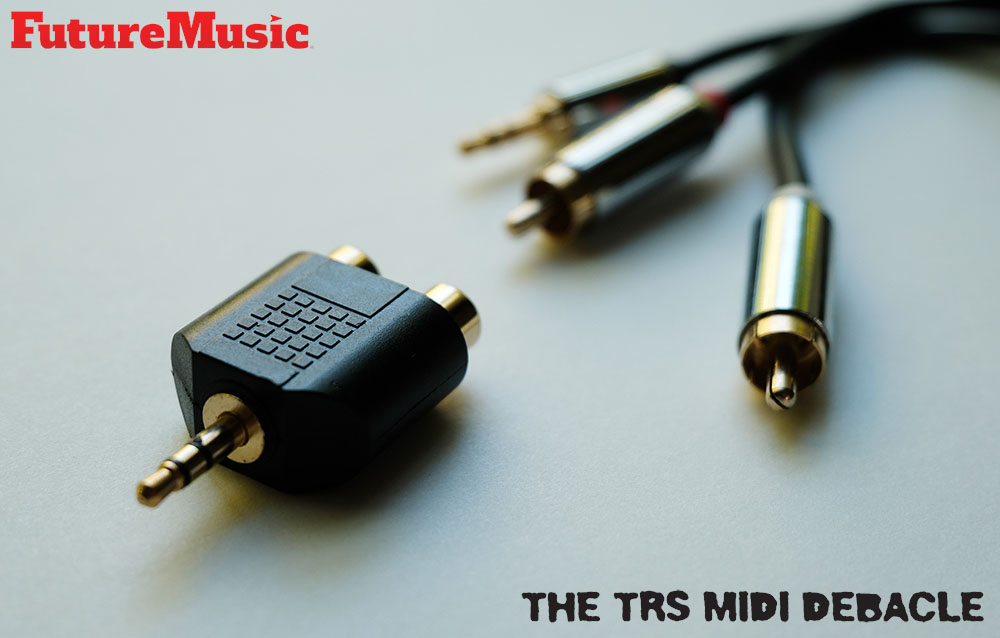
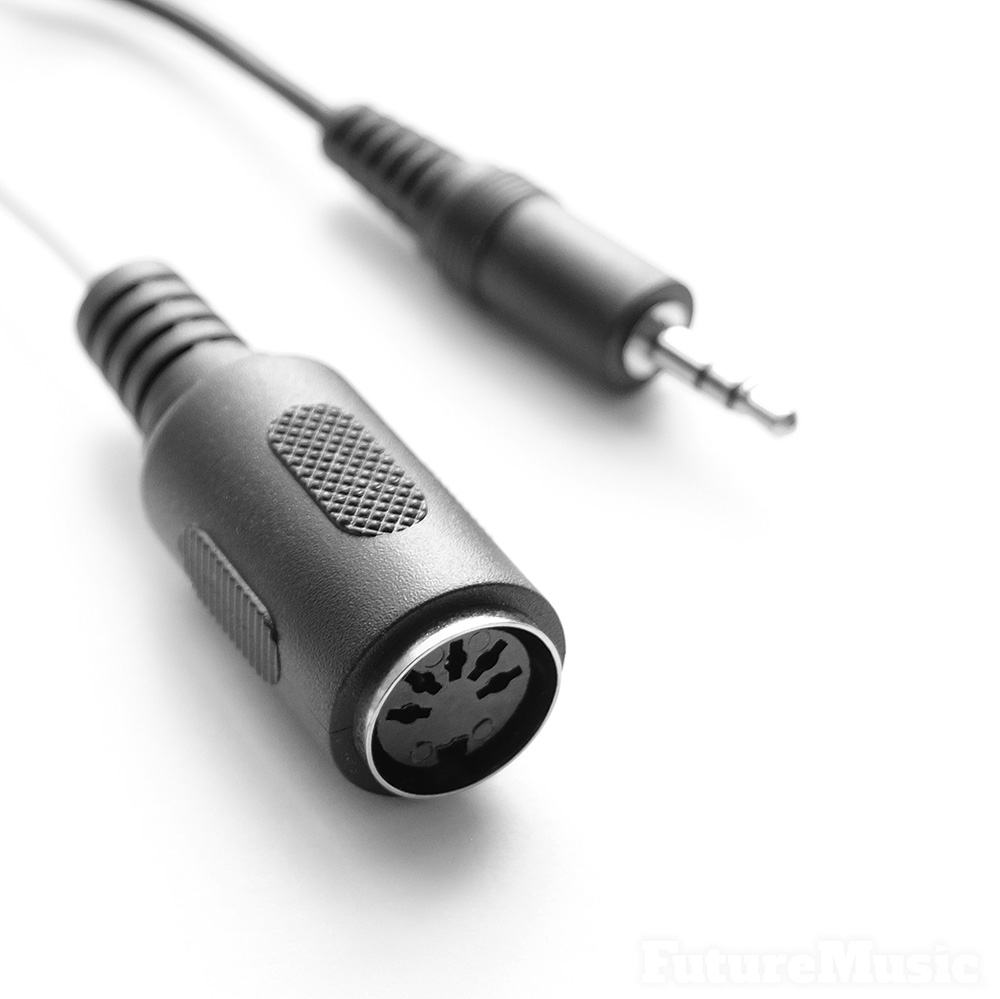
TRS MIDI uses a standard Tip-Ring-Sleeve connector, think stereo headphone jack, to carry those same three electrical connections. It can either be the 1/4″ variety or the more prevalent 3.5mm/1/8″ “minijack.” Type A maps DIN pin 4 (source) to the Tip and pin 5 (sink) to the Ring. Type B reverses this assignment, placing pin 5 on the Tip and pin 4 on the Ring. The two formats are physically indistinguishable and electrically incompatible for reliable communication. A third variant, sometimes called Type C or the 2.5mm format, uses a smaller jack diameter that was initially promoted by the MIDI Manufacturers Association as they were struggling to keep up the explosion of the format, but we’ll get to their stumbling around in just a minute. The worst thing about the 2.5mm format is that it added yet another physical incompatibility layer on top of the confusion and mess.

The easiest way for electronic musicians to get their music onto Spotify, Apple Music, iTunes, Amazon Music, Tidal, Instagram, Facebook, TikTok, Pandora, Twitch & much more! Click the banner above or the Go Button to save 7% off of your signup! GO!
The pressure that ultimately cracked the DIN format’s dominance came not from any technical failing, but from the relentless miniaturization of music hardware. Through the 2010s, a new generation of ultra-compact synthesizers, sequencers, drum machines and MIDI controllers arrived. These new devices coveted every millimeter of panel real estate since they were so small, thin and compact. (See: The Rise Of The Microstudio —Ed.)
The five-pin DIN connector, with its 13.2-millimeter shield diameter, had become an engineering inconvenience. The solution manufacturers gravitated toward was already in every musician’s pocket: the standard 3.5-millimeter TRS stereo headphone jack, sometimes called a minijack or 1/8-inch connector. Since MIDI only needed three conductors, and a TRS jack provided exactly three, the aforementioned Tip, Ring, and Sleeve, the physical attributes were perfectly suited. The Line 6 MIDI Mobilizer, released in 2010 as the world’s first portable MIDI interface for the iPhone, became the first commercially available product to carry MIDI over a TRS connection, establishing the wiring convention that would later be codified as Type A. Now typically other manufacturers who wanted to implement the new connection would have followed suit, or at the very least circled the wagons with other manufacturers and the MIDI Manufacturers Association and codified the concept, but nooooooooo…
As hardware synthesis enjoyed a wondrous commercial renaissance through the mid-2010s, driven by boutique manufacturers, the Eurorack modular ecosystem, and majors like Korg, Arturia, Novation, and Teenage Engineering releasing compact instruments, the TRS MIDI approach proliferated rapidly. Each manufacturer made its own decision, based on its own engineering intuitions or pre-existing internal conventions, about how to wire the three conductors. Korg, Make Noise, and Akai followed the Line 6 convention, what became Type A, while Arturia, Novation, and 1010music adopted a reversed arrangement, swapping the Tip and Ring assignments, which became Type B. IK Multimedia further complicated matters by using a physically smaller 2.5-millimeter connector on products like the iRig Pro, now frequently referred to in discussions as a third variant or Type C. Not a single governing body stepped in to halt the divergence before the market was irreversibly split.
“[Polyend] went with the 3.5mm Type B format because it was the most popular standard at the time we developed our first device with minijack MIDI. Then we stuck to it in the next ones.” -Piotr Raczynski
By the time the MIDI Manufacturers Association published its Recommended Practice document in August 2018, formally codifying Type A as the preferred standard, the damage had already compounded across hundreds of products. Worse, many manufacturers didn’t respect the MIDI Manufacturers Association’s standardization and just proceeded on their own path. What has now ensued has tarnished MIDI’s stellar reputation and left musicians to fend for themselves with a variety of very inelegant solutions.
What Went Wrong?
The TRS MIDI fiasco did not happen because the physics were complicated or the engineering was ambiguous. It happened because the MIDI Manufacturers Association and manufacturers responsible for stewarding one of music technology’s most sacred trusts, namely backwards compatibility, abdicated that responsibility at precisely the moment it was needed most. The story of who failed and why is not a simple finger point, but its central characters are identifiable, and their culpability, while distributed, is real.
The most significant institutional failure belongs to the MIDI Manufacturers Association and its affiliated body, The MIDI Association at midi.org. These organizations had successfully managed the evolution of MIDI for over three decades, shepherding updates to the electrical specification as recently as 2014, when they amended the original 5-volt standard to accommodate 3.3-volt device circuitry. They were not asleep at the wheel on all fronts. But on the question of TRS MIDI, they were catastrophically, and some say pathetically late. The Line 6 MIDI Mobilizer shipped in 2010. Korg began putting TRS MIDI jacks on the SQ-1 and Electribe 2 in 2014 and 2015. Arturia was shipping the BeatStep Pro with its own conflicting pinout. By 2016, community forums on the internet were publishing user-authored guides attempting to decode the wiring chaos. These crowdsourced, advice channels acknowledged at least two incompatible implementations and expressed aggravated bafflement that no standard existed. The MMA waited until August 2018 to publish RP-054, its TRS Recommended Practice document, meaning the industry had been manufacturing incompatible devices for roughly eight years without official guidance. Let that sink in. Eight. Years.

Master MIDI Clock Shootout: Step Audio Tempode vs. Sim’n Tonic Nome II
The manufacturers themselves bear direct and proportionate responsibility. The foundational error was one of individualism over coordination. Korg, one of the founding members of the original MIDI consortium in 1983, a company whose engineers literally helped write the DIN MIDI specification, chose to implement TRS MIDI in its own way, establishing what became the Type A convention.
What’s fascinating is that one of the most established and respected companies, Roland, basically sat this one out. Roland was one of the most influential companies in the MIDI ecosystem during the years when the TRS MIDI compatibility problem developed, and there is a credible argument that the standards associations, which include leaders from Roland, went into hibernation when they were needed most. Roland historically has one of the largest installed bases of professional hardware using full-size DIN MIDI. If you’re selling larger Grooveboxes, drum machines, synths, stage instruments, and even “Boutique” modules, there is certainly less pressure to abandon DIN if you don’t necessarily feel the urgency of minijack standardization.
These decisions were made without cross-industry consultation, without reference to any emerging standard, and without apparent concern for the users who would eventually need to connect these devices to one another…
Arturia and Novation, both influential in the compact controller and synthesizer market, chose to reverse the Tip and Ring, creating the Type B convention. These decisions were made without cross-industry consultation, without reference to any emerging standard, and without apparent concern for the users who would eventually need to connect these devices to one another. The irony is biting: the original MIDI 1.0 specification was the product of manufacturers who recognized they could not build a sustainable market without cooperation. Four decades later, the descendants of that cooperative spirit had completely forgotten the lesson.
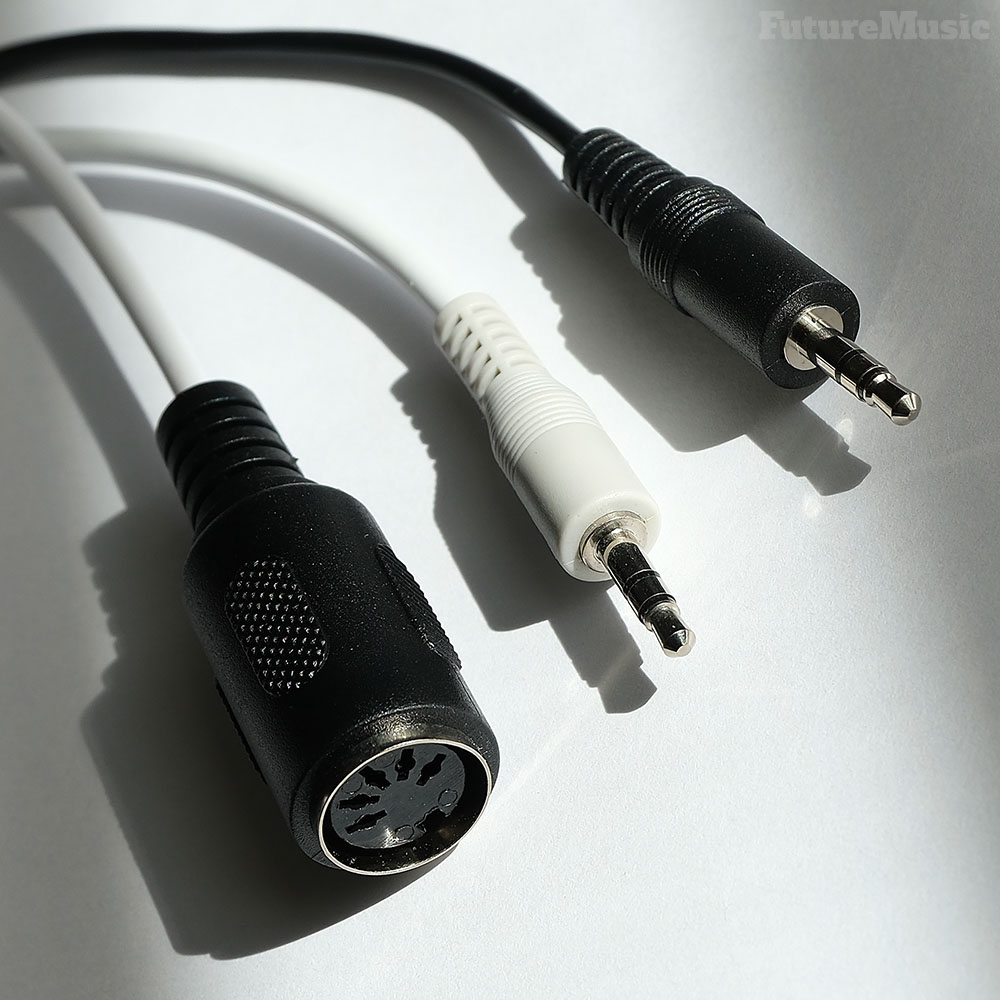
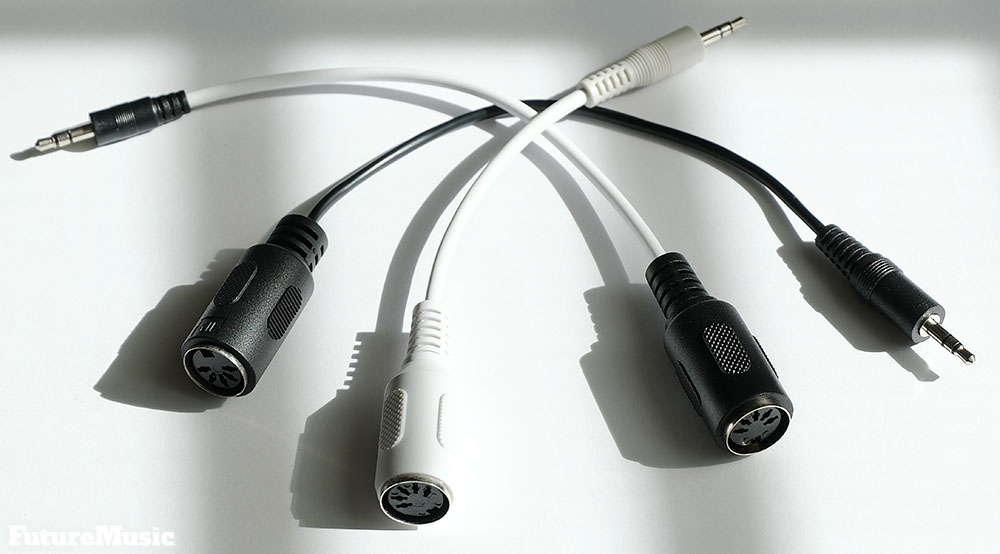
The practical consequences for working musicians have been both frustrating, infuriating and costly. Because the Type A and Type B connectors are physically identical, both a 3.5-millimeter TRS jack, a musician connecting a Korg device to an Arturia device with a straight TRS cable receives no MIDI signal and no error message. The connection simply fails silently, leaving the user to wonder whether the cable is bad, the device is broken, or some software configuration is wrong. Forums across the internet document this experience in exhausting repetition: musicians spending hours troubleshooting connections that appeared superficially correct, purchasing replacement cables, consulting manuals that frequently failed to clarify which TRS type the device used, and ultimately resorting to the workaround of a Type A-to-Type B adapter, itself a tiny dongle that is proprietary to no standard and all too easy to lose. Countless users complain online about spending exorbitant time attempting to connect a one device using a Type A output through a Type A-to-DIN adapter, through a standard MIDI cable, into a Type A to TRS cable only to receive no signal, the compounded uncertainty of multiple conversion points making the problem nearly impossible to isolate.
Beyond the wiring incompatibility, TRS MIDI introduced a new class of hazard that DIN MIDI had specifically engineered against: the possibility of plugging an audio cable into a MIDI port, or vice versa. The original choice of the five-pin DIN connector was partly motivated by the desire for a connector that could not be accidentally or confusedly substituted. A guitar cable cannot be plugged into a DIN MIDI port. A patch cable cannot be misrouted from an audio output into a MIDI input. With TRS MIDI, this protection evaporates entirely. The 3.5-millimeter TRS connector is used for headphone outputs, line-level audio, insert returns, and MIDI simultaneously, with no physical distinction between them. The MMA’s own Recommended Practice document notes that protection circuitry is “strongly recommended” but stops short of making it mandatory, another “half-assed” stipulation that left individual manufacturers free to implement varying levels of protection, or none at all. Worse, thanks to the ever-shrinking size of these modules, the I/O descriptions have become so small and often just embossed into the chassis that it’s an exercise in patience to figure out the I/O and make the correct connections.
How TRS MIDI Became An Absolute Disaster

Support Ambient Music
StretchMetal and the Atmospheric Music Alliance are raising $5000 to support ambient music events taking place across the United States, and virtually with the Atmospheric Music Alliance. Contributions will go directly toward artist and venue fees, production support and the continued development of AMA. Please consider donating today!
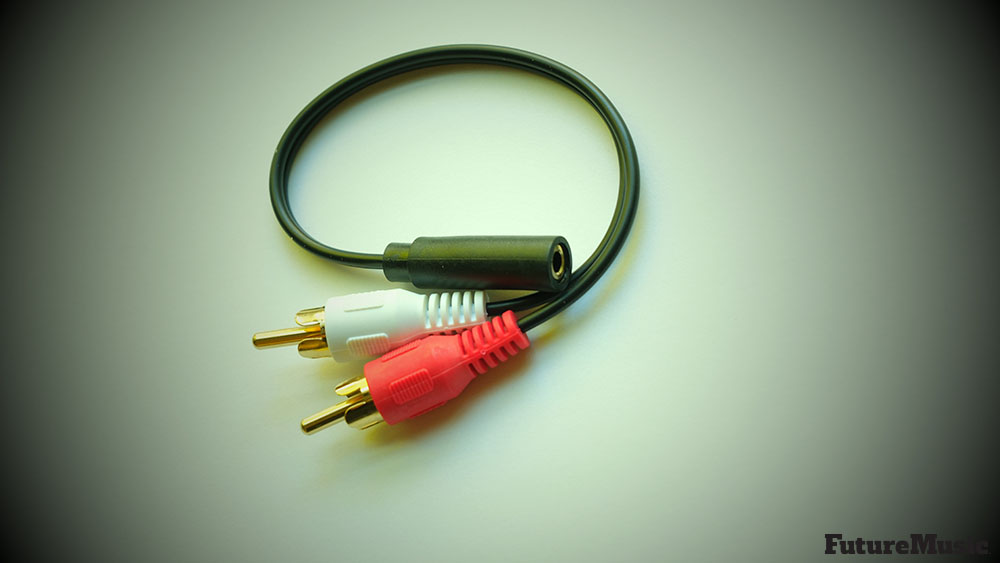
The 2.5-millimeter variant used by IK Multimedia added a dimension of physical incompatibility on top of the wiring confusion. A musician seeking to connect an IK Multimedia iRig interface to any 3.5-millimeter TRS MIDI device required not only a polarity adapter but also a physical size converter. Think about this for just a moment – it takes two layers of dongle-mediated workaround before a single MIDI note could be played. IK’s user base was not amused at this decision with some stating in online forums that IK Multimedia’s decision served its own accessory sales rather than any user need. Although, IK can point its finger back at the MMA, who published a paper promoting the 2.5mm size.
TRS specification itself imposes a cable length limitation of approximately two meters…
Now here’s the kicker that makes this debacle even more mind-boggling, the TRS specification itself imposes a cable length limitation of approximately two meters. This is a fraction of the 15-meter maximum specified for DIN MIDI, creating a further practical constraint that is poorly documented on most devices and largely unknown to consumers until they discover it through failure.
Perhaps most damaging to the TRS MIDI transition was its effect on consumer trust and confidence. MIDI’s greatest asset, the one feature that had sustained its relevance across four decades and multiple technological generations, was its complete, unconditional interoperability. Musicians could connect any MIDI device to any other MIDI device and expect it to work. That expectation was not just a convenience; it was the promise that MIDI was founded upon. The TRS transition broke that promise, visibly and repeatedly, front and center on the world stage. The long-term reputational damage to the MIDI standard as a reliable, trustworthy protocol should not be underestimated. Younger musicians encountering hardware MIDI for the first time discovered not a robust universal standard but a compatibility minefield requiring research before every purchase and a drawer full of adapter dongles to survive.
So What Can Be Done?
The good news, anorexic as it may be, is that the TRS MIDI debacle is not intractable. It is a mess produced by institutional passivity and manufacturer individualism, and those are forces that can be reversed through institutional assertiveness and manufacturer coordination, which are incidentally precisely the forces that created MIDI’s original success. Here are some thoughts on what a strict, time-bounded remediation by the MIDI Association and the corresponding manufacturers who caused this problem could pursue. They certainly owe it to their users to find some sort of resolution.
The first and most immediately actionable step is a comprehensive mandatory labeling standard. The MIDI Association must immediately amend RP-054 to require that any device shipping with a TRS MIDI port at any physical size display the type designation directly on the device panel, adjacent to the port, in a standardized format. “MIDI A” and “MIDI B” must appear as physical legends, not buried in a manual or specified only on a product page.
The 2.5-millimeter physical variant must be formally deprecated from any further MIDI Association endorsment. This step costs manufacturers nothing in engineering terms and requires only the will to enforce it. Any member of the MIDI Association shipping a new product without compliant labeling should face removal from the organization’s certification program.
The second step requires the major manufacturers, specifically Korg, Arturia, Novation, Roland, Akai, and IK Multimedia, to convene under the MIDI Association’s facilitation and issue a unified public commitment to Type A exclusivity on all new products going forward, with a hard sunset date for any new Type B designs no later than the end of 2026.
Novation has already demonstrated that this is feasible: beginning with the Launchkey Mini MK3, the company quietly shifted its entire new product line from Type B to Type A without disrupting its product roadmap. Arturia, Polyend and others must follow. The remaining holdouts must commit publicly and visibly, with the MIDI Association publishing a regularly updated conformance register on midi.org that consumers can reference before purchasing.
Third, the MIDI Association must fund and standardize a universal hardware adapter specification. Not merely a wiring diagram in a technical document available only to members who pay an association fee, but a royalty-free, open reference design for a Type A-to-Type B bidirectional adapter that any manufacturer or third party can produce to a guaranteed specification. The current market of Type A and Type B adapters is already substantial, but it is unregulated. Adapters of uncertain quality and unclear labeling are widely available, and their proliferation contributes to the confusion rather than resolving it. A standardized, MIDI Association-approved adapter, clearly labeled, with a consistent form factor and color coding, would immediately address the installed base of existing Type B devices without requiring users to throw away working hardware.
A software solution that 1010music initially developed, allowed the user to switch from Type B to Type A, and vice versa, in the operating system settings. This approach, which may be implemented in a firmware update, could alleviate this substantial pain point with an elegant solution.
Most damaging to the TRS MIDI transition was its effect on consumer trust and confidence…
Fourth, and over a slightly longer timeframe, the MIDI Association should mandate that all new TRS MIDI-equipped devices implement autosensing input circuitry. This technology already exists and is already deployed by manufacturers like Elektron on the Model series of devices, which automatically detect whether an incoming TRS signal is Type A or Type B and adapt accordingly. The cost of implementing a dual-polarity optoisolator or equivalent autosensing circuit is minimal relative to the cost of the devices in which it would appear, and it would permanently dissolve the input compatibility problem without requiring users to carry adapters at all. Making autosensing mandatory on inputs, while still maintaining Type A as the output standard, would address the practical problem for musicians while the market works through its inventory of legacy Type B devices.
“[1010Music’s] solution on recent products has been to automatically sense the TRS mappings used on inputs and to offer user selection of the output mapping. Our Type B TRS to MIDI adapters are another solution that also enable connectivity to traditional MIDI connectors. The existence of two TRS mappings is a problem, but it is one that is easily solved with the right adapters and device settings.” —Christine Higgins
Fifth, and equally urgent, the MIDI Association must urgently upgrade its public communications. The RP-054 document, despite its importance, requires a paid membership to download in full, a barrier that ensures the manufacturers most likely to read it are already inside the building, while the engineers at smaller boutique companies who might benefit most are excluded. The core requirements of TRS MIDI compliance must be published in full, freely accessible, in plain language, in multiple languages, prominently on midi.org. The community resource at minimidi.world, a volunteer-maintained guide to TRS MIDI compatibility created entirely outside the official MIDI ecosystem because musicians needed it, should be formally partnered with or sponsored by the MIDI Association, which should feel some institutional embarrassment that a volunteer effort by Eric Skogen outpaced its own public documentation.
Finally, the MIDI Association must acknowledge directly and publicly, in an official statement, that the TRS MIDI standard was disseminated too late and that the organization failed in its custodial role during the critical window between 2010 and 2018. This is necessary for institutional accountability that will be the first public step to restore credibility. The original MIDI consortium earned its trust by acting decisively and cooperatively. The path back to that trust runs through the same territory: honest assessment, accountability, rapid action and visible leadership. The musicians who rely on this protocol deserve nothing less.
Conclusion
The TRS MIDI debacle is ultimately a story about the price of institutional complacency during a period of rapid technological change. MIDI, born in 1983 through an act of remarkable cooperative engineering between competing manufacturers, carried for four decades the most precious attribute any technical standard can possess: the unconditional promise that any device speaking the protocol could communicate with any other. The move to compact TRS connectors was motivated by engineering necessity, the five-pin DIN connector had become a physical obstacle in the miniaturized hardware renaissance of the 2010s, but it was executed without the governance, discipline, or foresight that the original specification’s authors had demonstrated four decades earlier.
Manufacturers, including MIDI’s own founding companies, raced to market with incompatible wiring conventions. The MIDI Manufacturers Association, the body created specifically to prevent such fractures, published its corrective Recommended Practice document in August 2018, eight years after the first TRS MIDI product shipped and years after two competing wiring standards had achieved deep market penetration. The result was a compatibility crisis that quietly eroded MIDI’s foundational promise: musicians discovered that two devices with identical-looking ports, connected by an identical-looking cable, might simply refuse to communicate, with no visible explanation and no simple remedy.
The fix requires the MIDI Association and the industry’s major manufacturers to act with the urgency and solidarity that the original protocol’s authors displayed in 1983. As detailed above, this is through mandatory panel labeling, a binding Type A commitment with a hard public deadline, a freely distributed standardized adapter specification, the ability to manually change the TRS MIDI Types in settings, universal autosensing input circuitry on new devices, fully open public documentation, and an honest institutional accounting of how the failure occurred. The musicians who depend on MIDI’s original promise of universal interoperability have waited long enough for the institutions and manufacturers who shattered that contract to repair it.