Baby Audio SubCulture Review
Baby Audio’s SubCulture is essentially a pitch detector running into three bass enhancement engines, ending in a basic channel strip. What makes Baby Audio’s SubCulture different from other bass processors is the entire processing chain realigns to incoming pitch information, and that the subharmonics are derived from the original source instead of simply being synthesized.
SubCulture is the sequel to the movie Baby Audio began filming when it acquired Denise Audio. Three months after the deal was announced, Denise released Bass XXL, which thickened bass the psychoacoustic way, generating harmonics above each note so the listener’s brain fills in the missing low end. SubCulture tackles the same problem, but from below.
However, before we get to our review, let-s discuss SubCulture’s backstory. According to Caspar Bock Soerensen, Baby Audio’s affable CEO, the technology behind it was first aimed at the rhythm section. Soerensen says the team was researching real-time audio layering for drums and percussion before realizing it was better suited to subharmonics. Development took about 18 months from early 2025, with professional mix engineers testing betas from early 2026. The finished plug-in arrived in our studio this summer with its aim at pushing the Bass XXL concept further. We sourced three reviewers to put SubCulture through its paces. However, let’s sort out how SubCulture is different than the other bass enhancement utilities on the market.
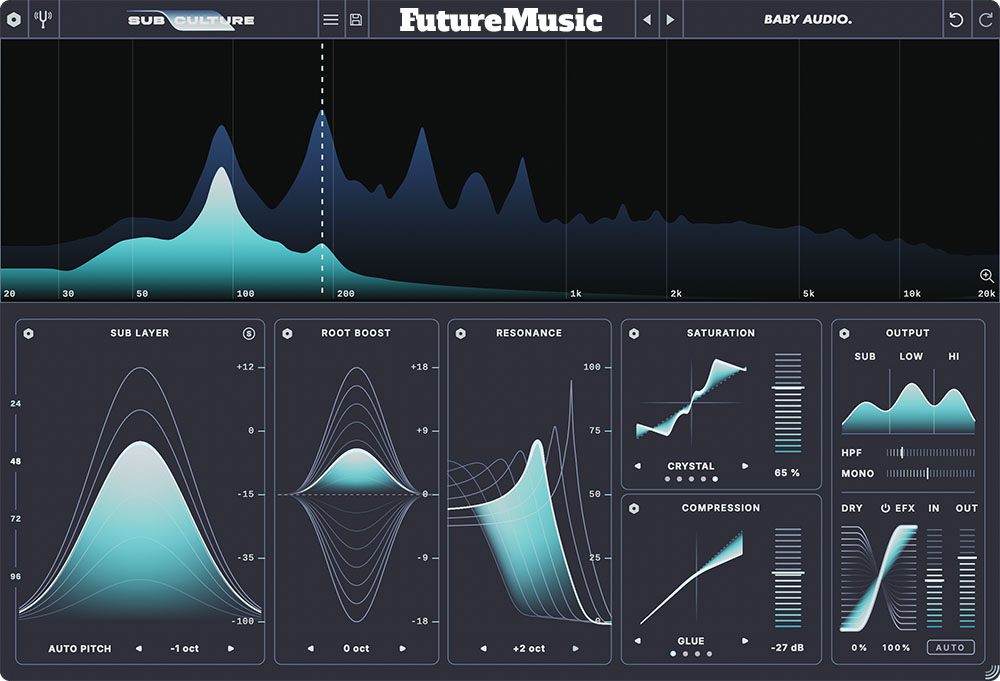
Baby Audio’s SubCulture is essentially a pitch detector running into three bass enhancement engines, ending in a basic channel strip. What makes Baby Audio’s SubCulture different from other bass processors is the entire processing chain realigns to incoming pitch information, and that the subharmonics are derived from the original source instead of simply being synthesized.
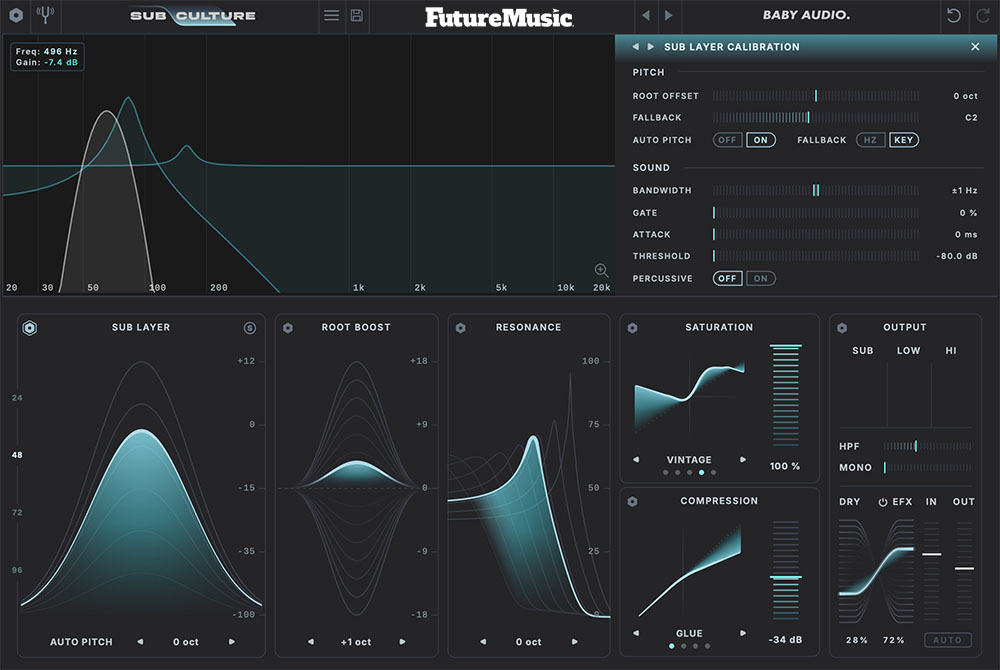
The first engine, Sub Layer, produces a pitch-shifted copy of the input and filters it to emphasize subharmonic content up to two octaves below the source. Its X/Y pad modulates the level vertically and the filter bandwidth horizontally. The filter slopes travel from 24 to 96 dB per octave, and the octave offset spans +/- 24 semitones. A calibration page adds a semitone root offset, a fallback frequency and a Gate control that makes the sub follow the source’s envelope, an Attack control, a Threshold that silences the sub on low-level input, and a Percussive switch that passes transients through unaltered for kicks and drums.
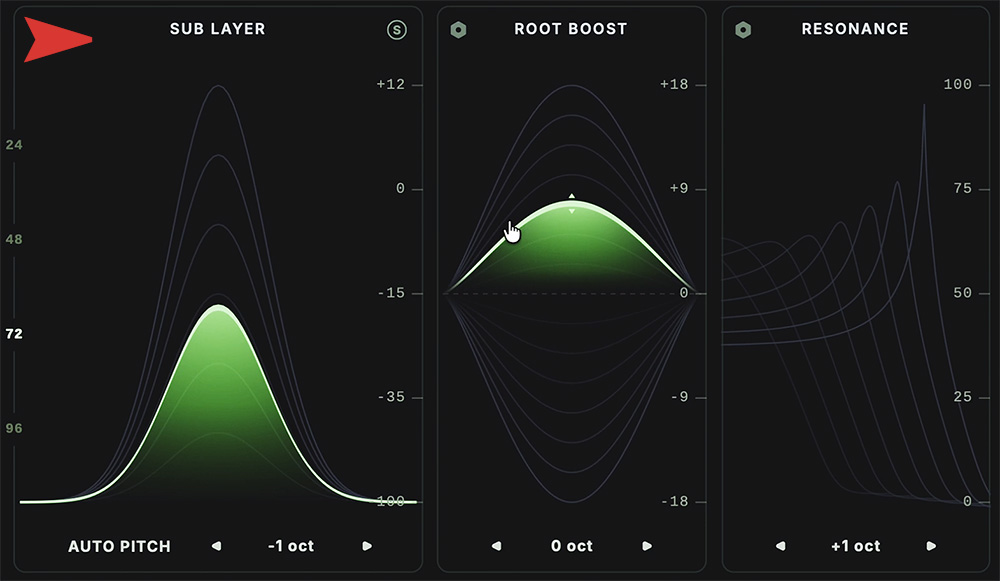
Root Boost is a variable-Q equalizer band that tracks the fundamental, offering up to 18 dB of boost or cut, an offset of +/- 24 semitones, and a Q range from 0.10 to 10. Resonance pairs an aggressive peak at the detected frequency with a broad low-pass filter to imitate driving an analog synth filter. It runs in parallel so it never replaces the dry signal, and beyond its single intensity control it offers 12 or 24 dB per octave slopes, Drive and an internal Mix.
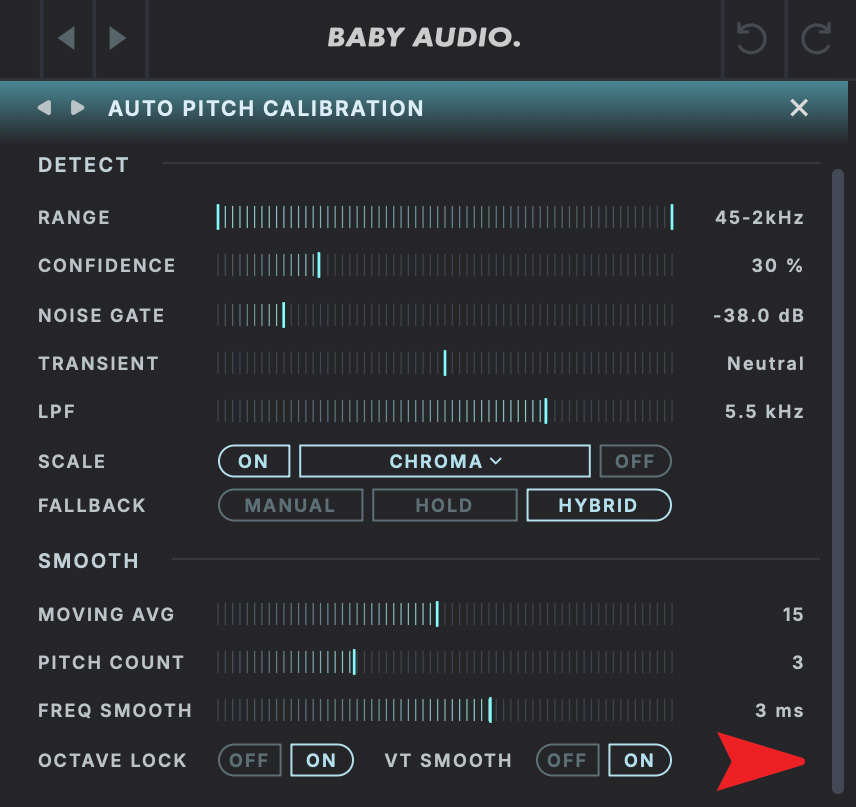
The detector can be tweaked in many ways. Calibration covers detection range, confidence threshold, a noise gate, transient reshaping of the detector feed, a low-pass filter for harmonically dense sources, scale snapping to any major or minor key, moving average, pitch count, frequency smoothing, octave lock and VT Smooth. Three fallback modes, Manual, Hold and Hybrid, determine behavior when the pitch detection comes up wanting. A MIDI mode lets incoming MIDI data dictate the engine’s preferences instead of the audio detector, which Baby Audio recommends for challenging material or for buss and master use. A Zero Latency mode exists, but it disables auto pitch detection entirely, limits the engines to their static fallback frequency, and restricts the range to -12 or -24 semitones. An adjustable Lookahead gives the tracker a head start at the cost of latency.
The plug-in ships with 177 presets from 16 contributors including Craig Bauer, Dacota G and Zardonic. It runs as 64-bit VST, VST3, AU and AAX on macOS 10.13 or later with native Apple Silicon support, and on Windows 10 or newer.
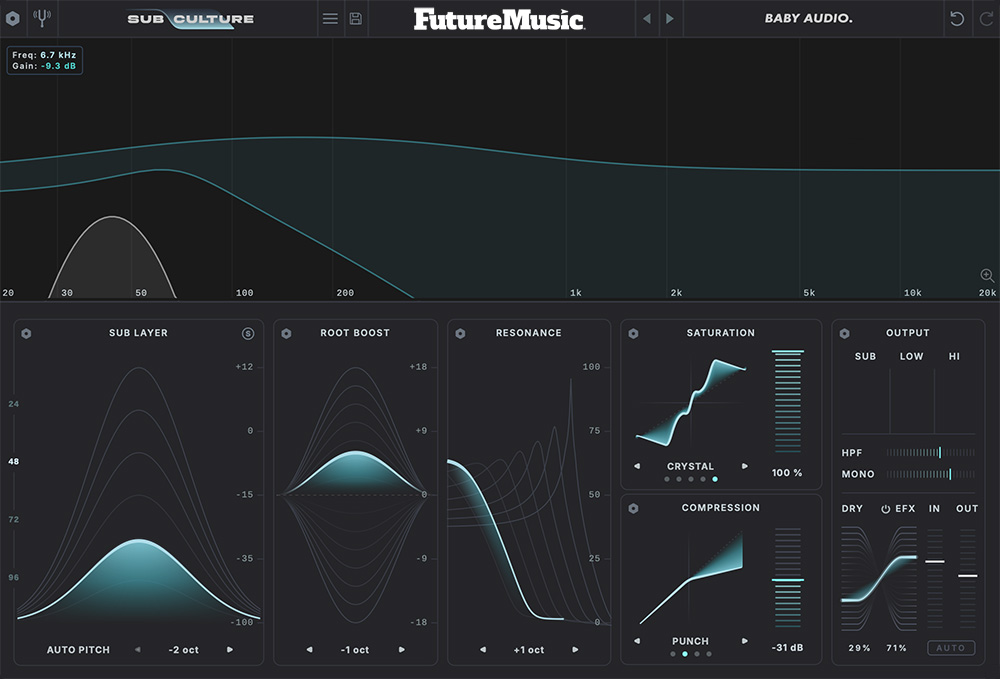
Further downstream, the Saturation stage offers Tube, Tape, Diode, Vintage and Crystal models, with Drive, Bias, Quality settings from Eco to Ultra, separate odd and even harmonic percentages, Shape, a frequency-limiting Narrow control, and a Target selector that saturates the dry signal, the generated sub, or both. The compressor provides Glue, Punch, Sustain and Custom modes with attack, release, ratio, a parallel Strength blend, optional manual makeup gain and Peak, RMS or Combo detection. The output section includes a three-band EQ for sub, low and high content, wet/dry and level controls, and a high-pass filter with selectable slope. A Mono control that removes the stereo information below a set frequency helps eliminate unnecessary audio info from influencing the detection. An Auto gain function measures via RMS, LUFS, gated integrated loudness per BS.1770, or a variant weighted toward the upper mids, and a brickwall limiter offers threshold, release, hold and lookahead.
Although quite long-in-the-tooth, Waves MaxxBass is the natural benchmark, and the comparison reveals how differently the two companies approach bass enhancement, not to mention what the latest technical advances bring to the table. MaxxBass raises the subjective level of bass without adding low-frequency energy, by analyzing the low frequencies and generating harmonics roughly an octave above it, with an option to attenuate the original content below a chosen frequency. Waves claims up to 1.5 octaves of perceived bass extension, and supplies mono and stereo components. MaxxBass is a psychoacoustic tool, essentially taking advantage of the ear’s ability of inferring a missing fundamental. SubCulture actually does the opposite, adding real energy at or below the fundamental, plus harmonic reinforcement from Resonance and saturation.
Baby Audio SubCulture Review
That difference defines SubCulture’s advantages. MaxxBass works from a frequency region, not pitch, so its enhancement is equally indifferent to whether a bassline sits on A or on E. SubCulture retunes a sub layer, an EQ band and a resonant filter to each note, which means it can deliver weight in a way that stays musically consistent across a moving line. It also consolidates what would normally be four or five plug-ins: sub generation, dynamic note-following EQ, harmonic coloration, compression, mono-making and limiting. MaxxBass, however, retains a somewhat structural advantage on polyphonic material and full mixes, where SubCulture’s automatic tracking does not operate.
Pitch-following subharmonic generation is not exactly new. Waves Submarine, which debuted in 2019, segments the signal into carrier, pitch, formant and envelope to generate subs one and two octaves down, and it targets a 20 to 240 Hz range with zero latency. In The Mix released a similar plug-in about two weeks before SubCulture premiered, dubbed Bassmaker, which marries a note- or frequency-locked generator with a pitch-tracked octave generator, adds saturation and a low-focused compressor and supports CLAP alongside AU, VST3 and AAX. We haven’t experienced Bassmaker, but SubCulture’s differentiation is in extending pitch awareness beyond the sub generator to the equalizer and resonant filtering, and in packaging everything into a complete bass finalizer.

With three updates in the first week alone, SubCulture’s launch probably wasn’t what Soerensen envisioned…
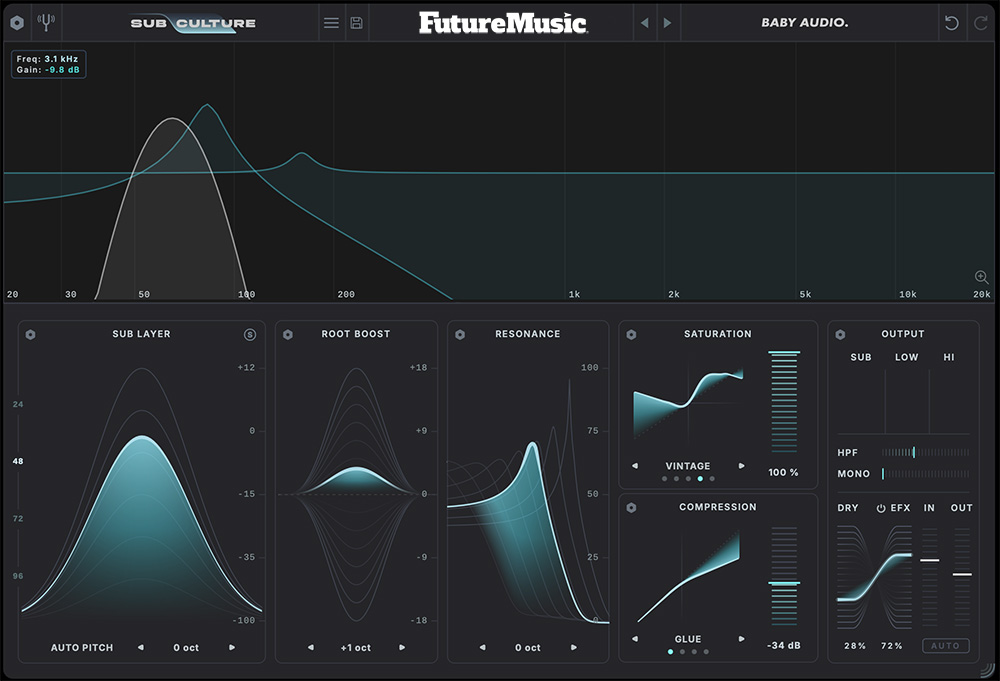
Baby Audio has always utilized a more playful and cartoony vibe with their plug-ins, but SubCulture’s user interface is well considered and all business. The display shows the dry signal behind SubCulture’s added content, along with a real-time readout of the detected fundamental, and hovering over any engine reveals the frequency range it is acting on and how it tracks pitch. The X/Y pads make the main controls quick to set, while the gear icons feature the deeper calibration pages without serious menu diving. The signal-flow chart is a savvy addition, showcasing the complex internal routing.
One of our reviewers felt that Root Boost is “SubCulture’s sleeper feature.” A static EQ boost on a moving bass line fuels some notes and reduces others. Resonance and the saturation stage supply most of the harmonic content that allows the bass to be more present on smaller speakers. The Target selector, which chooses whether saturation hits the dry signal, the sub, or both, is “the kind of routing detail usually missing from all-in-one bass tools.”
One of our reviewers felt that Root Boost is “SubCulture’s sleeper feature.”
Pitch tracking is where the plug-in lives or dies. On clean monophonic sources the plug-in “performs admirably” with accurate tracking especially on live instruments rather than synths with complex bass tones. However, dense and intricate bass tones expose SubCulture’s limits. A Double Bass passage found the pitch detection “jumping around,” producing “a garbled result even after smoothing adjustments.” If MIDI data is present, there is “an immediate improvement” but that is often not the case when dealing with audio sources only.
Latency proved to be an issue for our testers, “eliminating live use all together.” In Logic Pro, SubCulture added 36 ms at the default 5 ms lookahead. Low-Latency Mode could make tracking possible, but the reality is that SubCulture is really for post, since Low-Latency Mode switches off automatic pitch detection and “nerfs the engines.” Put another way, the plug-in’s defining pitch detection feature is unavailable in the one mode suited to real-time performance. Gain staging is much better. The Auto gain button, which matches output to input means extra loudness does not trick your ears. Offering LUFS-based measurement rather than simple RMS is also a great choice, given how much low-frequency content warps perceived level.

LinnStrument Sale
Roger Linn has put his LinnStrument on sale! (He never does this…) Learn More About LinnStrument
One interesting thing to note is that SubCulture is not just for bass applications. Adding a clean sub-octave or a fifth to vocals, stacking engines at different octaves on synth and guitar leads, and using fifths or sevenths for self-oscillating top layers on drums and synths can yield dynamic results.. The +24 semitone offsets make SubCulture a capable pitch-tracking harmonic layering tool for sound design and music bed applications.
An argument can be made that SubCulture’s largest omission is a psychoacoustic harmonic engine. Baby’s marketing leans hard on translation to small speakers, yet its flagship engine adds content that those speakers actually can’t reproduce. Here’s how one evaluator put it: “Consider a bass guitar’s low E at roughly 41.2 Hz: one octave down is about 20.6 Hz, two octaves about 10.3 Hz. The manual itself recommends setting the master high-pass around 30 Hz to avoid excessive subsonic content, which would remove much of a -12 semitone sub on notes in the instrument’s bottom register. Translation therefore depends on Resonance, saturation and creative use of Root Boost offsets.” Therefore, SubCulture may not replace MaxxBass in some production scenarios for exactly this reason, simply “because MaxxBass generates upper harmonics rather than simply saturating the fundamental.” The irony is that Baby Audio already owns this technology in Bass XXL.
Second, polyphonic tracking remains absent, and the MIDI workaround is only as good as the MIDI data you have. The CEO acknowledges the challenge; he said polyphonic tracking with tolerable latency and sufficient accuracy is difficult because a single misread ruins the result, but called it a concept the company might explore in a future update.
An argument can be made that SubCulture’s largest omission is a psychoacoustic harmonic engine…
Third, the latency trade-off could be managed better. A 46 ms figure at default settings, with zero latency available only by removing auto detection, leaves a gap between mix-stage and performance-stage use. Worse, there is no external sidechain input for the pitch detector either, which would allow users to detect from a clean DI while processing a distorted amp track, a common real-world scenario the LPF and transient controls only partly address.
Baby Audio SubCulture Changelog:
- v1.0.1 – Released July 14th, 2026
- Removed clicks when toggling Sub Layer Percussive ON/OFF
- Fixed a Viterbi error (VT Smoothing parameter) when Percussive Material was OFF and VT Smoothing was On
- ixed a casing mismatch preventing PCP activation validation
- v1.0.2 – Released July 18th, 2026
- All saturation Quality modes now have an identical frequency response
- The output EQ is now phase-transparent at flat settings
- Sub Percussive parameter OFF state behavior improved on first alignment
- v1.0.3 – Released July 21st, 2026
- Fixed an AU-only crash when closing the plugin window in MIDI or Zero Latency mode
- Fixed a host crash on load for old Windows CPUs without AVX2
- Fixed a Pro Tools crash when dragging an instance to another insert slot or option-dragging a copy to another track
Read Next: Telepathic Instruments Orchid Review
Judged as hardware engineering, the Telepathic Instruments’ Orchid is merely good. Judged as a songwriting tool, it’s excellent, and it would be genuinely outstanding if the next revision spent its effort on removing walls rather than adding rooms… Telepathic Instruments Orchid Review
Another shortcoming, which has affected several Baby Audio releases is quality control at launch. We saw it with our Tekno review, but SubCulture set a new low water mark with three updates in the first week. Not good. Some fixes addressed fundamentals: saturation Quality modes that did not share a frequency response and an output EQ that was not phase-transparent at flat settings, and Baby Audio’s response was immediate, but these are issues that should have been caught in a beta that ran for months.
Never known for their manuals, Baby Audio needs to step up their documentation…
Never known for their manuals, Baby Audio needs to step up their documentation. It wasn’t an issue when they first started simply because their products weren’t complex, but as the releases became more sophisticated, the manuals never elevated to the level they needed to be to eliminate frustration. The SubCulture manual stumbles over and over. It introduces the compressor as offering three states, then lists four modes. The product page’s QuickStart places each module’s gear icon at the top right, while the manual places it in the upper left corner. Combined with retailer listings claiming a standalone version and older macOS support, the result is confusion that could simply be avoided with a more dedicated and detail oriented approach.
While our reviewers liked the interface overall, there are some important settings that are buried. The MIDI tracking mode resides in the Settings menu under a label that does not make its status obvious, and the calibration page, is wonky and could be better sorted. A guided calibration routine or source-type presets for the detector itself would help matters considerably.
Conclusion
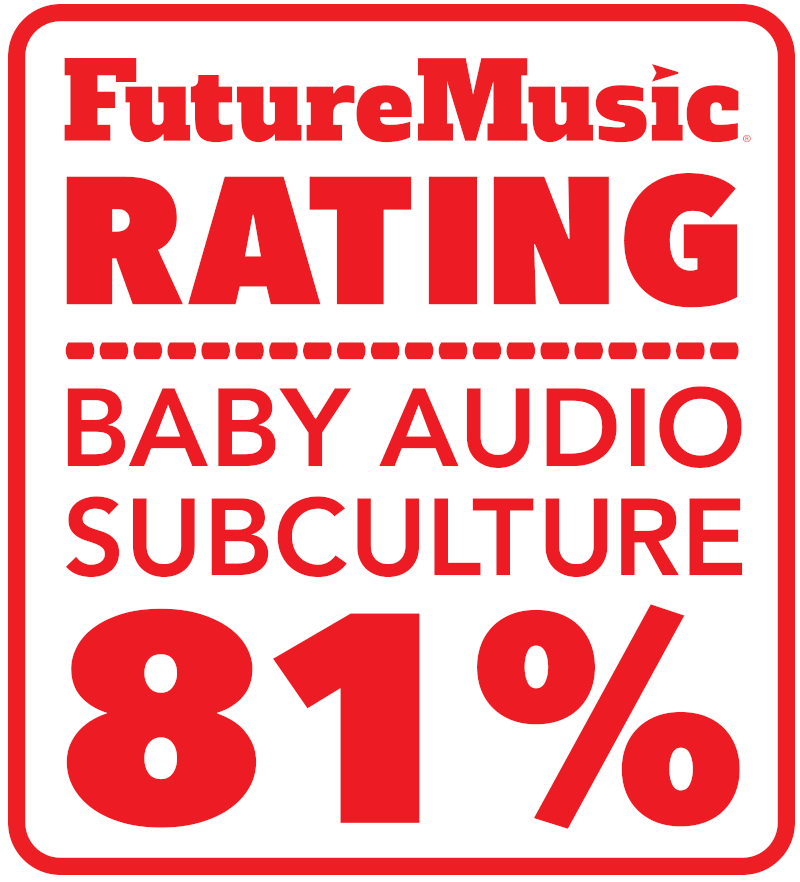
Baby Audio’s SubCulture earns high marks for concept and execution of its core idea: applying pitch awareness to the entire bass chain rather than just the sub generator, and the channel-strip consolidation will save many engineers real time and CPU taxes. The calibration depth, Percussive mode, Target routing and loudness-matched output demonstrate careful design choices. Points come off for the gap between its small-speaker translation claims and its sub-first architecture, the latency compromise that removes tracking in zero latency mode, reported instability on dense sustained sources, and a launch that needed several fundamental fixes in its first week. It is an excellent mixing tool for monophonic bass, kicks, 808s and vocals, and a less convincing one for full mixes, live use, or engineers whose main goal is making bass audible on phones. Worth A Look.
Baby Audio’s SubCulture costs $129 and is available now.
Price Note: Prices are as of September 2026, quoted in US dollars and are different in other countries and geographical locations.
Introductory Pricing SubCulture is available direct from Baby Audio for $79 (limited time).
Cheers:
+ Pitch awareness extends beyond the sub generator to a tracking EQ band and a tracking resonant filter, which is SubCulture’s most distinctive technical contribution and the reason moving basslines stay consistent without automation.
+ The Sub Layer derives its content from the source rather than an oscillator, and its Gate, Attack, Threshold and Percussive controls keep the generated layer tied to the dynamics and timing of the original performance.
+ Pitch detection calibration is deep with range, confidence, gating, filtering, scale snapping, octave lock, smoothing stages and three fallback behaviors that let experienced users rescue difficult material.
+ MIDI and static fallback modes extend the plug-in to polyphonic material, buses and masters, albeit without automatic tracking.
+ The saturation stage offers five models with odd and even harmonic balance, bias, frequency narrowing and a Target selector that can process dry, sub or both.
+ The compressor, three-band output EQ, high-pass filter, mono-maker and brickwall limiter make it a credible single insert for an entire bass channel.
+ Loudness-matched Auto gain with RMS and LUFS options supports honest A/B comparisons and protects downstream processors.
+ The interface balances approachability and depth with clear X/Y pads, real-time visual feedback on each engine and an optional signal-flow chart.
+ Offsets up to 24 semitones above the root turn it into a creative harmonic layering tool.
Jeers:
— It has no psychoacoustic harmonic engine, so small-speaker translation relies on secondary processors while the headline Sub Layer adds content phones and laptops cannot reproduce.
— Automatic tracking is monophonic only, and independent users have reported unstable detection on sustained low string ensembles and poor first impressions on DI bass.
— Significant latency at default settings, and the zero latency mode removes auto pitch detection entirely.
— The launch required three bug-fix releases within a week, including corrections to saturation frequency response and output EQ phase behavior.
— Documentation contradicts itself on compressor modes and control locations, and retailer listings misstate format and OS support.
— The MIDI mode is buried in the Settings menu, and the calibration depth creates a learning curve for users who expect instant results.
— There is no external sidechain for pitch detection.
— Baby Audio overbaked the “first plug-in” framing, given that Waves Submarine and In The Mix Bassmaker already offer pitch-following sub generation.
The Future: Baby Audio’s SubCulture should have spent a bit more time marinating before being released. The most valuable update would be a fourth engine that brings Bass XXL’s psychoacoustic harmonic generation into the pitch-tracking architecture, so that the plug-in could deliver tuned, note-aware upper harmonics for small speakers alongside real sub energy for large systems. This would not only close the gap with MaxxBass on its home turf, but also challenge Baby’s new competiton. After that, we would like to see an external sidechain input for the pitch detector, a low-latency mode that retains some form of automatic tracking even with reduced accuracy, and a more prominent MIDI mode toggle on the main panel. A guided calibration assistant or detector presets for common sources such as DI bass, distorted bass, 808s, vocals and low strings would make the deep tracking controls far more approachable. Longer term, Soerensen’s own admission (FutureMusic Link) that polyphonic tracking is on the company’s radar points to the feature that would transform SubCulture from a channel tool into a bus and mastering tool.
Off The Record: Not the cleanest of product launches. And considering Tekno didn’t exactly fly out of the gate firing on all cylinders either, Baby Audio needs to take a hard look at their quality control.