FlickSwitch Audio Liminal Review
FlickSwitch Audio Liminal: A Review of the First Dynamic Threshold Processor
Liminal, the debut plug-in from Sydney’s FlickSwitch Audio, arrives with an unusual claim attached to it. Rather than positioning itself as a better compressor or a fresh take on multiband processing, it introduces an entirely new category that the company calls the Dynamic Threshold Processor.
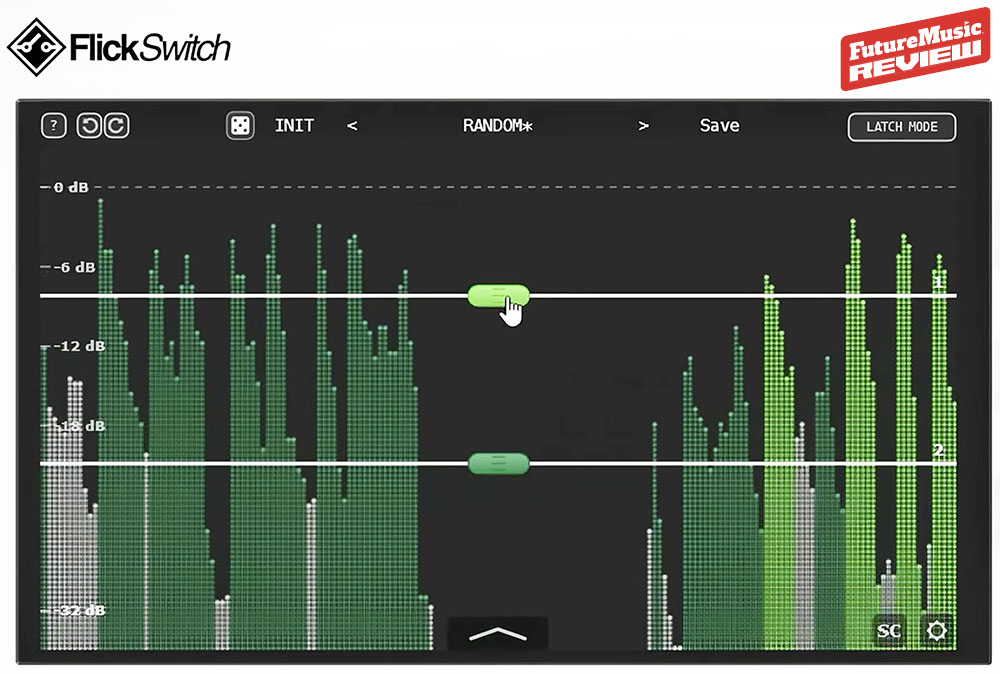
The premise is deceptively simple and inventive. Where a multiband processor slices audio by frequency, Liminal divides it by intensity. It listens to the incoming signal, detects transients, and sorts them into three separate lanes according to how hard they hit. Two adjustable thresholds do the sorting. The first threshold catches the loud, high-intensity events such as snare cracks and kick attacks, the second captures the medium-intensity material such as ghost notes and lighter hits, and everything that falls beneath both thresholds is treated as the noise floor, effectively the quietest layer of the performance. Each of those three lanes is then open to its own processing.
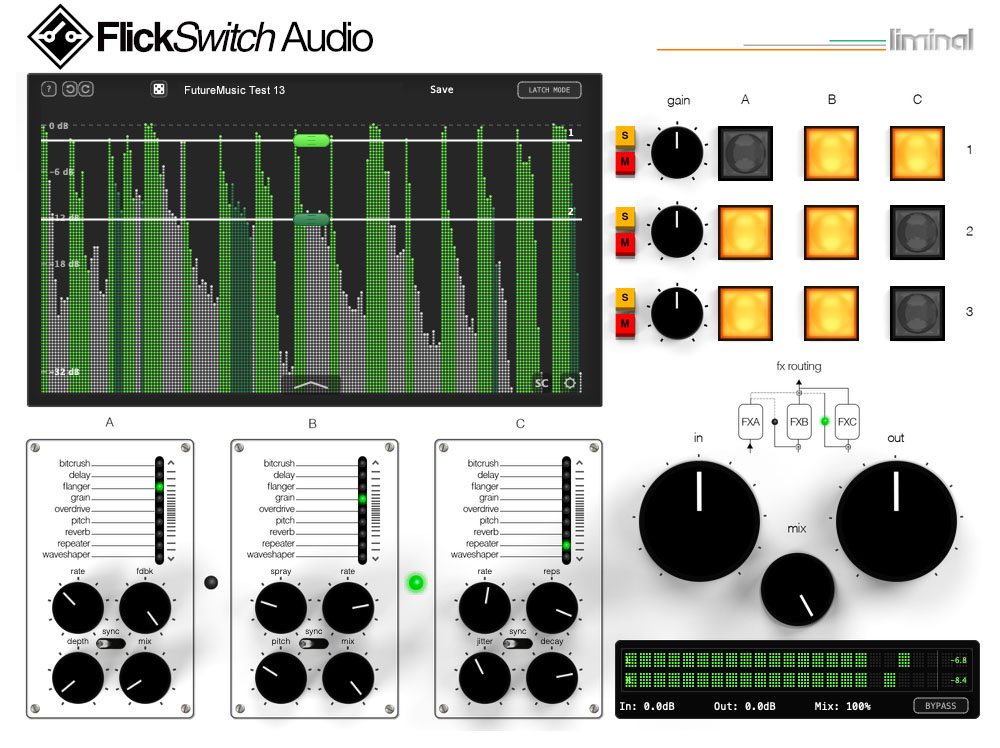
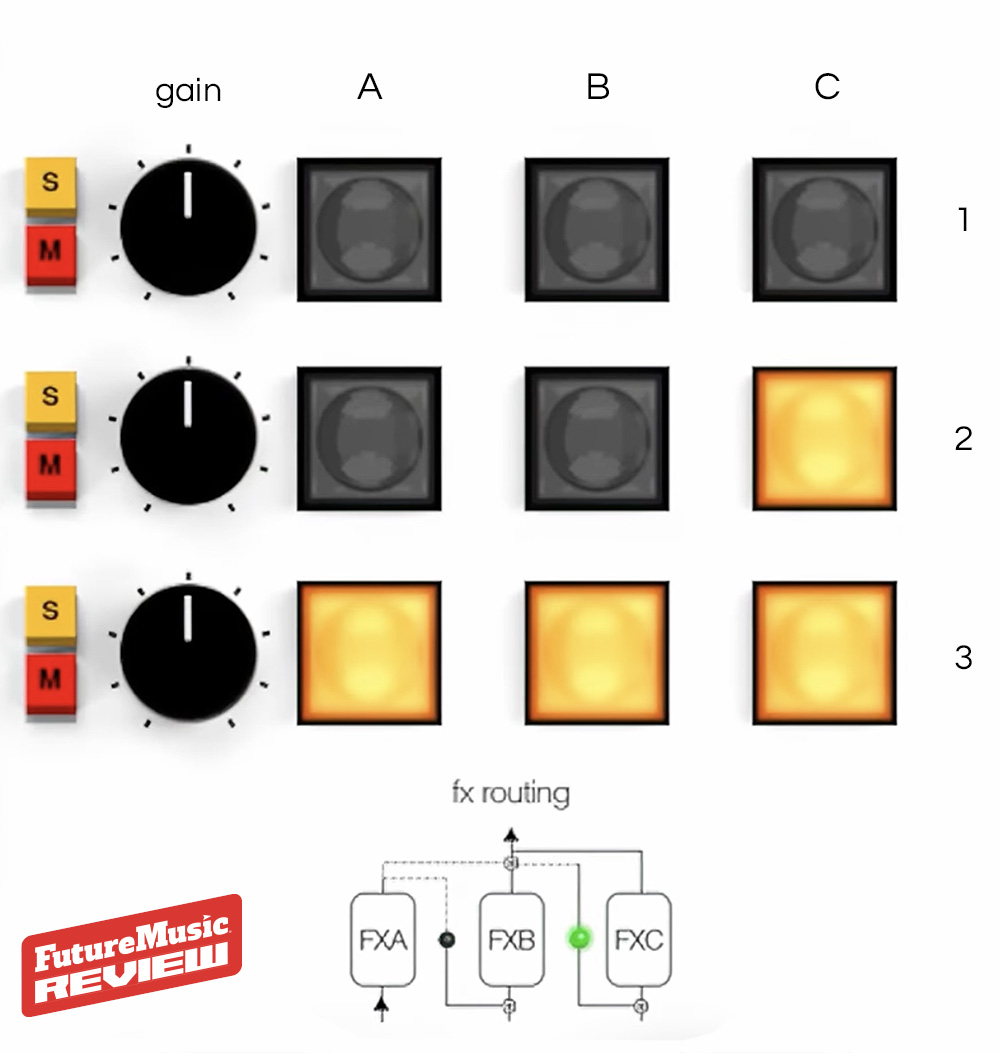
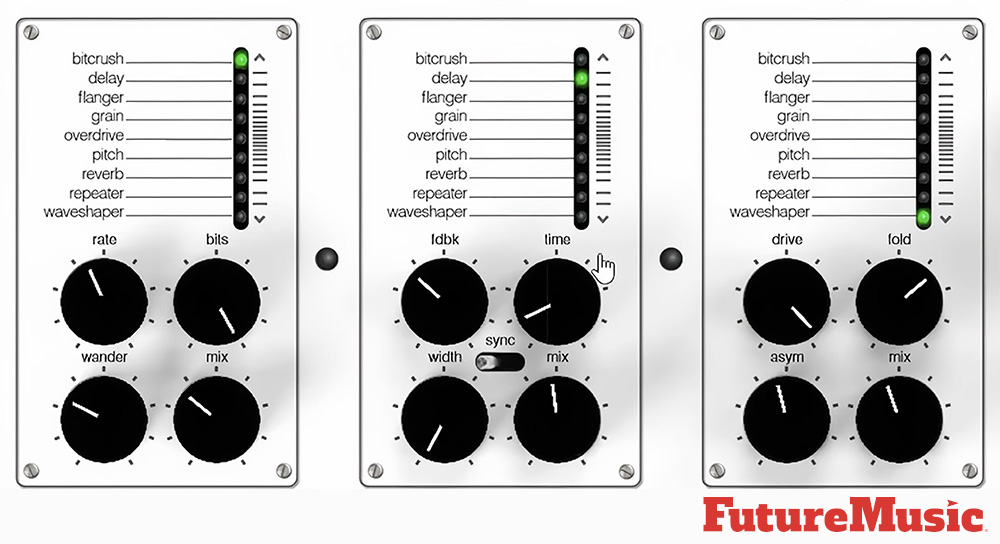
What distinguishes Liminal from anything else on the market is that this amplitude-based routing is paired with a full effects rack rather than a set of gain reduction curves. Nine effects are on board, Bitcrush, Delay, Flanger, Granular Delay, Overdrive, Pitch Shifter with stereo detune, Reverb, Beat Repeater and Waveshaper. Each transient lane can be routed through as many as three effect slots labeled A, B, and C, and those slots can run in parallel or be chained in series through several configurations, including A into B, B into C, or a full A into B into C signal path.
Layered on top of that are dedicated input and output EQ sections for each lane, inter-band sidechain compression, per-lane gain, and solo and mute buttons. The input EQ is not a tone control but a detection filter, meaning you can tell a lane to trigger only on certain frequencies, such as ignoring low end so that only snare-range hits at the same volume as the kick get processed. The output EQ handles traditional tone shaping without consuming an effect slot. A latching Performance Mode, MIDI lane assignment, full automation support, a parameter randomizer, and a real-time scrolling waveform visualizer that color-codes each lane round out the feature set. The idea of triggering discrete effects chains based on how loud a moment is, rather than what pitch it occupies, is the thing you simply do not find elsewhere, and it is the reason the plug-in is difficult to compare against any established competitor.
What distinguishes Liminal from anything else on the market is that this amplitude-based routing is paired with a full effects rack rather than a set of gain reduction curves…
Spend an afternoon with Liminal and the first thing that becomes clear is the interface. The centerpiece is a real-time scrolling waveform that shows transient detection as it happens, with light green marking the high-intensity lane, dark green marking the medium lane, and gray representing the untouched noise floor. Dragging the threshold bars up and down gives immediate visual feedback about which parts of the signal are being captured, and this turns what could have been an abstract, numbers-driven process into something closer to sculpting with your hands. Our evaluators who came to the plug-in cold reported the same arc of experience, a brief moment of feeling daunted by the sheer number of possibilities followed quickly by the realization that the layout “indeed makes sense.” That is a meaningful achievement for a plug-in introducing a concept most producers have never encountered.
Underpinning the accuracy of the whole system are the three transient detection modes. Percussive mode uses fast envelope followers and suits drums, percussion and sharp staccato material. Sustained mode leans on slower envelope followers that track sustain tails, which makes it the right choice for pads, strings, vocals and piano. Adaptive mode continuously analyzes the signal and decides for itself whether the material is percussive or sustained, which is the sensible default for full mixes, varied stems, or those moments when you simply are not sure what you are dealing with. Deeper controls for lookahead and sensitivity are available for anyone who wants to fine-tune the detection rather than trust the presets, and this two-tier approach, easy on the surface and detailed underneath, is one of the plug-in’s quieter strengths.
FlickSwitch Audio Liminal Review
Sonically, Liminal is at its most exciting when it stops acting like a corrective tool and starts behaving like a transformation engine. The modules that drew the most praise from our reviewers were Granular Delay and Waveshaper, the former capable of turning a simple string pluck into an evolving synth texture and the latter delivering extreme distortion. Because you can apply these only to a chosen intensity layer, you can do things that are otherwise quite difficult, such as pitching only the hardest snare hits upward while drenching the sustain in reverb and leaving the ghost notes bone dry. On a drum buss this means processing rimshots and ghost notes independently from a single instance. On a delicate piano part it means rebalancing the performance without hours of manual gain automation that risks editing the soul out of the playing.

The bundled artist presets, contributed by producers including Backchat, Jeff Slaugh, Martin Gonzalez, Sean Hubrich, Shizaru, and Soek, are not merely demonstrations but teaching tools, each arriving with descriptions and usage suggestions that help decode how the plug-in’s more esoteric routing decisions translate into finished sounds.
It is worth being straightforward about where the plug-in sits in the maturity curve. This is version one from a brand-new developer, and the changelog tells a reassuring story of active work, with the v1.01 update in July 2026 rewriting parts of the transient detection backend for substantial CPU savings, optimizing the effects chain and the reverb module, and smoothing out interface hangs when loading presets. The very existence of that optimization pass, combined with the recommendation for an i7 or better processor on Windows and Apple Silicon on Mac, signals that Liminal demands a fair amount of your system, which is unsurprising given that a single instance can be running detection plus up to nine simultaneous effect instances plus multiple EQ stages. On modern hardware this is a non-issue, but it is a consideration worth weighing before loading a dozen instances across a large session.
The most immediately felt limitation is format support…
For all its ambition, Liminal ships with gaps that are worth naming. The most immediately felt limitation is format support. There is no AAX, which means Pro Tools users are shut out entirely. There is also no VST2 and no standalone application, so anyone outside the macOS and Windows VST3 and Audio Units world is left waiting. For a plug-in whose entire pitch is creative flexibility, the format story is surprisingly rigid, and it will keep Liminal out of a meaningful slice of professional studios where Pro Tools remains the standard.
The architecture itself also imposes a ceiling that becomes apparent once the novelty settles. The design is fixed at two thresholds and therefore three lanes. That is a deliberate and defensible choice for clarity, but it means a producer who wants to carve four or five intensity bands out of a dense, complex source cannot do so, and the plug-in cannot grow with the ambitions of its most demanding users. Similarly, each of the three effect slots holds a single effect instance, so the depth of any one lane’s processing chain is capped at three modules. Power users accustomed to open-ended modular routing will feel the walls closing in sooner than they would like. There is little public information about oversampling or a high-quality rendering mode, which matters a great deal for effects like Waveshaper and Bitcrush that are prone to aliasing, and the absence of clear documentation on that front is a gap a distortion-heavy plug-in cannot really afford. Two activations per license is on the stingy side for producers who move between a laptop, a studio desktop, and a rendering machine.
Read Next: The TRS MIDI Debacle
FutureMusic Special Report: How the music technology industry abandoned 40 years of interoperability, let manufacturers run wild, and turned a simple connector swap into a crisis of confusion, incompatibility, and lost trust… The TRS MIDI Debacle
Conclusion
Liminal is a confident, genuinely original debut that does something no established competitor does, and it manages to make an unfamiliar concept approachable without dumbing it down. It is not without the rough edges you would expect from a first release, but the trajectory is promising and the core idea is sound. Worth A Look.
Liminal loses points for its narrow format support, CPU thirst and the ceilings baked into its architecture, but the sheer originality of the concept, the intelligence of the interface, and the fair pricing make it one of the more genuinely interesting plug-in releases of the year.
FlickSwitch Audio Liminal costs $99 and is available now.
Price Note: Prices are quoted in US dollars and are different in other countries and geographical locations.
Cheers:
+ A genuinely new processing paradigm, splitting audio by transient intensity rather than by frequency, with no direct competitor
+ Nine capable effects, from corrective tools to transformative modules like Granular Delay and Waveshaper, all routable per lane
+ Flexible routing across three slots in both parallel and multiple serial configurations
+ Excellent real-time color-coded visualizer that makes threshold setting intuitive and immediate
+ Three detection modes (Percussive, Sustained, Adaptive) with deeper lookahead and sensitivity controls
+ Dedicated per-lane input detection EQ and output EQ, plus inter-band sidechain compression, for shaping before any effect is added
+ Strong educational artist presets with descriptions and usage tips
+ Subscription-free pricing with a perpetual license and lifetime free updates
+ Active development, with an early optimization update already delivering real CPU improvements
Jeers:
— CPU-hungry, with i7 or Apple Silicon strongly recommended
— No AAX support, locking out Pro Tools users entirely, and no VST2, Linux, or standalone versions
— No support for Blue Cat’s PatchWork
— Architecture fixed at two thresholds and three lanes, with no room to expand for complex sources
— Each effect slot holds only one effect, capping per-lane chain depth
— No real info on oversampling or anti-aliasing, a concern for the distortion modules
— Only two activations per license
The Future: The next version of Liminal should push the concept past its current boundaries while filling the practical holes that keep it out of some studios, and the priorities almost pick themselves. Adding AAX support would open the door to Pro Tools users and immediately widen the plug-in’s professional reach. The next upgrade should consider upping the user-definable number of thresholds and lanes, allowing the tool to scale from the three-lane simplicity that makes it approachable today to the four or five-band depth that complex, dense sources demand. Allowing more than one effect per slot, or introducing a properly modular chain within each lane, would satisfy the power users who currently hit the ceiling too soon, and a clearly documented oversampling or high-quality mode would let the Waveshaper and Bitcrush modules shine without aliasing artifacts. Rounded out with a more generous activation count and a slightly lighter CPU footprint, a future version built along these lines would take an already inventive debut and turn it into an essential, category-defining tool rather than merely a fascinating one.