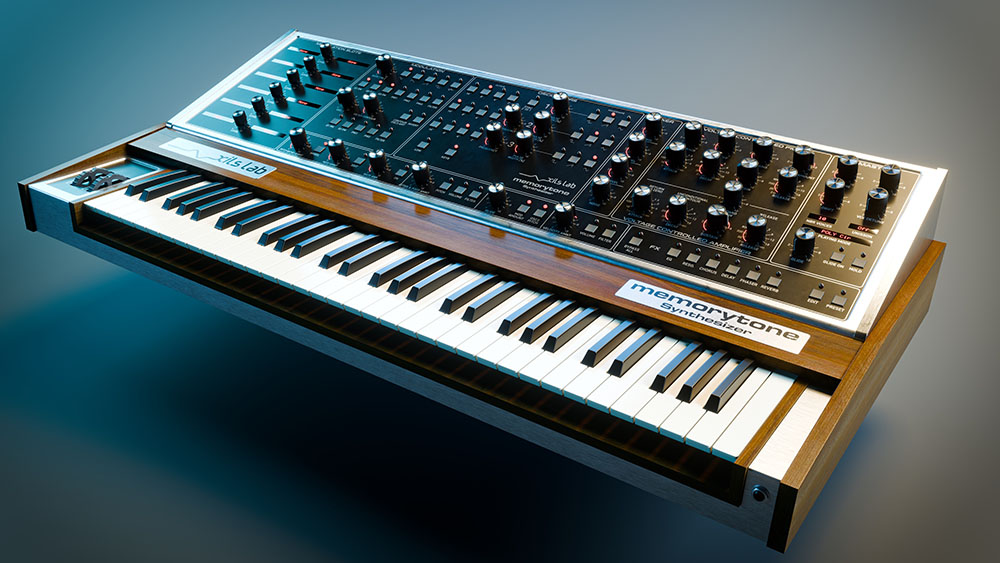
XILS-lab has released MemoryTone, a software synthesizer based on the architecture of the 1982–1985 Moog Memorymoog. MemoryTone expands the original six-voice, three-oscillator-per-voice design to 16-voice polyphony, with up to 18 oscillators available in unison mode, while adding modern modulation, expression, sequencing, and effects capabilities. The original Memorymoog used six independent voices, each with three oscillators, a 24 dB/octave low-pass ladder filter, and two ADSR envelope generators.
Unfamiliar with XILS-Lab? Check our our The Eighty review.
XILS-Lab MemoryTone

The easiest way for electronic musicians to get their music onto Spotify, Apple Music, iTunes, Amazon Music, Tidal, Instagram, Facebook, TikTok, Pandora, Twitch & much more! Click the banner above or the Go Button to save 7% off of your signup! GO!
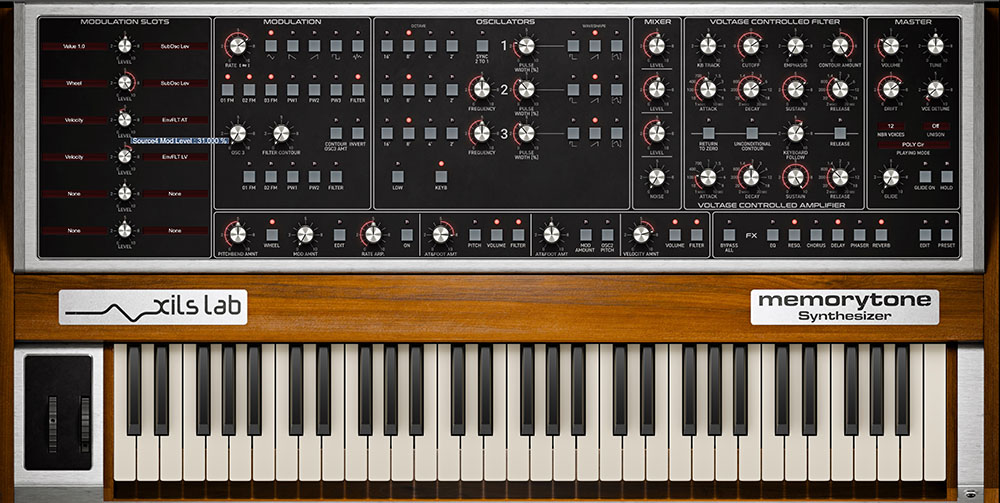
MemoryTone models the interaction between its oscillators, voice-to-voice variation, mixer levels, and filter behavior, including level-dependent drive and saturation in the mixer. The synthesis section provides three oscillators per voice with freely combinable pulse, sawtooth, and triangle waveforms, variable pulse width, oscillator hard sync, independent oscillator 2 and 3 detuning, and a low-frequency mode for oscillator 3. A noise generator is also included.
The filter is a 24 dB/octave self-oscillating ladder filter with keyboard follow and envelope control…
The filter is a 24 dB/octave self-oscillating ladder filter with keyboard follow and envelope control. MemoryTone also models analog drift and voice-to-voice detuning variations. Playing modes include mono, polyphonic, circular polyphonic (POLY cir), and unison, with mono and polyphonic glide.
MemoryTone includes an LFO with a 0.1–100 Hz rate range and triangle, saw up, saw down, square, and sample-and-hold waveforms. Modulation destinations include oscillator FM, pulse width, and filter parameters, with OSC 3 available as a modulation source and dedicated filter-contour modulation.
Additional modulation is provided by six freely assignable modulation slots, polyphonic voice modulation, velocity amount, aftertouch, expression, and MPE (MIDI Polyphonic Expression) support. MIDI Learn is included, and all parameters can be controlled via MIDI.
An advanced arpeggiator provides mono and polyphonic operation, octave extension, broken-chord and random patterns, adjustable gate and swing, and programmable sequencing. The integrated effects section includes EQ, three-band resonator, chorus, delay, phaser, and reverb. Effects can be routed independently for greater control over signal processing.
MemoryTone includes a preset management system that can filter sounds by Bank, Type, Author, Feeling, Style, and Project. The factory library combines recreated sounds associated with the original Memorymoog with newly programmed sounds. The original Memorymoog’s factory programs included contributions from synthesizer programmers including Wendy Carlos, Herbert Deutsch, and Jan Hammer, among others. Jan Hammer also used the Memorymoog extensively on the Miami Vice television series.
MemoryTone is available for modern music production and performance, combining the Memorymoog’s three-oscillator voice architecture and ladder-filter design with 16-voice polyphony, MPE, expanded modulation, sequencing, and integrated effects.