Soma Laboratory Lyra-8 Review
Long-Term Review
The story of the Soma Laboratory Lyra-8 is really a tale about a musician building tools for himself and challenging electronic instrument design. Vlad Kreimer, a musician, sound producer and radio engineer, based initially in Donetsk and later in Moscow, had been constructing synthesizers for his own live performances long before the idea of a commercial product ever entered the picture. His earliest serious build, a handmade eight-bit mono sampler constructed in 1992 from scratch in the wake of the Soviet Union’s collapse, established the ethos that would define Soma Laboratory. Create instruments that don’t exist yet, and do so with emotional intent, instead of technical prowess.
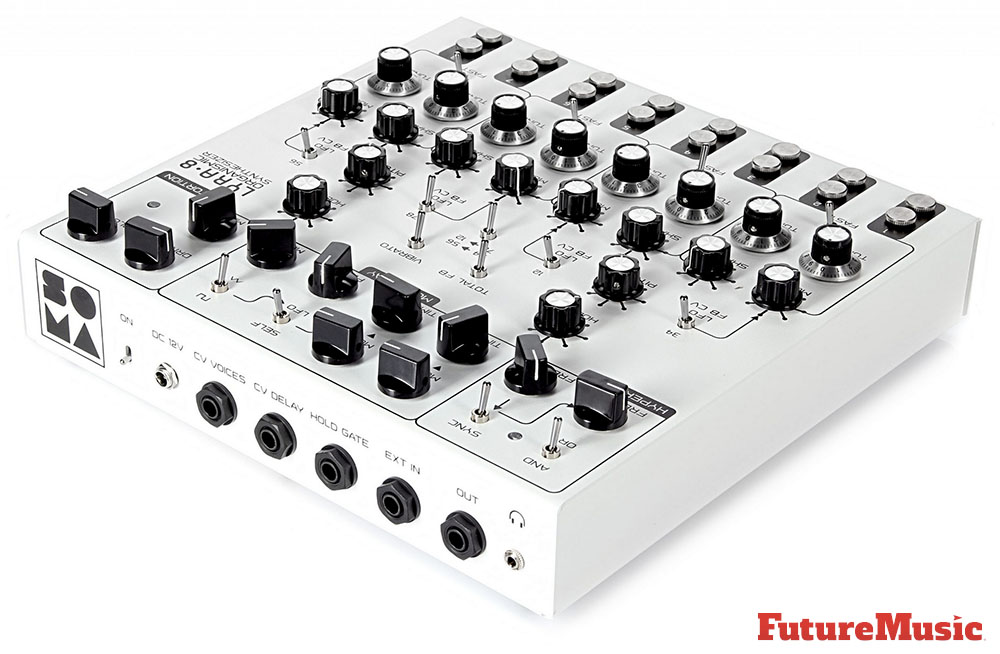
The Lyra-8 drew from Soviet-era engineering, experimental electronic music and Kreimer’s interest in biological systems, resulting in a synthesizer that intentionally resists conventional musical structure. Rather than refining existing paradigms, it discards them almost entirely, positioning itself as something closer to an ecosystem. At its core, the Lyra-8 is an eight-voice analog synthesizer organized into pairs of voices that can interact, modulate and destabilize one another. Each voice is controlled via a touch plate instead of a keyboard, immediately breaking from the expectations of pitch accuracy and predictability. The synthesis architecture is deceptively simple on paper, built around oscillators, modulation and distortion, but the internal cross-modulation and shared controls, not to mention the delay and distortion effects, create a dense web of nonlinear behavior. The voices can be tuned loosely into intervals, but the instrument resists exact pitch relationships, encouraging clusters, drones and evolving harmonic fields rather than structured melodies.
When Kreimer uploaded a demonstration video of the Lyra prototype in 2016, the response from the electronic music community was immediate. He had never thought of himself as a builder of new synthesizers for others, yet the response to that video forced his hand, and Soma Laboratory was born not from a business plan but from a sudden, unanticipated demand. The instrument’s reputation spread rapidly across studios, film scoring suites, modular rigs and the stages of experimental electronic musicians worldwide, including one of our staffers, who made the Lyra-8 his “Covid purchase.” After a lengthy internal discussion about how we’re in “a golden era of gear” at the pub, the conversation fell on the abundance of “unconventional” offerings now available, and specifically what Soma is developing. We decided that the Soma Lyra-8 never got the long-term FutureMusic treatment. After some prodding and too many pints, we got our mate to lend out his Chernobyl Green version to four other evaluators for this extended evaluation. Their comments in quotes below.
Kreimer’s philosophy of “romantic engineering” is not engineering in service of technology. It is engineering in service of emotion, discovery, and what Kreimer calls the natural conversation between a machine’s internal components. The Lyra-8 was the instrument that established this philosophy in the first place and made Soma synonymous with a certain rare quality in contemporary synthesizer design, namely surprise.
Soma Labs Lyra-8 Review
To understand the Lyra-8, one must immediately abandon the familiar vocabulary of subtractive synthesis. There are no voltage-controlled oscillators here in the conventional sense, no filter cutoffs, no resonance knobs, no ADSR envelopes laid out in tidy linear progression. The eight voice generators at the heart of the Lyra-8 derive their character from vintage electric organ tone generators, non-linear, sensitive to component-level variation and deliberately resistant to the kind of precise, repeatable control that defines most contemporary instruments. The sound depends on every part, down to individual resistors, and that unpredictability is a design feature rather than a manufacturing defect.
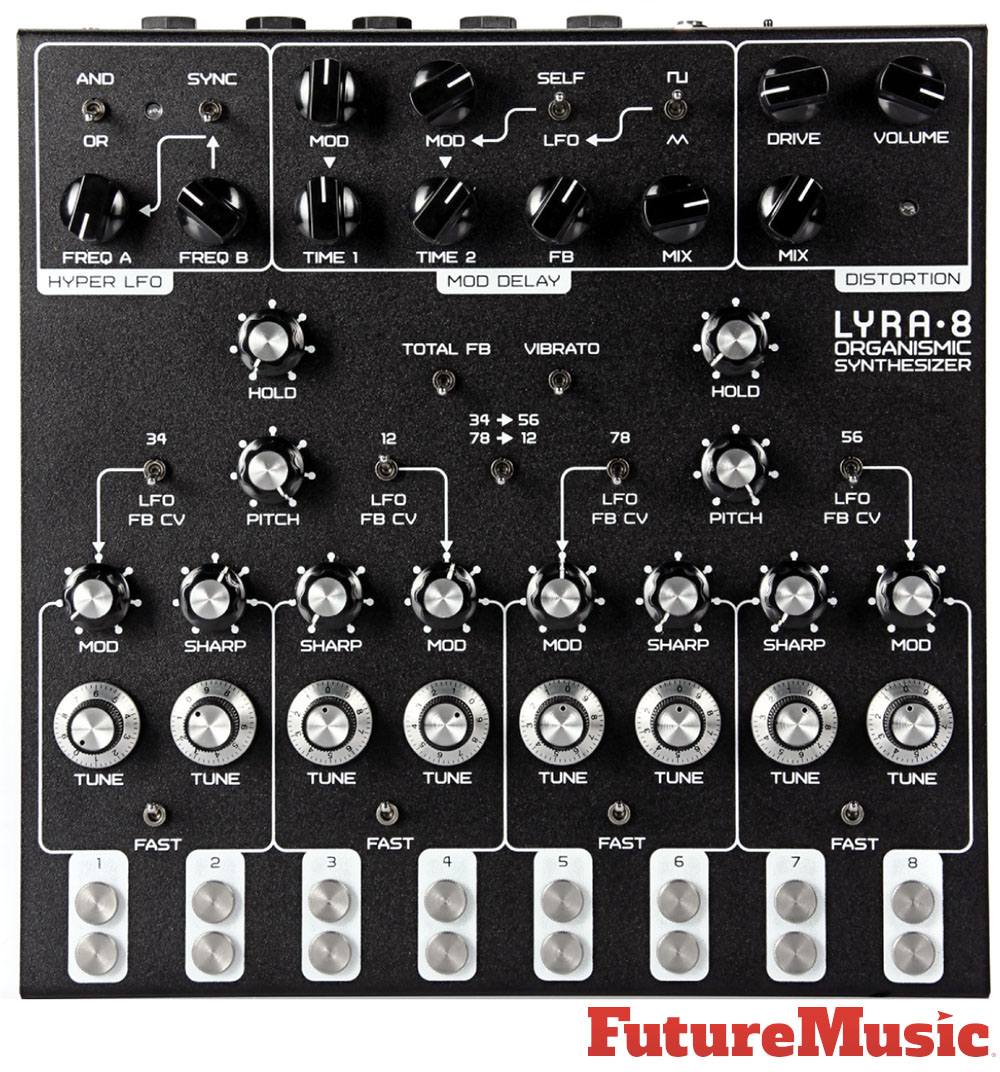
The eight voices are organized into four pairs, 1-2, 3-4, 5-6 and 7-8, and those pairs are further grouped into two clusters of four (1-2-3-4 and 5-6-7-8), creating what Soma describes as a tree-like hierarchical structure that nonetheless enables non-hierarchical feedback relationships, meaning each voice can interact, modulate, and destabilize one another. The voices are triggered via the metal contact sensors at the base of the panel, which respond to the body capacitance of the player’s fingertips. (Or coins for sustain… — Ed).

The easiest way for electronic musicians to get their music onto Spotify, Apple Music, iTunes, Amazon Music, Tidal, Instagram, Facebook, TikTok, Pandora, Twitch & much more! Click the banner above or the Go Button to save 7% off of your signup! GO!
The voices being controlled via the contact patches instead of a keyboard, immediately breaks from the expectations of pitch accuracy and repeatability. The synthesis architecture is deceptively simple on paper, built around oscillators, modulation and distortion, but the internal cross-modulation and shared controls create a dense web of nonlinear behavior. The Lyra-8 can be tuned to any temperament, microtonality, or drone cluster. However, the instrument resists exact pitch relationships, encouraging evolving harmonic fields rather than structured melodies. All of our reviewers employed a guitar pedal with tuning capabilities, with the Meris LVX being a favorite, when they wanted to tune the Lyra to a particular key.
The effects section is not an afterthought, but a central component of the Lyra’s identity. The built-in delay is a wide-ranging, analog-style circuit capable of everything from subtle spatial thickening to unstable, self-oscillating feedback loops. It is paired with a distortion stage that can push the signal from gentle saturation into aggressive, “almost collapsing textures.” What makes the Lyra’s architecture unique is that the effects are deeply integrated into the signal path rather than treated as post-processing, meaning they actively shape the behavior of the instrument rather than simply decorating it. The delay in particular becomes part of the instrument’s feedback ecosystem, allowing sound to “fold back into itself” and interact with newly generated material in unpredictable ways. Let’s take a closer look at the effects section and what makes it special.
The effects section is not an afterthought, but a central component of the Lyra’s identity…
The Mod Delay is described by Soma as “approximately two-thirds analog.” This is an interesting claim for an analog instrument, and one that speaks to the modifications required to achieve its particular behavior. It consists of two independent delay lines sharing a common cross-feedback path, meaning the output of each line feeds back into the other, creating resonant interactions between them. Each delay line has its own modulation depth control, and the sources available for that modulation are the Hyper LFO (in either its square or dual-triangle form —Ed.), external CV signals, or the output of the delay line itself. That last option is the self-modulation mode, in which the delay’s own audio output is used to vary the sample rate of the delay clock, effectively making the delay a feedback oscillator that sculpts itself in real time. The sonic results range from “gentle pitch-shimmer” and “flanger-like coloration” at subtle settings to “churning, resonant walls of degraded audio that behave almost like a separate instrument when driven hard.”
The delay is deliberately Lo-Fi. Noise at long delay times is not only quite apparent, but openly embraced by Kreimer. He feels that the noise itself generates interesting soundscapes when combined with feedback, LFO modulation and self-modulation. The cross-feedback architecture means that the two delay lines are not simply parallel paths but mutually influencing circuits, capable of entering states of resonance that produce pitched, sustained tones from pure feedback, again, functioning as an additional voice when pushed into self-oscillation. For ambient, drone, and experimental music production, this is not a limitation but a core expressive resource. That said, as mentioned above, our reviewers found that employing a guitar pedal out of the Lyra-8 can “soften the noise” or provide “more controllable reverb or delay.”

Native Instruments Absynth 6 Review
Native Instruments has successfully rebooted Absynth in many positive ways and laid the foundation for the next generation of users. Native Instruments Absynth 6 Review
Following the delay in the signal chain is the distortion. This is noteworthy because the full character of the delay, including its noise, its resonances, and its self-oscillation behavior, is passed into the distortion circuit rather than simply the dry synth signal. The Drive control increases harmonic content and crunch, while the Mix knob blends the distorted signal with the incoming clean material. This post-delay distortion architecture is unusual in the synthesizer world and produces results that are equally unconventional.
The external input jack, located on the rear panel, feeds into the signal chain before the delay and distortion sections, meaning the Lyra-8’s effects chain can be applied to any external source…
When the delay is in a state of complex feedback and the distortion is engaged, the interaction between the two stages generates textures that no single-effect chain could replicate. Multiple reviewers have noted that the distortion “operates across the full frequency spectrum” rather than “biasing toward midrange fuzz,” preserves “low-frequency weight” even under heavy drive, and has a “subtle low-pass characteristic” that prevents the aggressive brittleness common to many digital distortion units.
The external input jack, located on the rear panel, feeds into the signal chain before the delay and distortion sections, meaning the Lyra-8’s effects chain can be applied to any external source. A “superpower” that “adds charisma” to drum machines, modular or Eurorack setups, another synthesizer, and anything else you can feed into it, yielding the “same transformative character” it applies to its own output. In fact, Lyra’s effects are so distinctive and powerful that Soma extracted it and sells it as a standalone Eurorack module, the Lyra-8 FX, in direct response to users who wanted to apply its character to external sources.
A consistent picture emerges of the Lyra-8 by our evaluators as an instrument that is both “deeply inspiring” and “deliberately uncompromising.” Many evaluators describe it less as a synthesizer and more as a “living organism.” That description might sound exaggerated until one interfaces with the cross-modulation between voices, combined with unstable tuning and shared control parameters, creating conduct that cannot be easily predicted or replicated. This is not merely randomness, but analog instability shaped by volatile interaction, which gives the instrument a sense of continuity and internal logic even when it behaves erratically.
The touch interface is another defining element that consistently receives good and bad feedback. On a technical level, it removes velocity sensitivity, discrete note triggering, and traditional articulation in favor of continuous contact-based control. This results in a playing experience that feels immediate and tactile, but also imprecise. Our testers that celebrated the Lyra-8 tend to emphasize this immediacy, noting how quickly it leads to “expressive, evolving soundscapes.” More critical perspectives point out that this same design makes it “difficult to execute intentional harmonic ideas,” especially in contexts that “require repeatability” or “integration with other instruments.”
Soma Lyra-8 Specs:
- Max output voltage: 2 v 0-to-peak
- Output: Mono 1/4″/6.3 mm TS or TRS (balanced) jack
- Output resistance: 100 Ohm
- EXT IN: 1 v 0-to-peak
- EXT IN connector: 1/4″/6.3 mm TS jack
- HOLD GATE: full HOLD volume +5 V
- HOLD GATE connector: 1/4″/6.3 mm TS jack
- CV DELAY : unipolar, range of 0 to +5 volt
- CV DELAY connector: 1/4″/6.3 mm TS jack
- CV VOICES: unipolar, range of 0 to +5 volt
- CV VOICES connector: 1/4″/6.3 mm TS jack
- Power Supply: +12 V, 0.2 A, centre positive
- Power Consumption: 2 watt
- Dimensions: 266 x 266 x 62 mm
- Weight: 2.5 kg

Support Ambient Music
StretchMetal and the Atmospheric Music Alliance are raising $5000 to support ambient music events taking place across the United States, and virtually with the Atmospheric Music Alliance. Contributions will go directly toward artist and venue fees, production support and the continued development of AMA. Please consider donating today!
The Hyper LFO’s contribution to the “organic quality of the sound” is significant. Because its waveform is synthesized rather than selected from a fixed set of shapes, even “small movements of the two frequency knobs produce dramatically different modulation patterns.” At slow rates, it imposes a “hypnotic rhythmic pulse on the voices and delay.” At faster rates, it begins to enter audio-frequency territory, “adding FM-like sidebands to whatever it modulates.”
The Lyra-8 “succeeds brilliantly on its own terms,” but those definitions are narrow in ways that limit its broader utility…
There are, however, recurring points of friction that appear across multiple reports. The Lyra-8 “succeeds brilliantly on its own terms,” but those definitions are narrow in ways that limit its broader utility. The most significant omission is the lack of any robust system for pitch organization. While the instability of tuning is central to the instrument’s character, the complete absence of scalable or constrainable pitch relationships forces the user into an experimental space and limits the instrument’s applicability in structured musical contexts.. A more flexible approach that allows optional quantization or interval locking would not undermine the instrument’s philosophy, but would expand its range considerably.

The touch plates provide a binary sense of contact rather than a rich spectrum of pressure or position data, which limits expressive control compared to more advanced tactile interfaces. The lack of patch memory is often cited, though this is clearly an intentional design decision rather than an oversight. These criticisms are technically accurate, but they must be understood within the framework of the instrument’s goals, which prioritize exploration over control.
With all the glorious evolving sounds and textures, the Lyra-8 is unfortunately mono…
Furthermore, the absence of MIDI limits integration flexibility. The noise floor demands noise gating for clean studio work. The lack of patch memory imposes a discipline of documentation that many users will find “burdensome.” Finally, with all the glorious evolving sounds and textures, the Lyra-8 is unfortunately mono.
Conclusion
The Lyra-8 is not a general-purpose synthesizer, and evaluating it as one would be a mistake. The build-quality is “off the charts” with an all-metal enclosure, robust switches, beefy knobs and hearty I/O. Weighing in at 2.5 kilograms, the Lyra-8 has the “physical authority of laboratory equipment,” rather than consumer electronics. The control knobs have a tactile weight and precision that invites the kind of slow, deliberate manipulation the instrument rewards. It is a highly specialized instrument designed to explore a particular relationship between human input and sonic emergence. For ambient, drone, dark atmospheres, experimental electronic, industrial, sound design and some film scoring applications, the Lyra-8 has been holding court for almost ten years. Its capacity to generate slowly evolving, textural, emotionally charged material that feels genuinely alive may be the sonic experience you’re looking for when contemplating a synth of this nature.
At the same time, its limitations are real and significant. It is difficult to integrate into structured musical workflows, challenging to control with precision, and resistant to replicating a performance, which is why “you may want to continually record the output every single time you get your hands dirty.” Based on the user’s expectations, these characteristics and attributes will either be the Lyra-8’s greatest strengths, or its most frustrating weaknesses. Vlad Kreimer did not set out to build a better synthesizer. He set out to build a different kind of thing entirely, something whose internal logic resembles a living organism’s more than a machine’s, and he succeeded. Recommended.
Soma Labs Lyra-8 costs €670 / $800 and is available now.
Price Note: Current net price excludes VAT, shipping, customs and transfer fees.
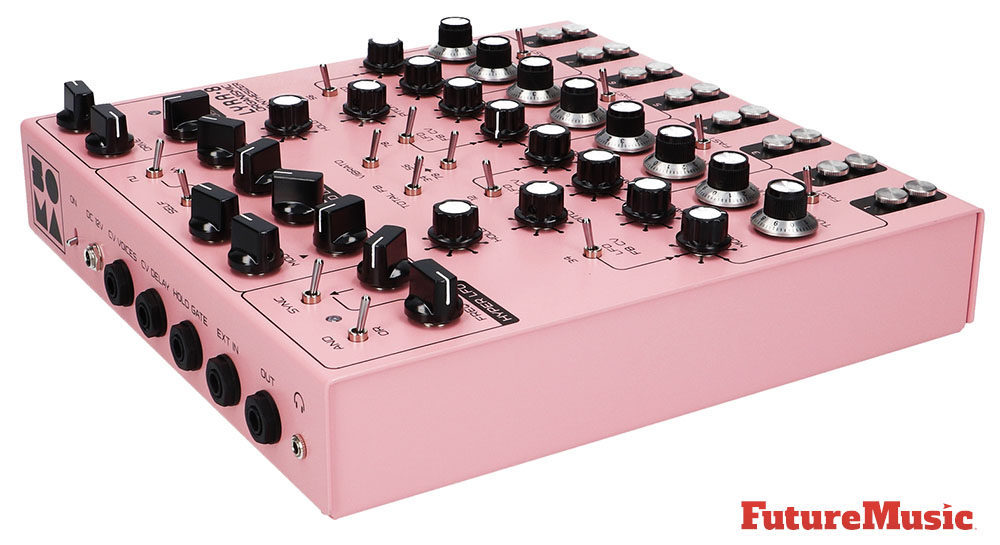
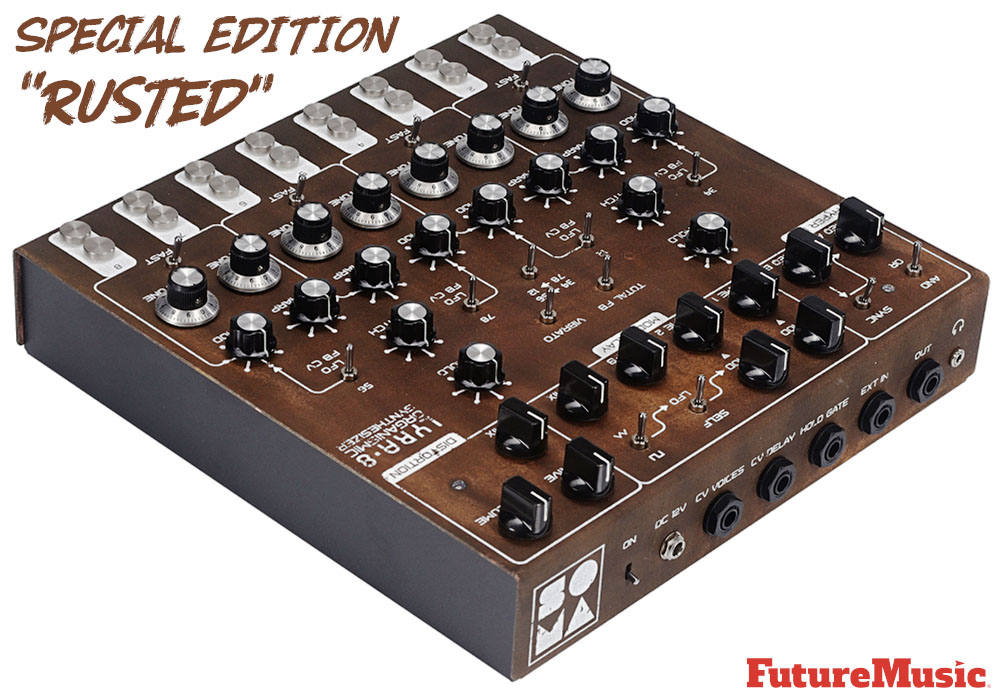
Lyra-8 Colors: White, Pink, Chernobyl Green, Black, Blue, Orange and Rusted
Accessories: Plastic cover – €50 / Cotton cover – €15 / Soft case – €50 / Hard case: €340.
Cheers:
+ Genuinely unique sound architecture derived from vintage organ tone generators, producing a richness and organicism unavailable on any comparable instrument.
+ Eight-operator FM synthesis with analog nonlinearity generates spectral complexity that evolves continuously rather than in discrete steps.
+ Touch sensors respond to pressure, speed, duration, and environmental factors, creating an intimate and deeply expressive performance interface.
+ Hyper LFO synthesizes its modulation waveform from two interacting square-wave oscillators, making the modulation engine itself a source of complex, irreducible behavior.
+ Mod Delay featuring cross-feedback, self-modulation, and mutual resonance between two lines.
+ Post-delay distortion creates unique interactive textures by processing the full character of the delay output rather than the dry signal alone.
+ External input jack allows the effects chain to be applied to any audio source, functioning as a standalone effects processor of remarkable character.
+ Exceptional build quality all-metal enclosure, substantial weight, high-quality knobs, and a physical durability commensurate with professional use. (Literally, the best we’ve ever seen. —Ed.)
Jeers:
— Mono Audio Output
— No Patch Memory
— High Noise Floor across
— Steep Learning Curve
— No MIDI Implementation or Clock Sync
— Headphone Output Even Noisier Than Main
The Future: A future iteration of the Lyra-8 could retain its core identity while introducing selective layers of control that expand its usability without diluting its philosophy. The core architecture must be preserved: the organ-derived voice generators, the non-linear FM routing, the body-capacitance touch interface, and the post-delay distortion chain are not merely features but the soul of the instrument. Any revision that compromised them in the name of modernization would produce a lesser instrument by any meaningful measure. What the next Lyra needs is not a redesign but a thoughtful expansion of its practical intelligence without sacrificing its philosophical identity.
The addition of optional pitch stabilization, more expressive touch sensitivity, and MIDI implementation would allow the instrument to operate in a wider range of musical contexts. Enhancements to the effects section, particularly in terms of controllability and modulation, could further refine its already strong sonic capabilities. The goal should not be to tame the instrument, but to give the user more ways to engage with its inherent unpredictability. And, of course, moving from mono to full stereo.