Native Instruments Absynth 6 Review
Long-Term Review
To understand what Native Instruments release of Absynth 6 a couple of months ago means to the music community, you first need to understand how the impact the soft synth made when it first debuted in 2000. Self-taught software developer and composer Brian Clevinger released the first version of Absynth as a free download from his own website, operating under his Rhizomatic Software Synthesis moniker. This was not a time when soft synths were nearly as prevalent as they are today. VST plug-in technology had only been invented four years earlier, and the available virtual instruments were mostly rudimentary imitations of classic hardware. Absynth was something else entirely and it immediately captured the imagination of the industry.
After being electrified by the possibilities of SuperCollider in the mid-1990s, Clevinger started teaching himself DSP programming. He wanted to build something that bridged the divide between modular synthesis, immediate playability and unbridled by conventional workflows. What emerged was Absynth: a semi-modular synthesizer built around three oscillator channels, each capable of adopting radically different synthesis modes, each fed through a chain of processing modules before being combined into a master bus of effects. The engine blended subtractive, FM, ring modulation, granular, and sample-based synthesis in a single patch architecture that no other instrument matched at the time. It was, by any honest measure, extraordinary and it captured the imagination of the burgeoning computer music community.
Absynth 6 Review

The easiest way for electronic musicians to get their music onto Spotify, Apple Music, iTunes, Amazon Music, Tidal, Instagram, Facebook, TikTok, Pandora, Twitch & much more! Click the banner above or the Go Button to save 7% off of your signup! GO!
The response was immediate and according to Clevinger, overwhelming. He was suddenly inundated with messages from producers, composers and sound designers who found in Absynth something they could not find elsewhere. Absynth’s sounds felt alive, textures breathed and shifted, pads of such luminous depth that they seemed to contain entire worlds. If fact, Absynth quickly distinguished itself from anything available at the time by rejecting subtractive orthodoxy in favor of an architecture built for evolving textures, cinematic soundscapes and experimental synthesis. Within a year, Native Instruments had recognized what Clevinger had built, and in 2001, under the company’s then-founder Stephan Schmitt, NI acquired the distribution rights to Absynth. Clevinger remained the chief developer, and the partnership that would shape Absynth through five major versions was born.
Few software instruments carry the same mystique as Absynth…
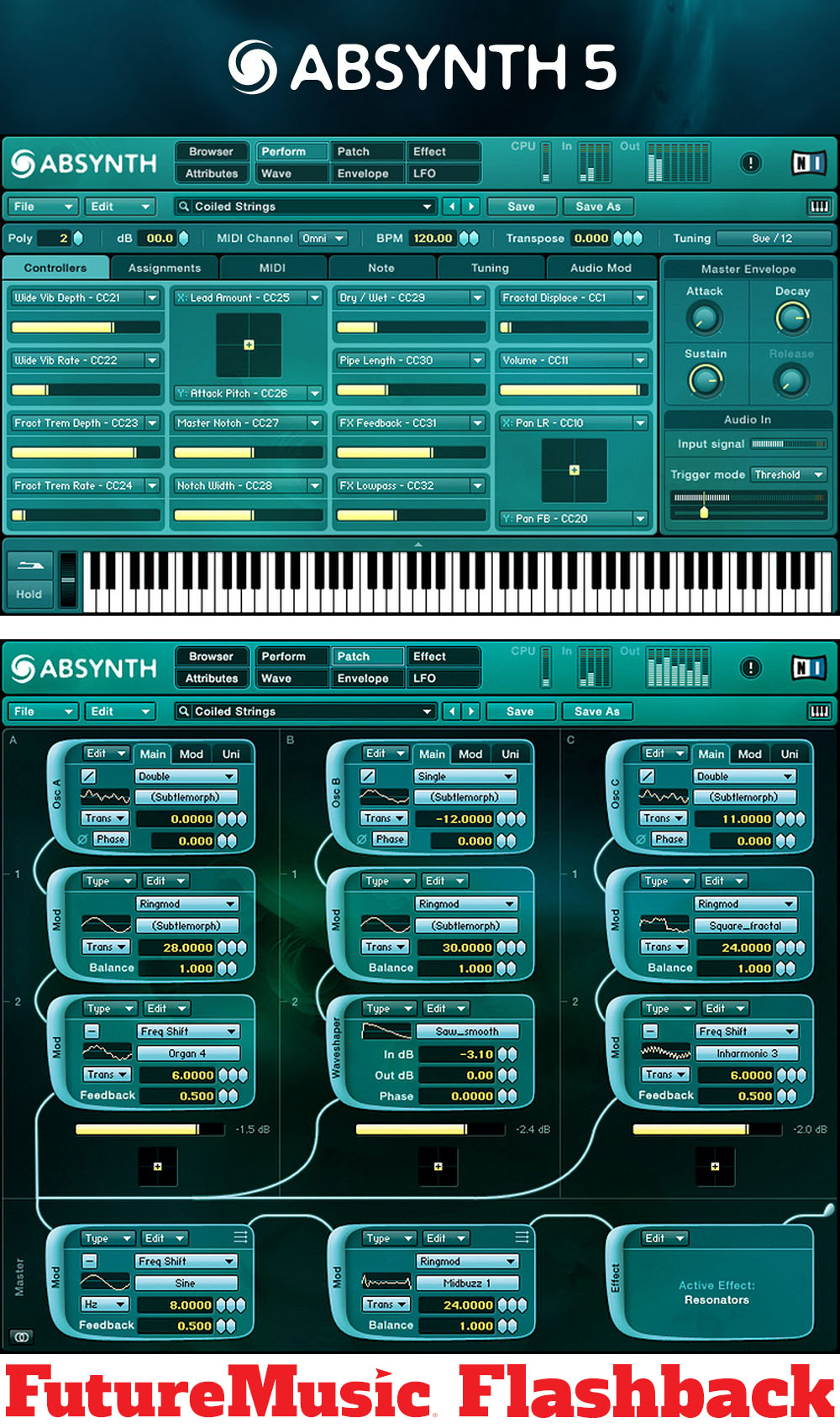
Over the following decade, Absynth evolved steadily. Each version deepened its synthesis architecture, expanded its effects suite, and somewhat refined the interface. Absynth’s UI, a glowing, acidic green that looked simultaneously futuristic and hostile, dense with tiny hexagonal controls. It looked like something that you’d find in the cockpit of a Predator or Alien movie. It still maintained a learning curve that rewarded patience, but intimidated newcomers. Version 3.0 introduced the custom waveform editor and deepened the modulation routing. Version 4.0 brought further depth to its oscillator palette. And then, in 2010, Absynth 5 arrived and it really came into its own.
With version 5.0, the 68-segment multi-stage envelope generator gave users even more control over the evolution of sound over time. The Mutator, Absynth’s take on parameter randomization, allowed users to blur and blend preset characteristics in ways that felt genuinely compositional. The effects suite, centered on the Aetherizer granular processor, the Multicomb resonator, and the Cloud filter, produced results of timbral complexity. Artists from Brian Eno to Hans Zimmer and the composers of countless film scores and electronic albums built their most otherworldly sounds with Absynth. The industry whispered about it like a secret weapon.

Meris Enzo X Review
The Enzo X guitar pedal synth is ambitious and versatile, its effects engine broad and musical, and its connectivity and control make it suitable for modern performance and production environments. Is it worth the your money? Find out! Meris Enzo X Review
By 2010, NI’s corporate attention had shifted toward newer ventures, including Komplete bundles, Maschine hardware, Kontakt libraries, Massive and other ventures. Absynth, sat dormant practically forgotten, receiving no meaningful updates for over a decade. The market moved on to exciting new products. Serum rewrote expectations for wavetable synthesis. Vital offered comparable depth at no cost. Pigments and Phase Plant demonstrated that deep, semi-modular engines could have intuitive and modern workflows. Absynth’s aging codebase became a technical liability when Apple Silicon Macs arrived. Absynth could not run natively on them, and in 2022, Absynth was quietly discontinued.
The outcry from the community was immediate and genuine. Clevinger himself released a video statement expressing his willingness to update the instrument if Native had only asked. But the damage was done and parts of the Native fanbase voiced their dismay, loudly.
With the constant din of distraught users showing no signs of abating, Native Instruments quietly assembled a small team and reached back out to Clevinger to see if he was interested in a collaboration that had the German company’s full backing. Native starting teasing social media and the interwebs with a “6” in Absynth’s signature alien-green color and confirmed what many had hoped but few had expected: The comeback was on.
On December 9, 2025, Absynth 6 was officially released and we started our long-term test with the venerable software with five evaluators. Their comments in quotes below.
Absynth 6 Features:
- Hybrid Synthesis Engine: A three-channel, semi-modular engine combining subtractive, FM, wavetable, granular, and sampling techniques, allowing for complex, multi-layered sounds.
- Advanced Envelope System: Features a 68-point envelope system with looping, breakpoints, and time-sync capabilities for highly complex, evolving textures
- MPE and Expression Support: Full MIDI Polyphonic Expression (MPE) and polyphonic aftertouch support allow for highly expressive performances
- Modernized Preset Browser: An AI-powered, visual browser that makes searching for sounds faster, with over 350 new factory presets, bringing the total to over 2,000
- Mutator and Sound Generation: Includes a Mutator feature that allows users to quickly generate and randomize presets for instant, fresh sonic textures
- Updated Effects and Surround Sound: Includes powerful creative effects like Aetherizer and Cloud Filter, with support for up to eight-channel surround sound, allowing for immersive 360-degree sound design
- Improved Sample Editor: A revamped sample editor provides precise control over playback modes, loop points, and wave-morphing
- Surround: Built-in support for multichannel surround spatialization
Microtuning: MTS-ESP for microtuning capabilities - Backward Compatibility: Fully compatible with all previous patches and presets
- Presets: 2,000+ factory-built presets, including 350 new sounds
The core architecture of Absynth 6 maintains the semi-modular, three-channel framework that defined previous versions. Each of the three oscillator channels offers a choice of nine synthesis modes: Single waveform, Double waveform, FM, Ring Modulation, Fractalize, Sync Granular, Sample, Granular and the Audio Input mode that allows users to process external signals through the engine. Each channel feeds through two insert processing modules before the master bus adds a further pair of processors and a dedicated effects slot. The processing modules offer thirteen filter models alongside modulators including a frequency shifter, ring modulator and waveshaper.
What is new in version 6 begins with the rewrite of the codebase, which was rebuilt around a modern plug-in framework, while the essential character of the synthesis engine was preserved with “increased fidelity.” The User Interface (UI) is entirely reimagined, but still unmistakably Absynth green. It’s now rendered with subtlety, clarity, and the kind of visual hierarchy that “makes extended editing sessions a pleasure.” Circular knobs have replaced the tiny hexagonal controls of previous versions, contrast and “legibility have been dramatically improved,” and the entire interface is now fully scalable for HiDPI displays.
The Granular engine has been significantly enhanced, with a four-fold increase in the maximum number of simultaneous grains enabled by modern computing power, producing “thicker, richer granular textures” than were possible in version 5. The filter section has been augmented with a new suite of ladder filters in low-pass, high-pass, band-pass, and notch configurations, adding an analog-like warmth and character to the processing palette. The original Absynth filter models are preserved as legacy options, with a new pair of Feedback Filter models extending the resonance-driving capabilities that some legacy filters previously offered. MTS-ESP support for global microtuning has also been added, broadening Absynth’s appeal for microtonal composition and alternative tuning systems.
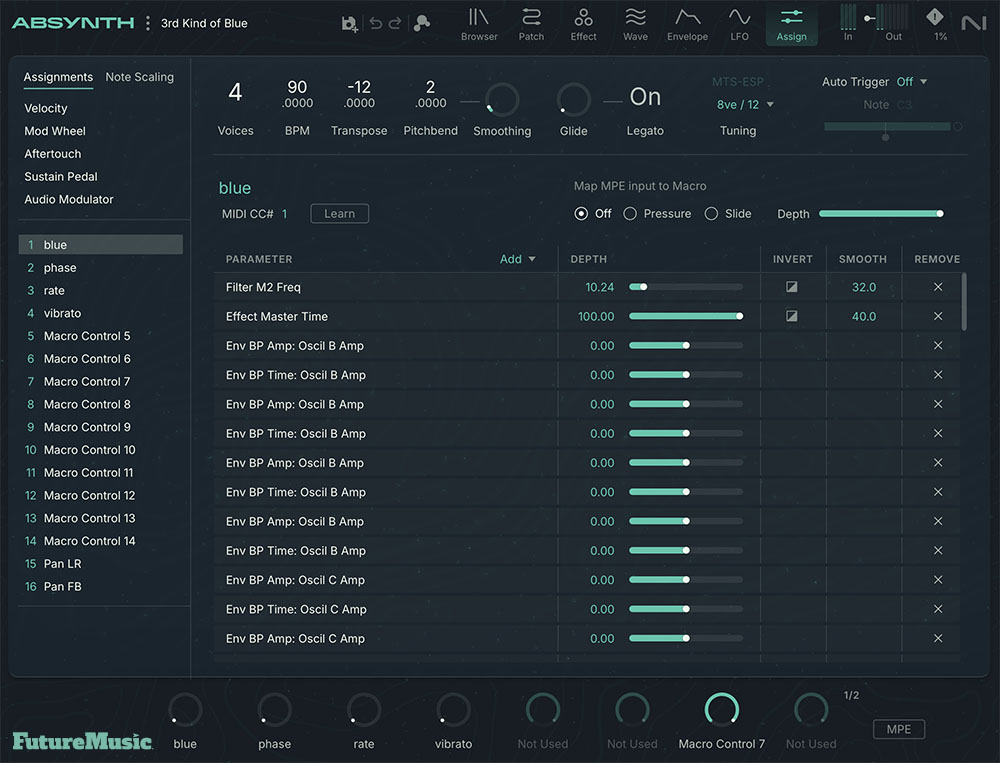
MPE and polyphonic aftertouch support represent a significant performance upgrade, allowing MPE-capable controllers to apply per-note expression, including pitch slide, pressure, and other dimensions, independently across Absynth’s synthesis parameters. Sixteen macro controls now provide a layer of quick performance and automation access that was previously absent. The surround sound engine has been extended to support up to eight-channel formats, including quadraphonic, 5.1, and octaphonic configurations, with per-effect spatial placement. This is a huge win for composers working in immersive audio formats.
One of Absynth 6’s greatest achievements is that it manages to feel both familiar and new.
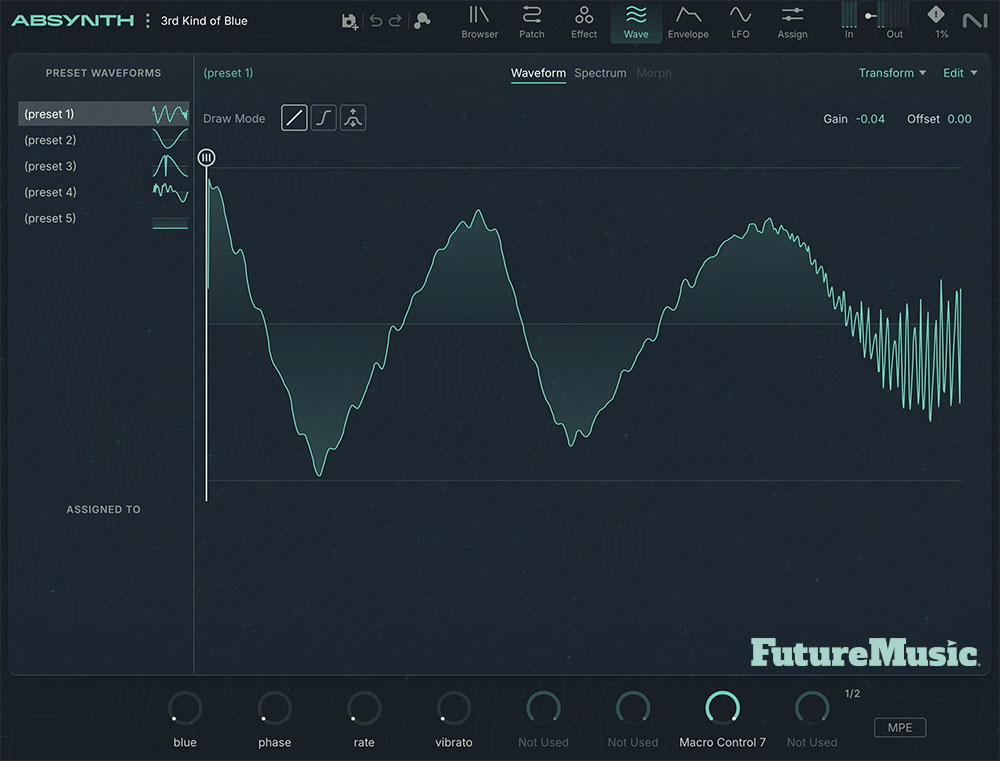
The Absynth FX plug-in, a companion to the main synthesizer, makes the entire effects suite available as a standalone insert in any signal chain, transforming Absynth’s processors into a versatile effects tool for sculpting any audio. This is “a brilliant inclusion,” stated one of our enamored reviewers, and “should be touted more in NI’s marketing.” The Mutator has been refined with cleaner UI, improved target and strength control and a persistent Mutation History. The wave editor has been refreshed to make custom waveform creation more accurate and precise, although users can’t import or export their creations.
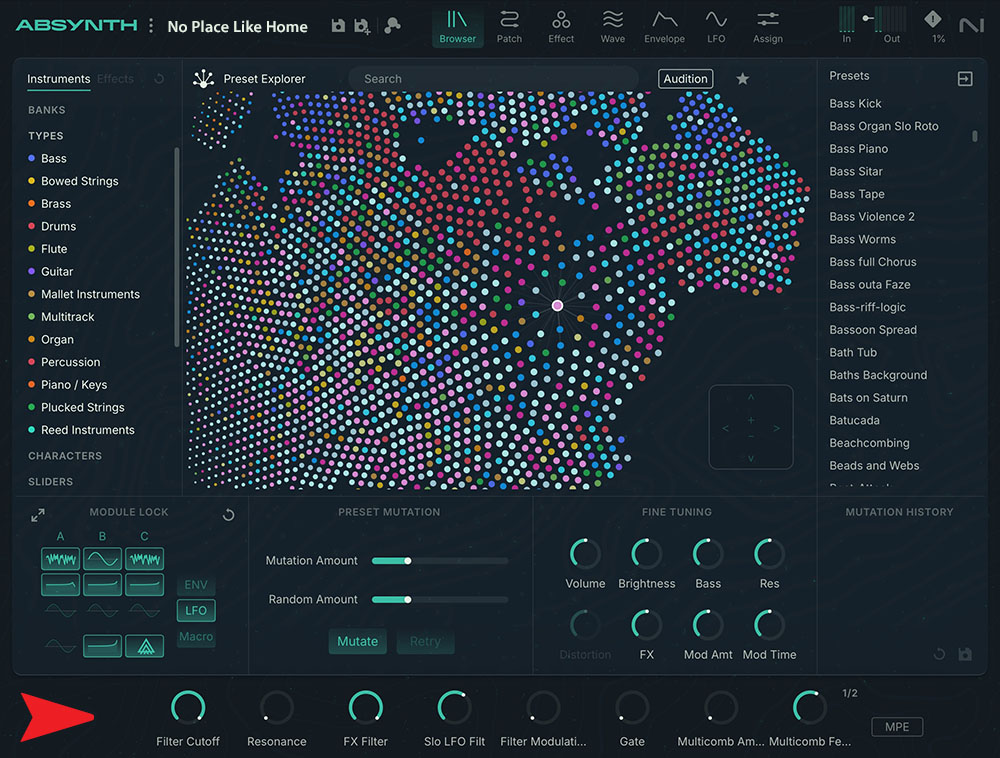
The new Preset Explorer has been one of the most discussed new features of the release. It presents the entire library as a fun celestial map, placing sonically similar presets as neighboring nodes in a visual constellation that users can navigate freely, filtering by character type and zooming into specific sonic neighborhoods. It is presented as being AI-driven, but “it doesn’t feel very liquid, considering recent LLM advancements, and is more marketing since the timbal analysis was done only once by AI, and then set in stone.”
Loading Absynth 6 for the first time is an experience that carries a particular emotional weight for anyone who spent time with any of its predecessors. The interface is simultaneously familiar and transformed. The characteristic green is still there, but “it has shed the harsh, retina-scorching brightness” of version 5 in favor of something altogether more muted and sophisticated. Circular knobs with clear labeling have replaced the “somewhat annoying” small hexagonal controls that veterans tolerated and newcomers frequently lambasted. “The [UI] transformation has been executed with commendable care.”
The opening screen is the Preset Explorer, and “it is genuinely one of the most engaging preset navigation systems I’ve encountered” in a commercial synthesizer. Rather than presenting a scrolling list organized by category and subcategory, the Explorer renders the entire library as a visual map of nodes, each representing a preset, positioned in proximity to other presets of similar timbral character by an AI analysis of the sounds. The result is navigation by feel rather than vocabulary. You drift toward a cluster, hear a preview on click, follow neighboring nodes toward something new.
“The Preset Explorer is genuinely one of the most engaging preset navigation systems I’ve encountered…”
The Character slider adds a further dimension of filtering, narrowing the celestial body to presets matching selected qualities. For example, manipulating the darker, brighter, denser, more sparse, etc. sliders morphs the constellation in real time to rearrange itself. “It’s fun and engaging,” cites one reviewer, “and hasn’t gotten old.” The Mutator remains available within the browser context, and the Mutation History continues to build a saved library of variations as you spend more time with Absynth. Taken together, “these tools create a browsing and discovery experience that is difficult to match” among the current generation of software instruments.
Absynth 6’s synthesis architecture will feel immediately familiar to anyone who worked with version 5, and that is precisely the goal. The decision was made to preserve the engine’s essential character while improving it rather than replacing it. The three oscillator channels remain the structural heart of every patch, and the range of synthesis modes available within each oscillator gives the instrument a breadth of timbral starting points that few competitors match in a single slot.
Native Instruments Absynth 6 Specifications:
- Apple System Requirements: macOS 14, 15, 26 (latest update)
- Windows System Requirements: Windows 10 or 11 (latest Service Pack)
- CPU: Intel Core i5 or equivalent CPU, or Apple Silicon
- RAM: 4 GB (6 GB recommended)
- Hosts: Runs in 64-bit VST3, AU, and AAX
- Graphics: OpenGL 2.1 or higher / DirectX 9 or 11
- Hardware Integration: Kontrol keyboards and Maschine via Komplete Kontrol and Maschine software*
- Full MPE and polyphonic aftertouch support
- MTS-ESP support for real-time microtuning and alternate tunings
- Supports ASIO, Core Audio, and WASAPI
* Your mileage may vary.
The FM engine, offering two operators and smooth, clean modulation, produces the classic digital warmth and bell-like resonance that FM synthesis is known for. The Ring Mod mode creates the harsh, metallic partials that define industrial and experimental textures. One of Absynth’s more distinctive inventions, the Fractalize engine takes a waveform and superimposes copies of itself along the waveform’s contour, iterating up to seven times to produce self-similar, fractal harmonic structures of increasing complexity. The granular engines, both the standard Granular and the Sync Granular mode, benefit most obviously from the version 6 improvements. The aforementioned increase in maximum grain count, provide granular textures have a density and richness that was simply not achievable before, and the Granular Engine itself is now described by Clevinger as sounding the way he always intended it to from the beginning.
The insert processing modules that follow each oscillator channel are where Absynth’s genuine semi-modular character asserts itself. The new ladder filters carry an analog-like resonance and warmth that adds a dimension of organic quality to what is otherwise a distinctly digital instrument. The Cloud filter, a granular processing unit that smears audio into dense, comb-filtered haze, remains one of the most singular processing modules in any soft synth. “Pairing a fractalize oscillator with a Cloud filter in the insert slot and feeding the result into an Aetherizer effect produces sounds that bear essentially no resemblance to anything else a synthesizer can generate.”
The result is that any parameter in Absynth can be made to evolve over time with a specificity and nuance that “completely transforms synthesis.”
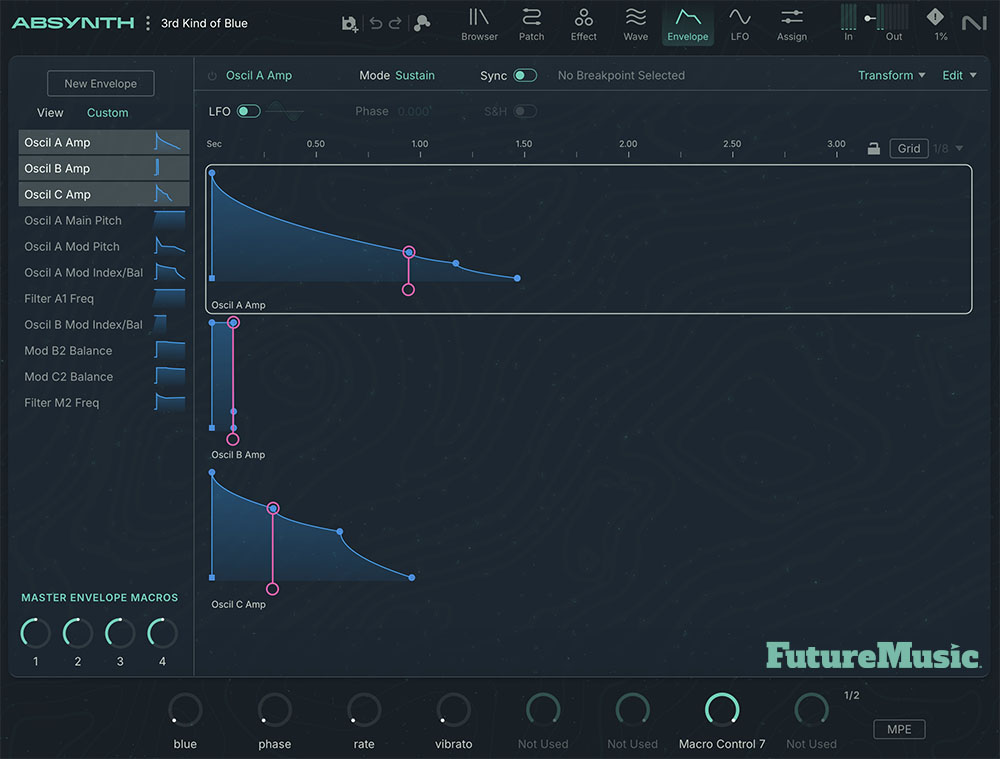
If there is a single feature that explains why Absynth has retained a devoted following despite a decade of neglect, it is the multi-stage envelope system. The 68-segment breakpoint envelope, which legend has it was named in homage to the 68-point score of absinthe liquor’s reputation, offers a degree of control “that relegates the standard four-stage ADSR to the category of charming primitiveness.” Each segment can be assigned an independent curve shape, looping behavior, time-synchronized transition, and breakpoint position. The result is that any parameter in Absynth can be made to evolve over time with a specificity and nuance that “completely transforms synthesis.”
Brian Eno’s longtime use of Absynth’s long, out-of-sync looping envelopes where each parameter evolves on its own timeline to create continuously changing soundscapes is now more accessible than ever. The separate Envelope and LFO pages in version 6 reflect the philosophy with which NI and Clevinger approached modulation design. “The manner in which you can control the envelopes is really the primary creative juice of the instrument,” reflects one tester. With version 6, twelve standard envelope shapes are available with vast customization, and LFO shapes are similarly configurable. The addition of MPE and polyphonic aftertouch support extends this modulation richness to the performance dimension. Individual notes can now be filtered, pitched, or amplitude-shaped independently through MPE control.
The factory library of over 2,000 presets includes all legacy patches from previous Absynth versions alongside 350 new creations…
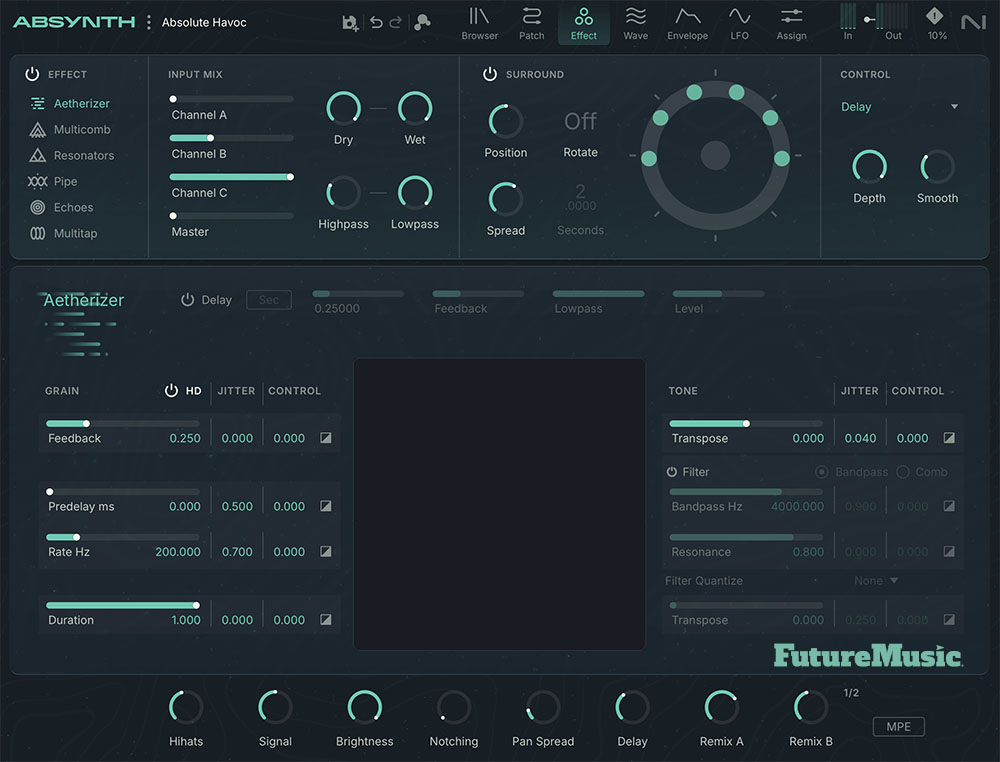
Absynth’s six effects, the Aetherizer, Multicomb, Pipe, Resonators, Echoes and Multitap, remain with some enhancements. The Aetherizer, which uses granular processing to transform any sound into shimmering, atmospheric waves, is still one of the most distinctive effects in Absynth. The Multicomb resonator and Pipe effects “create spatial depth and complex comb-filtered coloration that is uniquely Absynth.” The surround sound extension to octaphonic now allows each effect to occupy its own position in a three-dimensional spatial field, “a great addition for immersive audio work.” The companion Absynth FX plug-in, a standalone version of the effects suite, is one of the “most useful additions of the entire release.” And it resolves a long-standing frustration of the single effect slot limitation of each patch. CPU performance is reasonable for the complexity the effects offer, though very dense granular patches and high polyphony can push modern systems.
The factory library of over 2,000 presets includes all legacy patches from previous Absynth versions alongside 350 new creations from a team of noted sound designers, plus exclusive contributions from Brian Eno, Kaitlyn Aurelia Smith and the obligatory Richard Devine. The library showcases Absynth’s core competencies, namely atmospheric strings, evolving digital ambiences, hybrid acoustic-electronic textures, and electronic sequences generated through multi-point envelopes rather than conventional sequencing. The 266 new samples also expand the raw material available to the sample and granular engines.
“The progress is extraordinary, but it does feel somewhat like NI brass said to the developers, okay, enough is enough, let’s just launch this thing…”
And this is where Absynth starts to lose the plot. To not include full MIDI implementation of all parameters is a serious miss. It also demonstrates in some way that Native was completely naive in regards to a core group of potential users. Furthermore, MIDI CC mappings for macros are preset-specific rather than global, meaning that switching presets would lose the controller assignments. For users who want to explore the library with a hardware controller mapped to the macros this was a workflow-breaking omission, not to mention live performance capability. The 6.1 update has begun addressing bugs of this kind (see below), but the macro system should have arrived fully formed, with global MIDI learn capabilities, persistent controller assignments, and DAW automation integration that is as seamless as comparable systems in Pigments or Phase Plant.
The nine oscillator modes available are the same exact nine modes that were available fifteen years ago. Competitors like UVI Falcon and Kilohearts Phase Plant offer engine palettes of considerably greater breadth. A spectral synthesis engine, deeper wavetable morphing capabilities, or physical modeling elements, capabilities that would have felt like natural extensions of Absynth’s existing sonic philosophy, would have given the instrument genuine new creative territory to explore.
Native using the term AI in any fashion with Absynth 6 “just rings false to individual who actually have used LLMs…and Native Instruments should dump it until they can actually implement AI for creating patches,” remarked one reviewer. This was echoed by the other evaluators. “AI sound generation in Absynth should have been included at launch. It would have been a paradigm-shifting leap forward for the instrument’s synthesis capabilities.”
Finally, while the UI tweaks are certainly welcomed, and overdue, it only marginally improved the staggering learning curve. Multiple pages, no drag and drop, and so on “didn’t alleviate the pain point for newbies.” It’s not overwhelming like some other offerings, and patience definitely rewards, but it’s “not insignificant.”
Conclusion
Absynth 6 is a deeply innovative instrument housed within an aging framework that still hasn’t fully emerged from its chrysalis. Its strengths are undeniable. Few synthesizers can match its ability to generate evolving, organic textures or its capacity for long-form sonic storytelling. The hybrid engine remains technically robust, and its sound quality continues to hold up against modern competitors. Yet its weaknesses, particularly in a steep learning curve, poor MIDI implementation, multipage interface design, and true AI innovation, prevent it from achieving the undeniable renaissance that we believe NI was hoping for. That said, Native Instruments has successfully rebooted Absynth in many positive ways and laid the foundation for the next generation of users. We hope they continue to devote resources to the venerable synth so that it can reach its true potential. Recommended.
Native Instruments Absynth 6 costs $199 ($99 upgrade) & is available now.

Cheers:
+ Amazing for evolving pads, soundscapes and cinematic textures
+ Rebuilt codebase with full Apple Silicon and VST3 / AAX support
+ Scalable HiDPI interface
+ Preset Explorer
+ 68-segment envelopes
+ MPE and polyphonic aftertouch
+ Full backward compatibility with all patches
+ Quadrupled granular engine grain count
+ New ladder filters
+ Absynth FX companion plug-in
+ Surround sound up to octaphonic with per-effect spatial positioning
+ Exclusive presets from Brian Eno, Kaitlyn Aurelia Smith, Richard Devine
Jeers:
— Not really AI
— Learning Curve
— MIDI Implementation
— CPU Heavy
— No new synth engines
— Buggy
The Future: Full MIDI implementation needs to be addressed – pronto. Should be added to the Komplete Bundle to increase the fanbase. A couple new synth engines would definitely bring new life to the legacy crop of paradigms. Total visualization of the interface, probably needs to happen in version 7.0, would not only modernize the user experience, but also lessen the learning curve. True AI implementation for sound design would be simply amazing. Many of our gripes were addressed by the recent 6.1 update (see below).
6.1 Update:
» Added: 32 new instrument presets
» Added: 100 new samples
» Added: Undo/Redo
» Added: Audio Modulator
» Added: LFO Retrigger
» Added: Auto Trigger
» Added: Metadata editing for Properties in the List Browser
» Improved: Save/Save As functionality, including visual indication of preset modification
» Added: Default Author option for Save As
» Added: Waveform renaming in the wave preset list
» Added: Standalone now supports up to 8 audio output channels
» Fixed: FL Studio FX plug-in could block audio
» Fixed: Master Pan macro control did not work correctly
» Fixed: Tuning menu unusable when scaling at high levels
» Fixed: Some labels truncated at 85% view size
» Known Issue: Preset Name metadata editing is not possible
» Known Issue: Metadata property modifications require saving and rescanning before they are stored and displayed