Spectrasonics Omnisphere 3 Review
Long-Term Review
The story of Omnisphere is, in many ways, the story of Eric Persing, a sound designer whose fingerprints are on some of the most sonically distinctive machines of the last four decades. Persing spent twenty years at Roland, where between 1984 and 2004 he served as chief sound designer and shaped the sonic character of instruments that would define an era: the D-50, with its legendary “Digital Native Dance” preset that became the defining sound of late 1980s popular music; the JD-800; and the sweeping JV and XV series. These were instruments that provided inspiration for countless Billboard hits, as well as delivered entirely new emotional soundscapes. It would prove to be both blueprint and motivation for everything Persing built afterward.
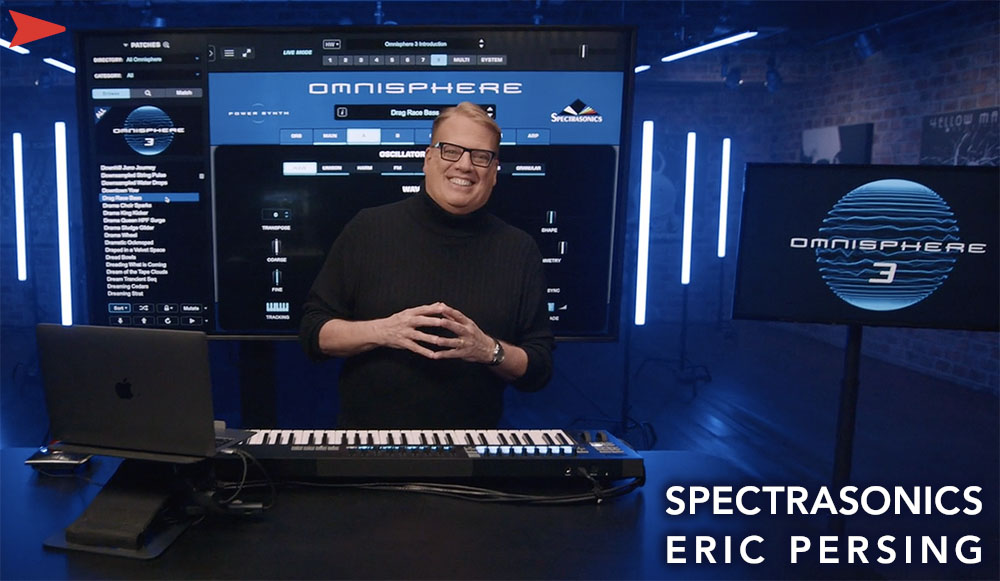
Under the guidance of Eric Persing, the Spectrasonics brand evolved through a series of influential sampling CDs, which ultimately migrated to a line of virtual instruments. Initially these were very focused, embracing rhythmic loops, bass sounds, and pad-like instruments. This last element, originally known as Atmosphere, was the seed that morphed into Omnisphere, quickly embracing other elements while providing an powerful synthesizer packed full of sonic content in both modeled and sampled form.
Omnisphere 1.0 arrived in the autumn of 2008 to a reception that was, by the standards of the software instrument world, thunderous, especially to film composers and ambient artists. Omnisphere built on the success of Atmosphere with a huge core library. What the instrument offered at launch was unlike anything else available: a synthesis engine that married deeply sampled source material, including recordings of a burning piano, obscure industrial percussion and bowed metal, with a modulation architecture, all wrapped in an interface that, while occasionally labyrinthine, had a logic to it. The instrument quickly escaped the narrow categorization of “sample-based synth” and embedded itself into the workflows of film composers, television music supervisors, game audio directors and pop producers alike.
The Omnisphere 1.5 update in 2011 brought significant improvements to the synthesis and modulation systems. In August 2018, version 2.5 saw the advent of the ambitious Hardware Synth Integration initiative, leading to the unveiling of Omnisphere 2.8’s Sonic Extensions libraries in October 2021. The Hardware Synth Integration initiative was an incredible flex. Rather than asking synthesizer owners to laboriously map their physical hardware to software parameters, Spectrasonics built dedicated profiles for hundreds of synthesizers, transforming supported hardware into purpose-built controllers for Omnisphere. A Prophet-6 became, in effect, an Omnisphere interface. An Oberheim OB-Xa found a new calling as a tactile front panel for a software engine that could model its own filter topology. It was an idea that no competitor had attempted at that scale, and it cemented Omnisphere’s reputation as an instrument that rewarded investment in the broader ecosystem.
Spectrasonics Omnisphere 3
By the time version 2.8 and its Sonic Extensions arrived, Omnisphere had been on the market for over a decade and was still considered an industry standard. Omnisphere is a staple in music production, motion picture, and video game scoring, as well as sound design, with its hybrid system giving users access to a synthesis engine and an enormous sound library. The question for much of the early 2020s was not whether Omnisphere remained relevant, but whether Spectrasonics would deliver a true major version update in the face of a competitive landscape that had grown considerably more sophisticated.
The answer arrived for the holidays last December, Omnisphere 3, which represents a major upgrade. What could have been a predictable, incremental update instead arrived as a significant overhaul, remastering all the legacy sounds in their library, dozens of fresh synthesis and effects features, smarter global controls, deeper hardware integration, and performance upgrades. We assigned four evaluators to put Omnisphere 3 though its paces. They spent about a month each utilizing the Spectrasonics flagship in their workflows that spanned Ambient, Film Scoring, Techno and Shoegaze; their comments in quotes below.

The easiest way for electronic musicians to get their music onto Spotify, Apple Music, iTunes, Amazon Music, Tidal, Instagram, Facebook, TikTok, Pandora, Twitch & much more! Click the banner above or the Go Button to save 7% off of your signup! GO!
The major enhancements in Omnisphere 3 are 18 all-new sound libraries comprising a mind-blowing 26,000 patches, and the Omni FX upgrade which adds 35 new effects and can be used as an independent standalone plug-in in your DAW.
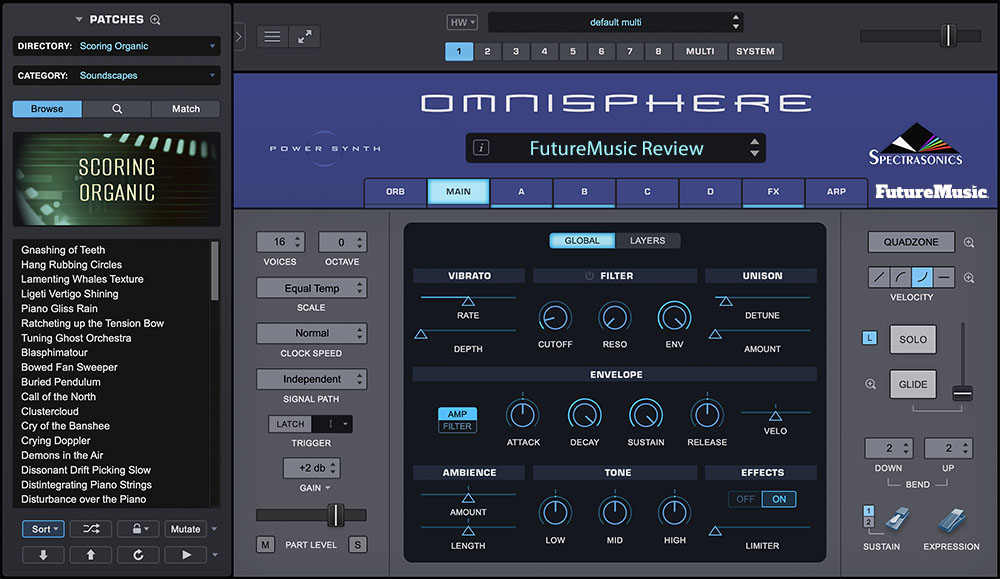
The new libraries are are sorted into 18 themed categories to meet the needs of different kinds of users, so that someone looking for an EDM beat wouldn’t have to wade through the esoteric, simply call up the Club Land library folder. The thematic libraries include Analog Vibes, Retro Vibes, Classic Digital, Scoring Electronic, Hard Edges, Warm Tones, Ambient Dreams, Club Land, Electronic Production, Electronic Underground and Scoring Organic, among others, offering something for every working context from cinematic underscore to commercial trap production.
The major enhancements in Omnisphere 3 are 18 all-new sound libraries comprising a mind-blowing 26,000 patches, and the Omni FX upgrade which adds 35 new effects and can be used as an independent standalone plug-in in your DAW.
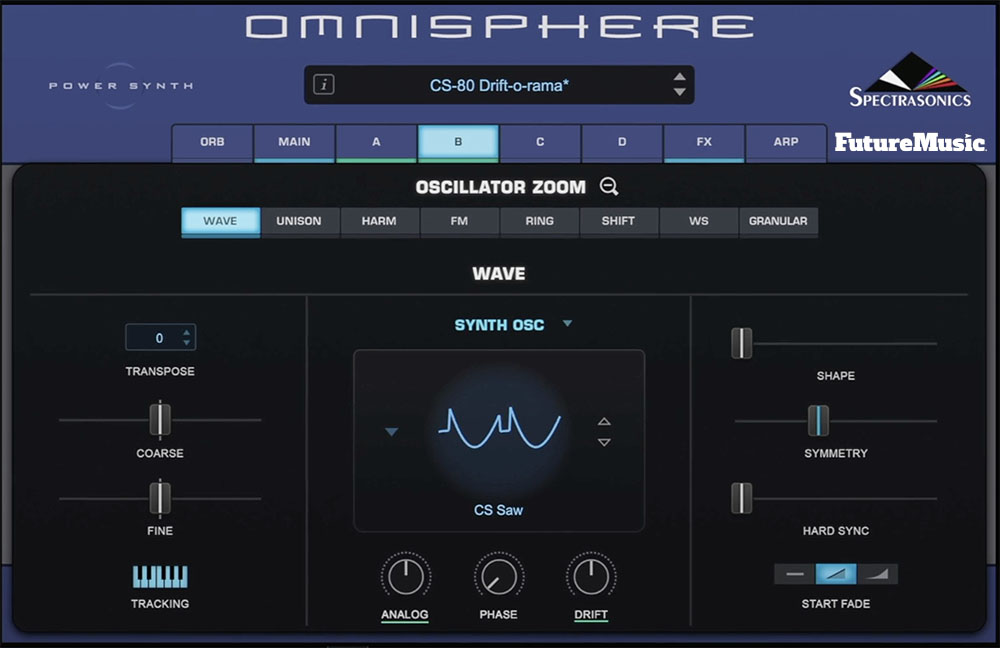
Beyond the library content, Omnisphere 3 introduces several meaningful synthesis advancements. New features include 36 new filter types, circuit-modeled saturation, vintage oscillator drift, MPE and classic glide modes that emulate the portamento curves of vintage synths like the OBXa, Minimoog and ARP Odyssey, as well as an emulation of the CS-80 glissando. (The CS-80 is a Persing favorite – see our XILS-Lab The Eighty Review —Ed.) A new polyphonic Dual Frequency Shifter tracks the keyboard and applies independent frequency shifts to each note, producing pitched artifacts that add an otherworldly, harmonically complex quality to any source material.
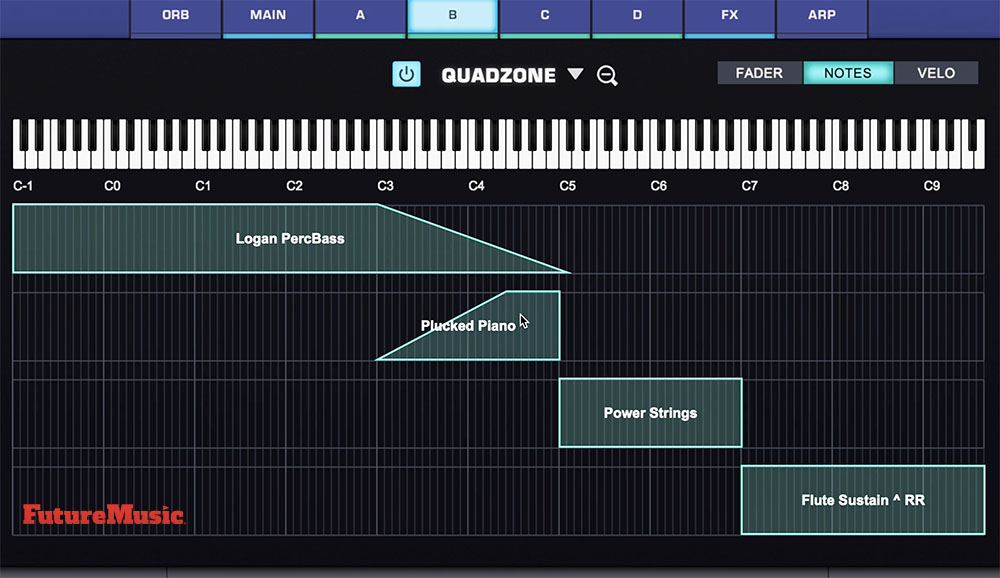
The new Adaptive Global Controls section gives users a high-level macro interface that intelligently maps to the most musically relevant parameters in each patch, adapting its behavior depending on the architecture of the sound being controlled. The new Quadzone feature provides a four-layer performance interface that allows players to morph between timbral zones using keyboard position, velocity, or a fader that can itself be a modulation destination. This includes polyphonic aftertouch from MPE controllers. The Mutations function offers one-click patch variation, analyzing patch structure and generating musically coherent alternatives rather than simply randomizing parameters. And the entire Omnisphere FX Rack, now encompassing 93 effects processors in total, can be loaded as a standalone plug-in in AU, VST and the AAX flavors, meaning the full suite of Spectrasonics effects is now available for processing any audio or instrument source in a session, not just Omnisphere itself.
Native Instruments Absynth 6 Review
Native Instruments has successfully rebooted Absynth in many positive ways and laid the foundation for the next generation of users. Native Instruments Absynth 6 Review
Whatever your musical tastes, if you need strong, emotive synth sounds Omnisphere 3 will have something for you. The new factory sound library navigates between nostalgia and modern with enough content for days, nah, months, nah, maybe even years. The Analog Vibes library captures the warmth and movement of classic voltage-controlled synthesis, offering everything from MiniMoog bass grooves to shimmering analog pads with authentic oscillator drift. Classic Digital pays tribute to the defining instruments of the 1980s digital era with such stalwarts as the Yamaha DX7, the PPG Wave and the Roland D-50 and JD-800 while applying the processing power of the 3.0 engine to push beyond mere emulation.
Designed with film and TV hybrid soundtracks in mind, the Scoring Electronic collection runs the gamut from the savage Omega Level Optic Blast to the ethereal reverberant wash of Distant Piano Dreams. The brutal, dare we say “Hangry” synth patches in Hard Edges should excite fans of harder electronic music, while ambient composers will enjoy the lovely Filtered String Orchestra pad and radiant organ tones found in the Warm Tones and Ambient Dreams collections.
What is perhaps most impressive about the new library is the source material Spectrasonics recorded during its development. The continued commitment to sourcing unusual acoustic phenomena and running them through synthesis processing has always been Omnisphere’s distinguishing quality, and it is fully evident in the version 3 library.
Our evaluators consistently described a characteristic “richness and detail” that’s hard to quantify but immediately recognizable. Many patches can get “scary close to hardware,” with “an organic feel that sets them apart from clinical-sounding competitors.” One defining characteristic that “may or may not suit attract potential buyers” is that many of the patches are “often heavily processed with high-quality reverbs, delays and modulation.” They sound “mix-ready out of the plug-in,” making Omnisphere an incredible inspiration tool. In fact, “a single patch can spark an entire track.” The tradeoff, as our testers have noted, is that these heavily processed presets can “sometimes require surgical stripping our of effects and processing when incorporating them into a mix” since “they can be quite dense.” That said, the ability to disable individual effect layers and synthesis modules makes this manageable.
It should be noted for accuracy that the whopping patch count of 26,000-plus requires some context. The truly new patches clock in around 8,708. The larger figures include remastered legacy patches and significant duplication across the 18 new categorical libraries. A single patch might appear in multiple categories, inflating the count. Even more notable is the fact that only 151 new sound sources were added, a modest 2.7% increase over the previous version. However, this is less a criticism than a testament to the power of the synthesis engine. Spectrasonics has extracted a vastly expanded sonic palette from existing raw materials by applying new filters, modulation capabilities, and effects to what was already there. As an example of what to expect with remastered patches, the original Ambient Space Piano preset has been reworked into the Ambient Space Piano Rich version with substantially enhanced Common effects.
Spectrasonics Omnisphere 3 Features:
- Omnisphere hybrid synth engine
- Remastered library with thousands of new sounds
- Quadzone modulation
- 35+ new FX for a total of 93 FX units
- FX Rack can be used as a standalone plug-in
- Powerful Granular Synthesis
- Wavetable Synthesis
- Synthesis engine with four Layers per patch and doubled Mod Matrix
- Polyphonic dual frequency shifter that can fully track your keyboard
- Enhanced FM/Ring Modulation capabilities
- Flex-Mod modulation system
- Eight full-featured LFOs per patch + syncing and complex waveforms
- 12 Envelopes with simple ADSR-style or advanced multi-breakpoint interfaces
- Polyphonic Timbre Shifting/Crushing, Waveshaping and Reduction
- Algorithmic adaptive global controls
- Mutations create instant variations of any patch
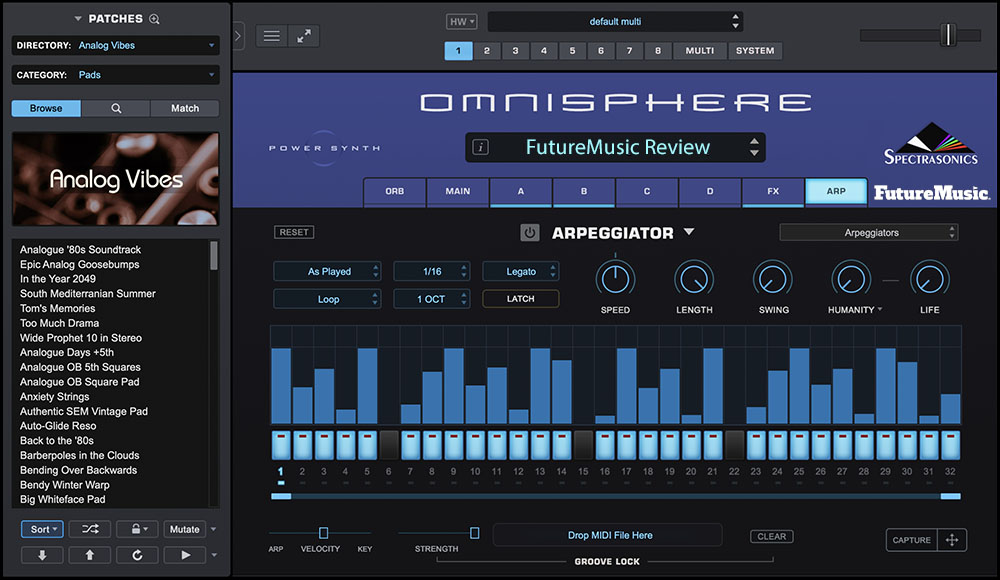
- Eight independent Arpeggiators with unique Groove Lock feature
- Synth Oscillator with 500+ DSP waveforms and up to 20 oscillators per patch
- Fully upgraded Filter section includes 36 new filter types in 7 distinct sonic flavors
- Component-modeled filter saturation provides warm analog coloration
- Oscillator Drift for authentic analog instability
- Sweepable EDM wavetables
- Unison Phase Scatter, Mix and Analog features
- OBXA, Moog, and Odyssey portamento curves with Auto-Bend and CS-80 Glissando
- Full MPE support
- Expanded hardware integration with support for synths and controllers from every major manufacturer
- Redesigned Browser

Support Ambient Music
StretchMetal and the Atmospheric Music Alliance are raising $5000 to support ambient music events taking place across the United States, and virtually with the Atmospheric Music Alliance. Contributions will go directly toward artist and venue fees, production support and the continued development of AMA. Please consider donating today!
The synthesis architecture of Omnisphere 3 represents a meaningful deepening of an already sophisticated platform. The four-layer structure that has defined the instrument since version 1.0 remains, but each layer has been enriched with new oscillator types, filter topologies, and modulation capabilities that substantially expand the palette of sounds. Building a sound starts with the Layering page. Every sound is a layer of four with users choosing how many of those layers to activate. From there, you can choose from either sample source sounds, or wavetable oscillators. The sample sources can be either sampled raw waveforms through to multisampled instruments, and on the other side there are over 500 wavetable oscillators to choose from.
One of Omnisphere’s superpowers, even from version 1.0, was its modulation capabilities…
The 36 new filter types deserve particular attention. With circuit-modeled saturation that introduces “warm harmonic coloration” as signal drives the filter harder, and authentic component modeling that captures the nonlinear behavior of specific historical hardware filters, Omnisphere 3 moves meaningfully closer to offering the sonic variety of a dedicated hardware filter collection within a single instrument. The classic glide modes, carefully modeled after the specific portamento curves of the Minimoog, Oberheim OB-Xa, ARP Odyssey, and Yamaha CS-80, provide a dimension of expressive realism that patch-centric users of the previous versions may not have realized they were missing.
One of Omnisphere’s superpowers, even from version 1.0, was its modulation capabilities. With a simple right-click, you can turn nearly any parameter into a mod destination and assign it to a range of sources such as LFOs, envelopes, or even bias sources, which are a more complex version of the traditional keyboard tracking parameter. What’s even more impressive is how the monstrously flexible mod matrix lets you target parameters in one or across all of the four synth layers.
The Mutations feature, one of the genuinely novel additions in version 3, transcends the random-patch generation found in other instruments. Rather than blindly shuffling parameter values, it analyzes the structural logic of the current patch, the relationship between layers, the modulation routing, the effect chain, and proposes musically coherent alternatives. It’s not touted as an Artificial Intelligence feature, so it’s simply algorithmic, but it was clear to our reviewers that this was on feature “screaming for AI integration in the future.” Users can control the degree of transformation, ranging from a subtle variation on a theme to a wholesale reimagining that preserves some ancestral DNA. Every mutation saves automatically, letting you explore without fear of losing happy accidents. Beyond inspiration, “this may work as a teaching tool to budding sound designers” allowing them to create a mutation, then deconstruct it layer by layer to understand the modulation techniques. It also lowers the barrier for preset users to start experimenting with the engine.
Quadzone, as mentioned above, represents the most significant enhancement to Omnisphere’s performance capabilities in version 3. By allowing players to define how the four synthesis layers relate to keyboard position, velocity, or a master fader, it transforms static patches into dynamic, performable instruments. For live performers who employ MPE controllers such as the Expressive E Osmose or ROLI Seaboard, the combination of Quadzone with per-note polyphonic aftertouch creates expressive possibilities that are “genuinely exciting.”
Quadzone, as well as MPE integration, represents the most significant enhancements to Omnisphere’s performance capabilities in version 3…
The 35 new effects added in version 3 bring the total to 93 processors and span a wide range of applications. Spatial effects include Super Verb, Velvet Verb, Solar Shimmer, Inversions, Refraction Delay and Magnetic Echo. Analog dynamics are represented by a Classic 1176 Limiter, Optical Leveling Amp, Solid State Mix Bus compressor, multiple tube compressors and saturators and vintage British and Class-A console EQs. Creative tools include Flip Backward, Pump-O-Matic, Half Speeder, Warp Shifter, Unstable Drifter, and Chameleon Chorus. “The standalone FX Rack plug-in might be the most immediately practical value addition in the entire upgrade for producers who already own Omnisphere 2.” To put this into context, a single premium reverb plug-in routinely costs as much as the entire version 3 upgrade price.
Over 300 pre-mapped profiles for hardware synthesizers and MIDI controllers from every major manufacturer, including Roland, Korg, Yamaha, Moog, Arturia, Novation, Native Instruments, to name a few, turn compatible hardware into a dedicated controller for Omnisphere. Touch the filter cutoff on your Behringer UB-Xa, and Omnisphere automatically maps it to the corresponding parameter, even loading the relevant OB-X filter model. This Jedi Power of bidirectional integration represents a design philosophy that no competitor has matched at anything approaching this scale. The expanded library of Hardware Integration profiles means that the chances of having one of the supported devices are very high.
The addition of full MPE support, a feature that Omnisphere users had requested since the expressive technology was announced, opens the instrument to a new generation of expressive controllers. Where previous versions could respond to channel aftertouch and MIDI velocity, MPE enables per-note control of pitch, pressure, and additional expression dimensions simultaneously. For composers who work with instruments like the Osmose or the Seaboard, this is transformative, or as one of our evaluators commented, “a dream come true.”
Spectrasonics isn’t one of those concerns that releases alpha or beta software and calls it a final release. They take their time to work out issues before the official debut…
Omnisphere 3 scales perfectly onto a 13-inch laptop display and performs remarkably well on an M2 MacBook Air, even with the library content installed on an external hard drive. (See our OWC Express 1M2 80G SSD Review for a great external drive for Omnisphere. —Ed.) The CPU efficiency of the STEAM engine continues to impress, particularly given the synthesis complexity. FutureMusic’s experience with Spectrasonics from version 1.0 has always been known for solid and stable performance. In fact, Spectrasonics isn’t one of those concerns that releases alpha or beta software and calls it a final release. They take their time to work out issues before the official debut. This is absolutely critical for professionals who can’t afford crashes mid-session or during a live performance. Our reviewers only reported some minor graphical interface glitches, but zero crashes were reported in four months — “impressive.”
The browser redesign, while not a visual overhaul, introduces genuinely useful navigational tools. The directory tree structure with thematic sub-categories, combined with expanded keyword and mood tagging, makes the vast library considerably more navigable than before. The ability to hide entire library folders that fall outside one’s workflow is a small, but a meaningful “quality-of-life improvement.”
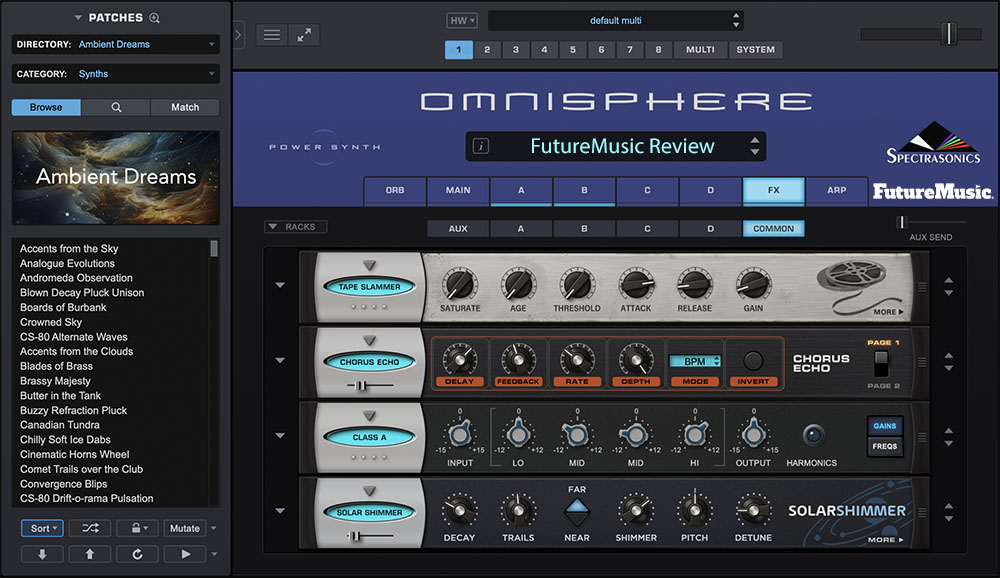
Let us be direct about something that many users of Omnisphere 3 tend to gloss over. By the standards of 2026, the user interface remains, visually and architecturally antiquated. It’s not that it’s cumbersome or unusable, but “Omnisphere looks somewhat outdated” and “a bit antiquated” compared to most modern software. It also doesn’t have the modulation UX, compared to other drag-and-drop systems. This is not mere aesthetics, it is more of “a workflow concern.” Competitors like Arturia Pigments, u-he Zebra, and even the deeply sophisticated Xfer Serum have demonstrated that a complex modular synthesis environment can be presented on a single, resizable, visually coherent canvas. Compared to these modalities, the multi-window, paginated system “feels tedious.” It’s certainly not an easy task for legacy systems, just ask Native Instruments with Absynth 6.
The Adaptive Global Controls partially address the issue of accessibility by providing a macro-level interface without requiring navigation into the deeper pages, but they do not resolve the fundamental architectural problem, which is that building a sound from scratch in Omnisphere 3 still requires moving between multiple pages and sub-windows in a way that “interrupts creative flow.” One of the recurring criticisms from composers who use Omnisphere for patch creation rather than preset browsing is that the modulation assignment process, while powerful, lacks the immediacy of modern systems. Modulation connections in Omnisphere are typically made via right-click menus and matrix entries rather than by drawing cables or dragging connections visually, an approach that made sense in 2008 but again feels increasingly labored in comparison to current standards.
Building a sound from scratch in Omnisphere 3 still requires moving between multiple pages and sub-windows in a way that “interrupts creative flow…”
The inability to import fully mapped user sample libraries into Omnisphere as instruments remains arguably the instrument’s most persistent long-term limitation. Users can import audio into a layer and apply granular processing to it, but creating a fully key-mapped, velocity-switched sample instrument from one’s own recordings inside Omnisphere is not straightforwardly possible without engaging in XML-level workarounds. To be fair, this limitation is a deliberate product decision rather than a technical oversight Spectrasonics has clearly weighed the value of maintaining library curation quality against the benefit of democratizing instrument creation within the platform, and has consistently chosen curation. But as instruments like Falcon demonstrate that full sample import and deep synthesis can coexist without sacrificing sound quality, the argument for maintaining this restriction should be re-examined at some point.
Natural-language search, or AI-powered semantic retrieval would not merely be convenient, it “would save considerable time” and be “transformative…”
Despite the improvements to the patch browser in version 3, navigating Omnisphere’s library “takes more effort than it should.” The tagging system is “unwieldy” and “cumbersome to search.” The new 18-category organization certainly helps, and the ability for patches to appear in multiple relevant categories is a genuine improvement over the previous single-category constraint.
Sound Match is one of Omnisphere’s most under-appreciated browsing tools, and with a library now numbering tens of thousands of patches, it has never been more essential. A single click analyzes the tags of your currently loaded sound and displays all comparable patches across every library, ranked by similarity strength. Rather than navigating by category or scrolling endlessly, a producer can lock onto one patch that fits a session’s mood and let Sound Match map the surrounding sonic territory.
It carried over from Omnisphere 2 rather than arriving fresh in version 3, but given the library’s explosive growth, it has quietly become one of the most practical tools in the instrument. However, a library of this scale demands a search experience approaching the sophistication of a dedicated media asset management system. Natural-language search, or AI-powered semantic retrieval would not merely be convenient, it “would save considerable time” and be “transformative.”
Conclusion
Omnisphere 3 is a “genuinely exceptional” instrument. It is the product of decades of accumulated knowledge about what working musicians and composers need from a software instrument, delivered by one of the most accomplished creative directors in the history of electronic music. The sheer density of immediately usable, professionally finished sound material it places at a user’s fingertips has “no equal in the software instrument world,” and the combination of that library depth with a synthesis engine of real architectural sophistication makes the instrument relevant to an incredibly wide range of musicians. Where Omnisphere 3 falls short of what a ten-year development cycle might have delivered is in the areas of modern workflow, sophisticated preset search and AI integration. From the bedroom producer looking for an inspirational preset to the Hollywood composer who needs a reliable sound design toolkit under intense deadline pressure, Omnisphere 3 delivers with consistent authority. Highly Recommended.
Spectrasonics’ Omnisphere 3 costs $499 ($199 To Upgrade) and is available now.
Computer Requirements: 2.4 GHz or higher processor / 8GB of RAM, 16GB or more recommended / 64GB of free hard drive space
Mac Users: macOS 13 Ventura or higher/ AU, VST3, VST2, AAX / Intel and Apple Silicon Native / 64-bit host
Windows Users: Microsoft Windows 10 or higher / VST3, VST2, AAX / 64-bit host
Cheers:
+ Outstanding sound quality
+ 18 new thematic libraries
+ Unrivaled factory sound library depth
+ 36 new filter types with authentic circuit modeling
+ Full MPE support
+ Polyphonic Dual Frequency Shifter
+ Mutations engine
+ Quadzone performance architecture
+ Standalone FX Rack
+ 93 Effect processors
+ Hardware Integration with over 300 profiles
+ Adaptive Global Controls
+ Backward compatibility with all previous project sessions
+ CPU efficiency on modern hardware
+ Rock-solid stability
+ Huge Value
Jeers:
— User interface architecture largely unchanged from 2008
— No drag-and-drop modulation assignment
— Limited native user sample import capability
— No AI-assisted sound design or preset search
— Inefficient patch browser
— No CLAP plug-in support
The Future: If Spectrasonics is preparing for another decade-long development arc before the release of Omnisphere 4, the most productive investments they could make would be in a fundamental rearchitecting of the user interface toward a modern, single-canvas, resizable paradigm with drag-and-drop modulation routing and a visually expressive patch editor that reveals the depth of the synthesis engine rather than obscuring it behind paginated menus. A genuinely powerful AI-assisted sound design layer that goes beyond Mutations to offer neural spectral morphing, generative patch creation trained on the vast Spectrasonics sound library, and a natural-language semantic search system that can navigate the library by emotional intent rather than keyword taxonomy. A product that has spent seventeen years earning the trust of the world’s most discerning and demanding composers, certainly puts the pressure on a groundbreaking company to reinvent its core promise ‐ but we’re sure Persing and company is up to the task.