XILS-Lab The Eighty Review
Long-Term Review
To understand what XILS-Lab has accomplished with The Eighty, one must first understand the instrument that inspired it, an analog synthesizer so ambitious, so expressively capable, and so technically demanding that it remains, nearly five decades after its debut, one of the most revered electronic instruments ever built.
The story of the Yamaha CS-80 does not begin with the CS-80 itself. It begins, as all great origin stories do, with an act of extraordinary ambition. In the early 1970s, Yamaha’s engineers were watching the synthesizer world slowly awaken to the possibility of polyphony, the ability of a keyboard instrument to play multiple notes simultaneously. Moog had their Polymoog project underway. Korg was exploring early polyphonic territory. But Yamaha, drawing on its deep heritage in electronic organ engineering, decided not merely to participate in this new frontier but to conquer it entirely. The result, completed around 1973 and released publicly in 1975, was the Yamaha GX-1. Stevie Wonder, who owned one and called it simply “The Dream Machine,” used it on Songs in the Key of Life. Keith Emerson of ELP brought one on tour. John Paul Jones of Led Zeppelin also played one. These were not casual endorsements, the GX-1 earned such devotion because it was genuinely unlike anything else in existence.
Does XILS-Lab The Eighty represent the best available software path to the CS-80’s musical universe?
The GX-1 was a monster in every sense. It boasted 18-voice polyphony spread across three manual keyboards and a bass pedal section, weighed well over 300 kilograms, and carried a price tag of roughly $60,000, about $350,000 in today’s money. With fewer than 100 were ever built, it was never intended as a consumer product. Rather, it served as Yamaha’s technological proving ground, a statement of what was achievable when engineering resources were applied without compromise, or a restraining budget. The integrated circuit tone generators developed for the GX-1 became the foundation for everything that followed.
XILS-Lab The Eighty

The easiest way for electronic musicians to get their music onto Spotify, Apple Music, iTunes, Amazon Music, Tidal, Instagram, Facebook, TikTok, Pandora, Twitch & much more! Click the banner above or the Go Button to save 7% off of your signup! GO!
Yamaha moved quickly to translate that foundational technology into something the working musician might conceivably own. In 1976, the first instruments in the CS (Control Synthesizer) series began appearing, starting with the CS-50, a four-voice polyphonic keyboard that introduced the integrated circuit voice architecture to a commercial audience at a more accessible price point. But it was the CS-80, introduced in 1977, that represented Yamaha’s genuine attempt to bring the GX-1’s expressive philosophy into a single-manual keyboard instrument. It weighed approximately 100 kilograms, still not exactly portable, but a dramatic reduction from its predecessor. Its price was around $6,800 at launch in the United States, placing it within reach of professional musicians even if it remained far beyond the budget of the casual hobbyist.
What made the CS-80 extraordinary was not any single feature but the totality of its expressive architecture. At its heart were eight voices of true polyphony, each voice comprising two complete synthesis layers, meaning the instrument effectively ran sixteen independent synthesis engines simultaneously. Each layer had its own oscillator, its own paired high-pass and low-pass resonant filters, and its own envelope generators. Unlike the standard ADSR envelope found on most synthesizers of the era, the CS-80 used Yamaha’s proprietary IL-AL system (Initial Level and Attack Level), which gave the attack phase a more nuanced, organic character. The two layers could be blended and detuned against each other, and this natural, analog beating between the two layers was the primary source of the CS-80’s famous texture and movement. There was nothing digital about that shimmer, just voltage differentials, thermal drift, and the organic imprecision of analog circuitry.
Few hardware synths carry the same mystique as the Yamaha CS-80…
The keyboard itself was a revelation. It was velocity sensitive, responding to how hard the player struck the keys much as a piano does. But it also offered something rarer and more remarkable: polyphonic aftertouch, the ability for individual note pressure applied after a key was struck to modulate each voice independently. Most synthesizers that offered aftertouch at all provided only channel aftertouch, a single, global pressure reading that affected all notes equally. The CS-80’s polyphonic aftertouch meant that a player could sustain a chord and selectively add vibrato or expression to individual notes by varying finger pressure independently. This was profoundly musical. Combined with a ribbon controller along the front of the instrument that allowed for polyphonic pitch glissandos, the CS-80 offered a tactile expressiveness that no other polyphonic synthesizer of its era could match and that very few instruments, even today, fully replicate.
Fewer than 800 CS-80’s were built in total across its production run, and production ceased in 1980. Its undoing was partly commercial and partly technological. When Sequential Circuits released the Prophet-5 in 1978, the synthesizer landscape changed abruptly. The Prophet-5 was lighter, far more affordable at around $3,995, and most importantly, it offered the ability to store and instantly recall programmed sounds. The CS-80 relied on analog memory, a system of tiny sliders behind a flip-up panel that could store four user patches but required physical manipulation and careful recording of settings to recall sounds reliably. In an era increasingly defined by studio convenience and rapid sound recall, the CS-80’s workflow began to seem burdensome and archaic. The Prophet-5, the Oberheim OB-X, and ultimately the revolutionary Yamaha DX7 in 1983 all drew the market’s attention toward convenience, programmability and digital precision.

Native Instruments Absynth 6 Review
Welcome Back Old Friend!
Native Instruments has successfully rebooted Absynth in many positive ways and laid the foundation for the next generation of users. Native Instruments Absynth 6 Review
Yet the CS-80’s cultural legacy was secured not by commercial success but by one man and one film. Vangelis, the Greek composer and synthesist, first acquired a CS-80 around 1977 and made it the center of his musical universe for the next several years. He used it on Spiral, on China, on the landmark Chariots of Fire score, and most indelibly on the soundtrack to Ridley Scott’s Blade Runner in 1982 after which Yamaha had already ceased production of the instrument.
The Blade Runner score, released just as the film struggled at the box office, would spend the next decade growing into one of the most influential pieces of electronic music ever recorded. The haunting opening theme, the plaintive shimmer of “Memories of Green,” the atmospheric drift of “Blade Runner Blues” were all shaped and defined by the CS-80’s particular combination of warmth, resonance and expressive depth. The CS-80 also found its way into the hands of artists like Stevie Wonder, whose early relationship with GX-1 technology continued into the CS era, and into Michael Jackson’s Thriller sessions, where it contributed to the lush string textures of “Billie Jean” and the orchestral warmth of “Human Nature.” Toto used it on “Africa.” Without a doubt the CS-80 was at the center of some of the defining sonic events of the early 1980s.
Today, a functioning example of the CS-80 commands prices ranging from $30,000 to well over $60,000 on the vintage market, assuming one can be found at all. The instruments are notoriously difficult to maintain, highly sensitive to temperature and humidity, and require specialized technical knowledge to service. Most surviving examples no longer play reliably. The CS-80 is, for all practical purposes, a museum piece. Although, Eric Persing of Spectrasonics fame, uses one almost exclusively to design the patches in his famed Omnisphere. Which is precisely why the question of faithful software emulation matters so much, and why XILS-Lab’s decision to take it on deserves serious examination.
XILS-Lab, founded in 2009 and led by Xavier Oudin from the company’s base in Grenoble, France, has built a reputation over the past fifteen years for deep, meticulous analog modeling. Their catalog includes the PolyKB III, a celebrated emulation of the rare PolyKobol II synthesizer, the XILS 505, which recreates the Roland RS-505, and a range of vocoders and effects that all share the company’s commitment to authentic analog behavior rather than superficial approximation. The Eighty, released in 2025, represents XILS-Lab’s most ambitious project to date and its entry into one of the most competitive and scrutinized niches in virtual instrument development.
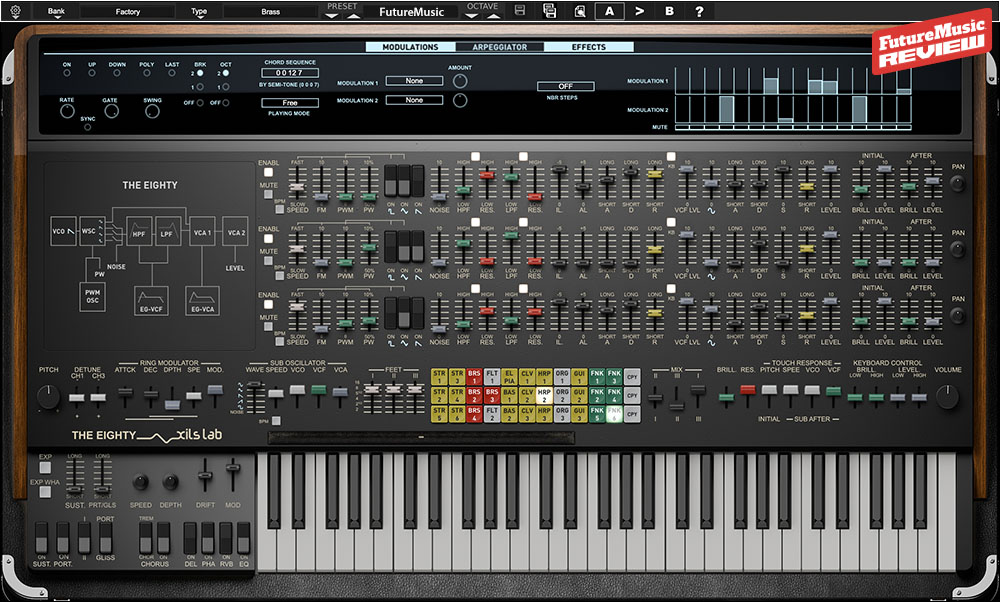
The instrument is built around three synthesis lines. The first two lines faithfully recreate the CS-80’s dual-layer architecture, with each line providing an oscillator, paired high-pass and low-pass 12 dB resonant filters, and the IL-AL envelope system that defined the original’s distinctive attack character. The third synthesis line is the instrument’s major structural innovation over the hardware original, offering an additional layer of sonic material that can be blended with the two authentic CS-80 voices through an innovative 2D mixer. This third layer opens creative territory that the original hardware simply could not reach and provides the instrument’s justification for being something more than a historical recreation.
The Eighty Specs:
- Software Type: Polyphonic Synth Virtual Instrument
- Platforms Supported: Mac, PC
- Bit Depth: 32-bit, 64-bit
- Plug-in Formats: AAX, AU, VST
- Authorization Type: iLok Account
- Hardware Requirements – Mac: Intel Core 2 Duo or higher, 4GB RAM minimum
- Hardware Requirements – PC: Intel Core 2 Duo / AMD Athlon 64 X2 or higher, 4GB RAM minimum
- OS Requirements – Mac: OS X 10.9 or later
- OS Requirements – PC: Windows 7 SP1 or later
The oscillator modeling in The Eighty is notably precise. XILS-Lab paid particular attention to the CS-80’s distinctive sawtooth wave generation, which included brief pulse-like artifacts that contributed to the instrument’s characteristic edge and aggression. The filter modeling is similarly careful. XILS-Lab implemented zero-delay filters for each synthesis line, an approach that eliminates spectral warping at high frequencies, a common artifact in digital filter implementations that causes the sonic character to shift undesirably at high cutoff settings. The resonance response has been calibrated to remain smooth and musical even when the cutoff frequency intersects with the oscillator’s fundamental, preventing the harsh self-oscillation that plagues less carefully engineered digital filters.
The expressive performance architecture mirrors and expand upon the original. Polyphonic aftertouch is faithfully reproduced with a progressive, responsive feel. Velocity sensitivity responds across all synthesis lines. Keyboard follower routing, which allows various parameters to be modulated by note position across the keyboard, is present and functional. A sub-oscillator and ring modulator section (the latter complete with its own attack and decay envelope) add dimensions of timbre that the original did not natively offer. The ring modulator in particular extends the instrument’s range into metallic, clangorous territory that contrasts interestingly with its characteristic warmth.
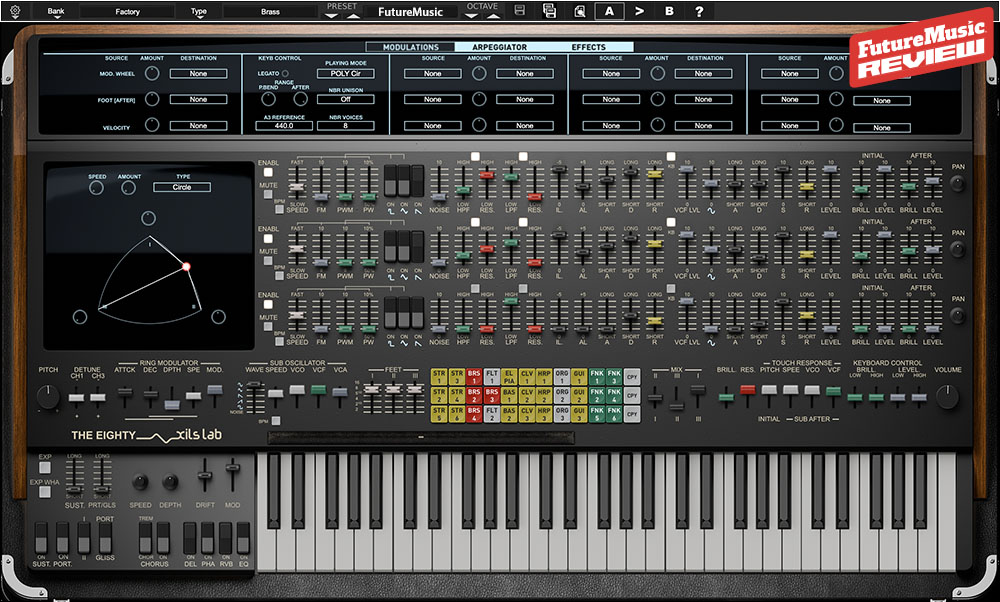
The modulation architecture is substantially deeper than the original hardware. A modulation matrix allows for routing between a comprehensive list of sources and destinations, and the extended arpeggiator goes well beyond simple up-down note sequencing. The arpeggiator in The Eighty incorporates cyclical modulation and muting possibilities on a per-step basis, allowing for rhythmically varied, dynamically shifting sequences that inject genuine life into held chords. The 2D mixer that blends the three synthesis lines offers animation capabilities, creating evolving textures that would be impossible on the hardware.
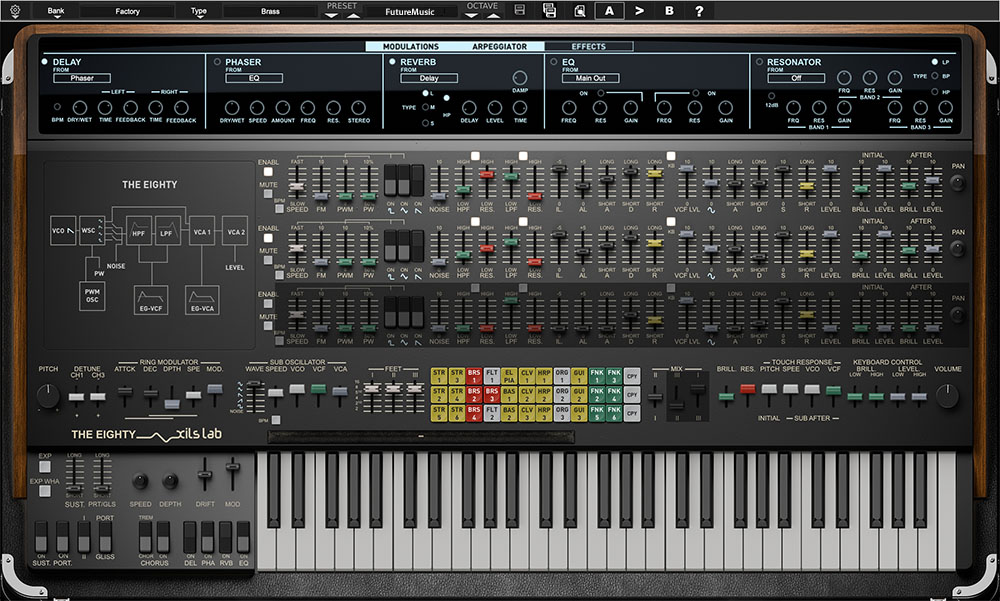
Effects are included in four independent modules with flexible routing: a stereo delay, a phaser, a reverb with three room size modes (Small, Medium, Large), and an equalizer. Version 1.1 of the plug-in added a PolyM Resonator, modeled on the filter bank of the Polymoog, which gives an additional tonal shaping option that complements the CS-80 architecture in historically appropriate ways. A chorus section handles tremolo, vibrato and ensemble effects separately from the main effects chain. The preset library ships with over 500 patches from sound designers including Nori Ubukata, SoundsDivine, Daniel Stawczyk, Gab Lavoie, and others, as well as faithful recreations of the original CS-80’s twelve factory hardware presets.
The oscillator modeling is where The Eighty earns its credibility…
There is a moment, when you first load The Eighty and play a sustained chord through its default patch, when the instrument announces itself and you know that this is a quality emulation. The sound is not the approximation of analog warmth that one has come to expect from software synthesizers, it is something denser and more alive with genuine air and body that seems to occupy physical space. For anyone who has spent time with recordings made on the original CS-80, the recognition is immediate.
The oscillator modeling is where The Eighty earns its credibility. XILS-Lab’s careful attention to the CS-80’s sawtooth character, including the brief pulse transients that give the original its particular edge on lead sounds and brass textures, means that the raw waveform output has a particular grain and complexity. When two of the synthesis lines are detuned slightly against each other, the beating between them produces a chorus-like movement that is texturally very close to what the original hardware generates through its own inherent analog instability. This is not achieved through a simple chorusing effect applied after the fact. It is a product of the oscillator modeling itself, and the difference in character is audible.
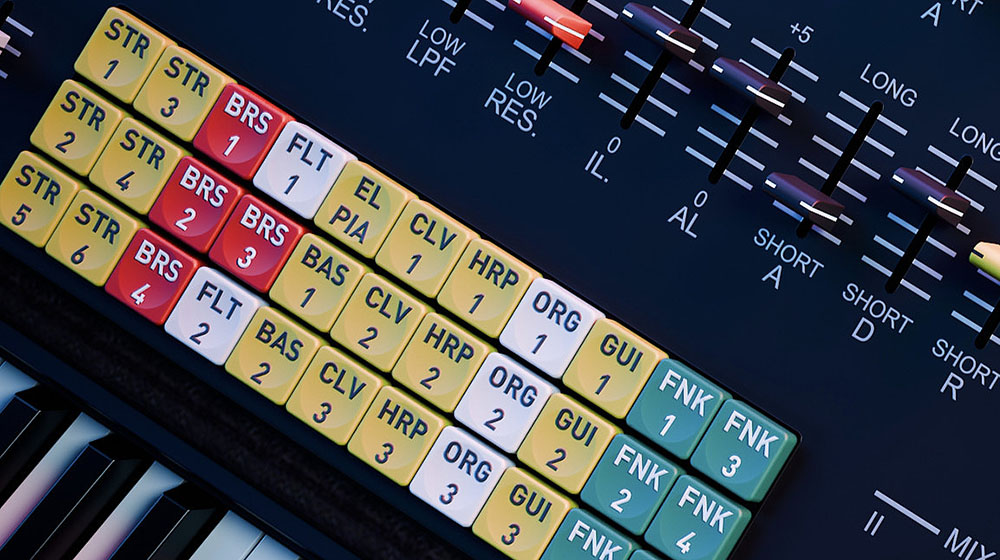
The filter response is equally accomplished. The zero-delay filter implementation handles high-frequency sweeps without the spectral distortion that mars many digital filter designs, and the resonance behavior through the whole range from gentle warmth to near self-oscillation is smooth and musical. Crucially, the HP-LP filter pairing behaves with the complementary sweep character that defines so much of the CS-80’s string and brass timbres. In fact, opening the high-pass filter while sweeping the low-pass creates that immediate, recognizable string attack character without any additional processing. Pads bloomed with genuine fullness. Brass presets had the right combination of bite and body. The flute and organ presets in the factory library sat convincingly in the acoustic register of their suggested instruments.
The third synthesis line represents the instrument’s most significant creative expansion, and in practice it justifies its presence completely. Being able to blend a third layer of CS-80 architecture into the sound, adjusted independently in character through its own filter and envelope settings, allows for sounds of depth and complexity. Some of the most impressive factory presets in the library exploit this third layer to create evolving pads and textures that would be impossible on a two-layer instrument, where the additional voice moves through the mix dynamically as notes are sustained. The 2D mixer’s animated blending is one of the more genuinely useful creative innovations in the instrument, and it rewards patient exploration.
The third synthesis line represents the instrument’s most significant creative expansion…
The polyphonic aftertouch implementation deserves specific attention because it is, next to the oscillator modeling, the feature most central to the CS-80’s musical identity. In The Eighty, polyphonic aftertouch is faithfully reproduced with a response that is progressive and natural, pressing individual keys harder after they are struck creates a smooth, continuous vibrato or filter modulation response that closely mirrors the feel of playing the original. Users with controllers that support polyphonic aftertouch will find The Eighty remarkably rewarding to play expressively. The ring modulator section, with its dedicated amplitude envelope, adds a useful metallic or clangorous color option that works particularly well when applied subtly to brass and bell-type sounds.
The effects chain is very modest in breadth but generally high in quality. The reverb, while limited to three room size settings, sounds warm and rich rather than clinical. The delay is clean and well-behaved with tempo sync. The phaser has the right kind of analog movement to it. The PolyM Resonator added in version 1.1 is a welcome addition that gives the instrument access to that Polymoog-adjacent formant-filtering color which pairs naturally with the CS-80 voice architecture. These effects are not trying to be a complete studio signal chain. They are trying to be the right tools for the job of making the instrument sound like it sounds on records, and in that narrower purpose they succeed well.
The preset library is one of the strongest ever assembled for a CS-80 emulation. The original twelve hardware presets are reproduced faithfully enough that blind A-B comparisons with recordings of the original instrument are challenging for most listeners. Beyond those foundation patches, the library emphasizes cinematic scoring. The pads are lush and the leads have the right combination of aggression and bite. The Vangelis-esque textures, think shimmering, harmonically rich sustained sounds that defined the Blade Runner world, are perhaps the best available for that aesthetic.
From a technical standpoint, The Eighty performs with reasonable resource efficiency given its three-layer architecture. Stability during testing was consistently solid, with no crashes reported across multiple DAW environments. XILS-Lab’s track record of maintaining and improving existing products over time suggests that ongoing development will address current limitations.
Competing directly with Arturia’s CS-80V, Cherry Audio’s GX-80, and Softube’s Model 77, The Eighty distinguishes itself primarily through the quality of its oscillator and filter modeling and the creative depth of its three-layer architecture. Arturia’s offering is the worst of the lot even with its longevity, while Cherry Audio’s GX-80 adds the GX-1 architecture to the mix for a different kind of scope. Softube’s Model 77, while more sonically focused, is more architecturally limited. For pure CS-80 character and expressive fidelity, The Eighty makes a strong case to be considered at or near the top of that comparison group.
The most significant omission is the absence of MPE (MIDI Polyphonic Expression) support…
With all the above accolades, it would be dishonest to review The Eighty without acknowledging the places where XILS-Lab’s execution falls short of its ambitions. The instrument is genuinely impressive in its sonic core, but several design and implementation decisions limit its appeal and usability in ways that a future version should directly address.
The most significant omission is the absence of MPE (MIDI Polyphonic Expression) support. This is not a minor deficit. It is a fundamental gap that becomes more glaring the more one understands the instrument’s philosophical identity. The CS-80 was, by any reasonable definition, one of the most expressive polyphonic keyboard instruments ever built. Its polyphonic aftertouch was decades ahead of its time. In 2025, the MIDI Polyphonic Expression protocol exists precisely to extend that kind of per-note expressive control to modern controllers. Instruments like the Roli Seaboard, the Expressive E Osmose, and the various MPE-compatible controllers now available are perfectly positioned to interact with a CS-80 emulation at a level of expressiveness that even the original hardware could not fully achieve. The Eighty supports polyphonic aftertouch, which was the CS-80’s own mechanism, but that is a narrower standard than MPE, which would also allow for per-note pitch bend, slide, and pressure control from a much wider range of modern expressive controllers.
The graphical interface is the second persistent point of criticism according to our evaluators…
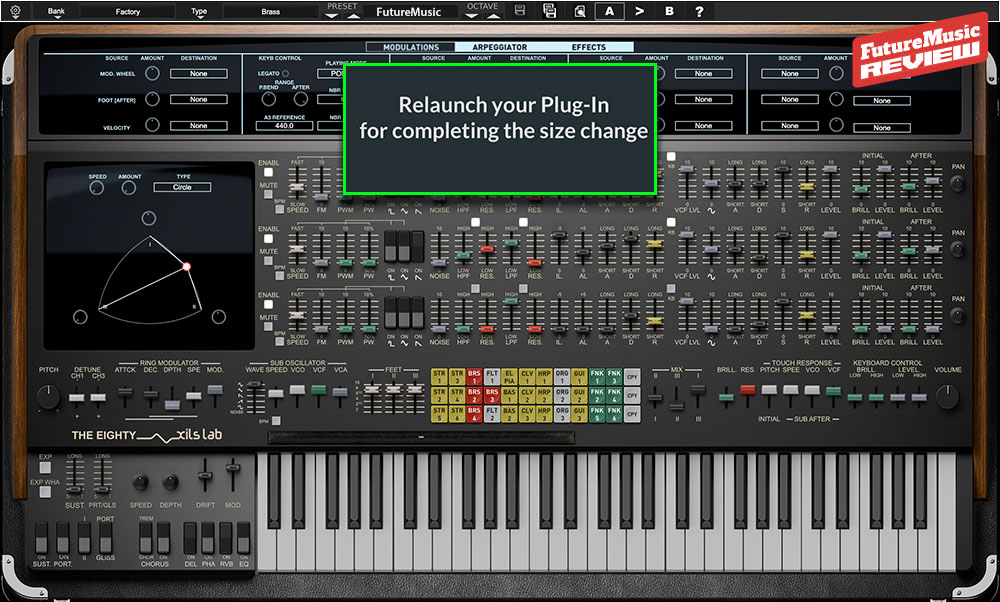
The graphical interface is the second persistent point of criticism according to our evaluators. The layout closely mirrors the original CS-80’s front panel, which is a reasonable design choice in the context of a historically faithful emulation, specifically because it reinforces the workflow logic of the instrument it recreates. But the implementation has real practical drawbacks. The interface is dense and cumbersome, particularly at smaller display sizes, and there is no option to hide sections of the GUI to reduce visual complexity for users who want to focus on specific parameters. Changing the display resolution requires restarting the plug-in entirely, which is a workflow interruption that feels ridiculous in this day and age. The majority of our reviewers reported that even after extended use, the interface demands more attention than it should, and the learning curve as significantly steeper than competing CS-80 emulations. The user manual, while covering all functionality, lacks programming examples and tutorial content that would help new users navigate the instrument’s depth more quickly.
The absence of an undo and history function within the plug-in itself is another legitimate complaint. While some DAWs provide plug-in level parameter history, many do not, and the absence of this basic safety net is particularly problematic for an instrument with the kind of complex patch architecture The Eighty possesses. A misplaced click on a filter cutoff or an accidental preset overwrite has no recovery path within the instrument itself. This is a standard feature in most modern software instruments and its absence feels like an oversight rather than a deliberate design choice.
The absence of a standalone version is a specific usability gap that multiple reviewers and users have noted…
The iLok protection requirement continues to generate significant frustration among our staffers, and The Eighty has renewed this conversation. It should be noted in fairness that XILS-Lab offers both hardware dongle and machine-based iLok software authorization, which eliminates the requirement to own physical iLok hardware. However, the broader iLok ecosystem carries operational risks. For example, machine-based licenses require internet connection management, and transfer fees for moving licenses between machines have been specifically called out as unreasonably expensive. In an era when many competing developers have moved to simpler, lighter-touch authorization systems, XILS-Lab’s continued reliance on iLok feels increasingly out of step with users expectations.
The absence of a standalone version is a specific usability gap that multiple reviewers and users have noted. For live performers who want to use The Eighty as a stage instrument controlled directly by a hardware keyboard, the requirement to launch a full DAW as a host adds complexity and potential failure points. A standalone application would make The Eighty meaningfully more deployable in live contexts, which seems particularly important for an instrument whose defining characteristic is expressive keyboard performance.
In direct A-B comparisons between The Eighty and recordings of hardware CS-80s, reviewers have noted that the plug-in can occasionally sound slightly more muffled or less punchy than the original, particularly in complex polyphonic passages. The Eighty also lacks some of the subtle per-voice variation and stochastic behavior that characterizes a real analog circuit in which no two voice cards are ever quite identical. This voice-to-voice variation, including the slight differences in tuning, timbre, and response between individual analog voice cards, is one of the hardest aspects of analog polyphony to emulate convincingly, and it is where the gap between The Eighty and a real CS-80 is most audible to experienced ears.

XILS-Lab would also benefit from expanding the preset browser’s functionality. Multiple evaluators noted that the browser remains somewhat limited for an instrument with over 500 presets, and that organizing, searching and creating personal preset categories could be more intuitive. Given that this is one of the few areas where every XILS-Lab product receives consistent criticism, it represents a systemic issue that demands a structural rethink rather than incremental patching.
Conclusion
The question before us is ultimately simple, even if the instrument is not: does XILS-Lab The Eighty represent the best available software path to the CS-80’s musical universe? After considering a wide range of technical assessments, tester experiences, and direct comparative analysis, is a qualified and enthusiastic yes, even with the genuine limitations outlined above.
On the positive side of the ledger, The Eighty delivers oscillator and filter modeling that is demonstrably more convincing than most of its competition, especially Arturia’s CS-80V, in the character of the sawtooth waveform and the smooth musically calibrated behavior of the zero-delay filters. The polyphonic aftertouch implementation is faithful and responsive. The three-layer architecture is a genuinely creative expansion of the original concept that opens sonic territory unavailable on the hardware. The factory preset library is one of the finest ever assembled for a CS-80 emulation, and the inclusion of the original twelve hardware presets reproduced with high fidelity is both a historical service and a compelling demonstration of the modeling’s quality. The effects chain, while modest, is well-chosen and well-executed. Technical stability is excellent.
It is the finest CS-80 emulation currently available when judged on the quality of its core sonic modeling, the creative ambition of its three-layer architecture, and the depth of its musical expressiveness. But it falls short of a higher score because of interface friction that has been consistently criticized across multiple independent reviews, the absence of MPE support in an instrument whose entire identity is built around expressive performance, and the lack of a standalone version. Recommended.
XILS-Lab’s The Eighty costs €79 and is available now.
The Eighty runs as a 64-bit instrument in VST 2.4, VST3, AU and AAX Native formats, supporting macOS 10.13 and later on both Intel and Apple Silicon hardware, as well as Windows 7 through 11. Authorization is handled through iLok, with both hardware dongle and software (machine-based) authorization supported.
Cheers:
+ Sound engine
Oscillator modeling faithfully captures the CS-80’s distinctive sawtooth character — including its brief pulse transients — giving the raw waveform a grain and complexity that most competing emulations smooth away.
+ Filters
Zero-delay 12 dB resonant high-pass and low-pass filters eliminate spectral warping at high frequencies and maintain smooth, musical resonance behavior across the full sweep range — a technically demanding achievement.
+ Architecture
The addition of a third synthesis line beyond the original CS-80’s dual layers is a genuinely creative expansion. Blended via an animated 2D mixer, it opens tonal territory the hardware could never reach.
+ Polyphonic Aftertouch
Polyphonic aftertouch is faithfully reproduced with a progressive, natural response. Velocity sensitivity and keyboard follower routing work across all three synthesis lines, rewarding expressive playing deeply.
+ Preset library
Over 500 presets from world-class sound designers, including faithful recreations of the original twelve CS-80 hardware factory patches. The library is among the strongest ever assembled for a CS-80 emulation.
+ Modulation
The extended arpeggiator with per-step cyclical modulation and muting, combined with a modulation matrix, gives the instrument a modern creative range far beyond what the original hardware offered.
+ Stability
Consistent technical stability across DAW environments. XILS-Lab’s customer support is among the best-regarded in the industry, and the company has a strong record of ongoing maintenance for all its products.
+ CPU efficiency
Despite running three full synthesis lines, CPU usage remains reasonable. Zero-delay filter design avoids the oversampling overhead that inflates resource consumption in comparable instruments.
+ Value
At its sale price, and even at full retail, The Eighty represents exceptional value compared to any hardware alternative — a functional CS-80 now commands $30,000–$60,000+ on the vintage market, assuming one can be found at all.
Jeers:
— No MPE
The absence of MIDI Polyphonic Expression support is the instrument’s most significant missed opportunity. An instrument built around expressive performance should fully embrace the modern standard that exists precisely to extend that expressiveness.
— Interface
The GUI is consistently cited as dense, cumbersome, and difficult at smaller display resolutions. There is no option to hide or collapse sections to reduce visual complexity, and resizing the window requires a full plugin restart.
— No Undo
The plug-in has no internal undo or parameter history function. In an instrument of this complexity, an accidental parameter change or preset overwrite has no recovery path independent of DAW-level plug-in history, which is not universally available.
— iLok DRM
Authorization via iLok remains a minor friction point for a small portion of users. Machine-based software authorization is available, but the broader iLok ecosystem — including transfer fees when moving licenses between machines — generates consistent and legitimate frustration.
— No Standalone
The plug-in requires a DAW host and cannot be run as a standalone application. For live performers wanting to deploy The Eighty directly from a hardware keyboard without a full DAW environment, this is a serious limitation.
— Voice variation
In direct comparison with hardware CS-80 recordings, the plug-in can sound slightly less punchy and dynamically alive, particularly in dense polyphonic passages. The subtle per-voice analog variation of real hardware remains incompletely modeled.
— Preset browser
The preset browser has been called “underwhelming.” Organizing, tagging, and creating personal categories within the 500+ preset library is less intuitive than it should be for a flagship instrument.
— GUI Resizing
Requiring a relaunch of the interface when resizing feels like 2002.
— Documentation
The 24-page user manual covers all features but lacks programming tutorials and sound design examples. For an instrument of this depth and complexity, the learning curve without guided content is steeper than it needs to be.
The Future: The path forward for a future major update is relatively clear: begin with full MPE implementation, which would transform the instrument into the most expressively capable CS-80 emulation ever released and align it properly with the modern expressive controller ecosystem that already exists and is growing.
Follow that with a comprehensive interface redesign that adds collapsible sections, a fully resizable window that does not require a plug-in restart, and a significantly improved preset browser with more powerful search, tagging and organization features; add native undo and history functionality independent of DAW support; introduce a standalone application version for live deployment; invest in further refinement of per-voice variation modeling to close the remaining gap between the software and the sonic behavior of real analog voice cards.
Consider removing or supplementing the iLok requirement with a simpler machine-based authorization option that does not carry transfer fees; expand the user manual with practical programming tutorials and sound design examples that help new users navigate the instrument’s considerable depth more quickly; and potentially deepen the effects chain with a more fully parametric reverb and a dedicated ensemble/chorus effect of the quality that the CS-80’s own chorus represented, and giving those tools the same level of meticulous modeling that the oscillators and filters have received.