Embodme Erae 2 Review
Long-Term Review
Embodme is a small Paris based company, spearheaded by Edgar Hemery, with an unusually singular obsession, turning human expression into music. Rather than chasing the crowded market of knob laden MIDI controllers and keyboards with a defined layout, the Embodme took Apple’s approach when they developed the first iPhone, the interface can completely change based on the application. Hemery informed us that this was precisely how they approached it. “Nicolas, our designer is a huge admirer of Jony Ive*, and had no synth background,” Hemery revealed. “[Apple’s methodology] fit our original approach which was everything dynamic, nothing static.”
The result was a flat, pressure sensitive surface that understands playing technique and translates it into MIDI and CV data. Embodme has now spent the last six years refining this concept that first reached the public in 2020 as the Erae Touch, a genuinely forward-thinking instrument. The luminous playing pad built around a matrix of force sensors and driven by MIDI Polyphonic Expression, earned a devoted following among modular tinkerers and expressive players, but it was also very much a first attempt.
Embodme listened to their audience, and the answer arrived as the Erae 2, a ground up redesign rather than a mild refresh. The project was supported through a Kickstarter campaign that opened in early 2024. First units began reaching backers late in 2024, and the instrument has been shipping and evolving steadily ever since. In one of our most extensive reviews, we utilized five evaluators of the Erae 2 and then had two of them revisit the controller when Erae Sound** debuted, Embodme’s new digital synthesizer. Our reviewers impressions are in quotes below.
* (Ive is Apple’s ex-Head Designer who left to launch his own company io in 2024. Just a year later, Open AI purchased io for $6.5 billion. —Ed.)
** We’ve embedded our Erae Sound evaluation inside of this review of the Erae 2 – see below in the red frame.
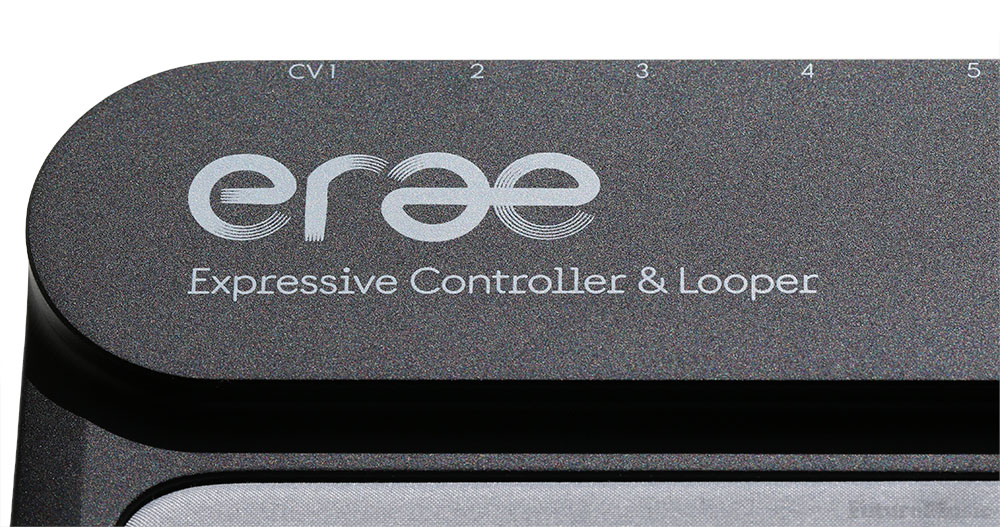
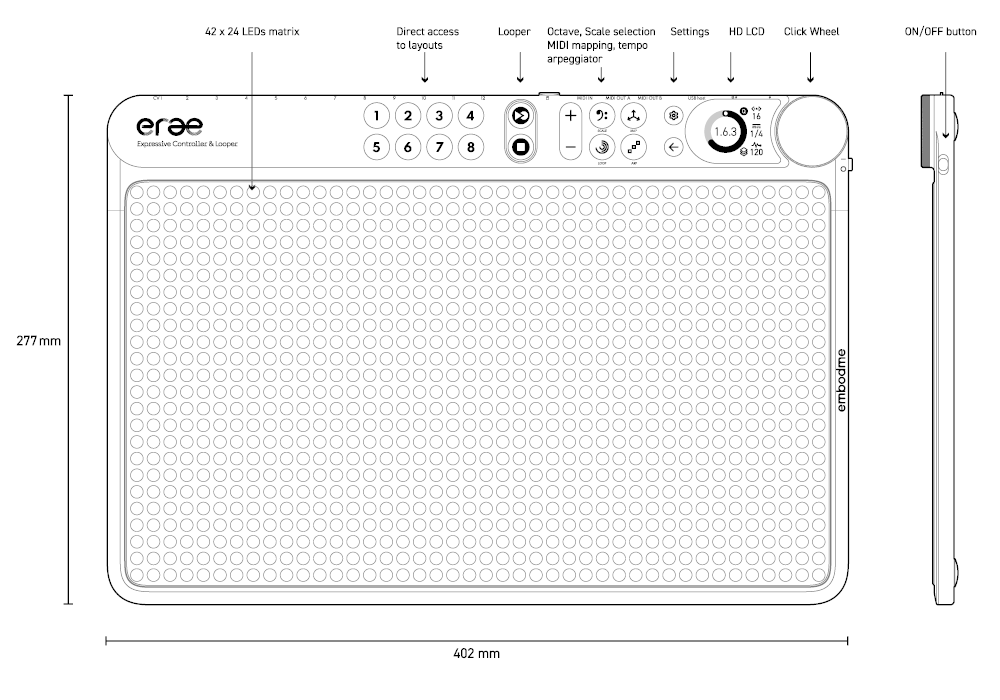
The Erae 2 is best described as an expressive controller and looper. Its core is a flexible playing surface embedded with 16,000 force sensors, driven by Embodme’s patented Force Multi-Touch technology, which reads pressure, position, direction and speed across a 42 by 24 RGB LED matrix. The company quotes roughly 100 micrometer positional resolution on the X/Y axis in both absolute and relative modes, and global latency is touted as under one millisecond. Where the original Erae was a MIDI device first and foremost, the second generation opens up dramatically for the modular world with 24 configurable analog outputs arranged across twelve dual TRS jacks, each assignable as control voltage, gate or trigger.
The Erae 2 adds a proper hardware control section too, with a high resolution LCD, a clickable rotary encoder, dedicated transport buttons and eight scene selectors, all of which the first model lacked. Rounding out the package are an eight track looper with per track length, quantization and tempo, a smart arpeggiator with key and scale selection, support for MIDI 1.0, MPE and MIDI 2.0, and the free Erae Lab software that lets players drag and drop keyboards, pads, faders, buttons and X/Y zones into fully custom layouts.
Pick up the Erae 2 and the first thing that registers has nothing to do with sound. It’s a sense of sophistication…
The surface itself is covered by swappable skins, with a thin four millimeter fabric skin included for fingertip play and thicker six millimeter silicone skins sold separately for stick and percussion work. Compared with its predecessor, the headline enhancements are clear, namely a grippier and far more sensitive surface, the enormous expansion of analog I/O, the tactile onboard interface, the integrated looper and a much more mature software ecosystem that Embodme has continued to extend through firmware updates such as 1.09, 1.1.2 and the substantial 1.1.3 release in January 2026.
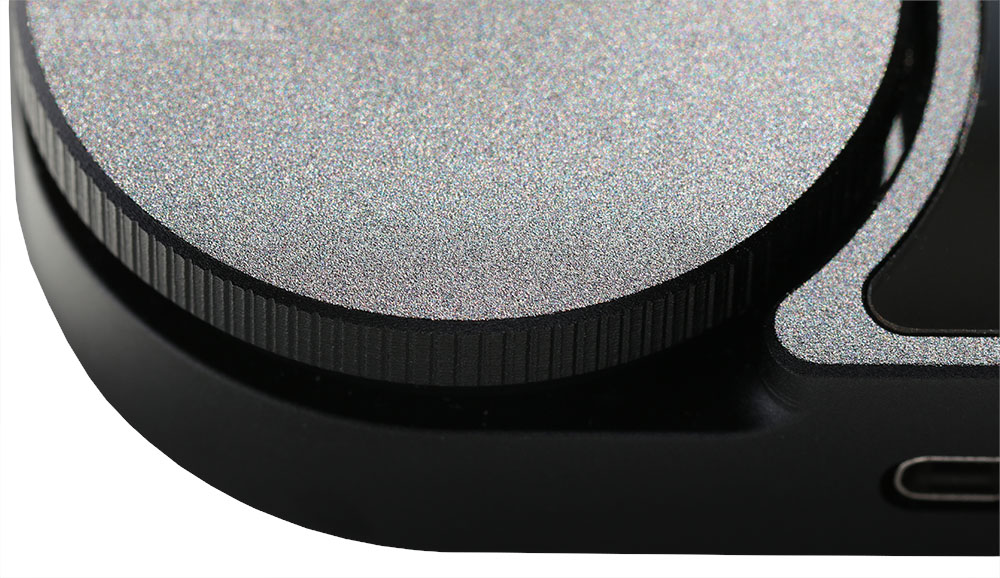
Pick up the Erae 2 and the first thing that registers has nothing to do with sound. It’s “a sense of sophistication.” The brushed aluminum housing “feels substantial’ and seems “as though it was milled from a single block.” With a weight of two and a half kilograms across a 40 by 28 centimeter footprint, is “substantial rather than portable,” which turns out to be a big plus on stage where it “simply stays put.” The LCD is bright and legible, and the encoder and backlit buttons feel solid with none of the wobble or hollowness that plagues cheaper controllers. “This is a piece of hardware that announces it’s pro right out of the gate.”
Embodme Erae 2 Review
When you first touch the surface, “a smile immediately erupts on your face.” Rather than the hard rubber of a pad grid or the rigid plastic of keys, the Erae 2 offers a gently springy skin that responds to pressure, movement and speed all at once. This is the defining characteristic of the instrument, and when it reveals itself, “it’s beyond satisfying.” In use, this tactile experience “is genuinely difficult to convey in words, and is much closer to an acoustic instrument reacting to the player than to a button being pressed.” All of our evaluators consistently singled out this quality, and often described it as combination of “luxurious,” “organic” and “pleasurable.”
The second generation surface is noticeably more precise and sensitive than the original. That improvement matters, because sensitivity was precisely where many users felt the first Erae came up wanting. A couple of our evaluators stated it can definitely compete with the expressive high-water marks of an Osmose, a Haken Continuum, Eigenharp, and the Roli Seaboard.
The full magic emerges when the surface is paired with an MPE capable sound source. Pitch bends follow a sliding finger, vibrato answers to gentle pressure, and filter sweeps open with a lateral glide, all simultaneously and per note. Testing against software such as Serum 2 and hardware like the ASM Hydrasynth or the Oberheim OB-6 shows just how precisely parameters can be shaped through touch alone, and the result is “staggering.” For sound designers and film composers this is close to a superpower, since a vibrato executed by hand carries an immediacy that no programmed LFO can match.
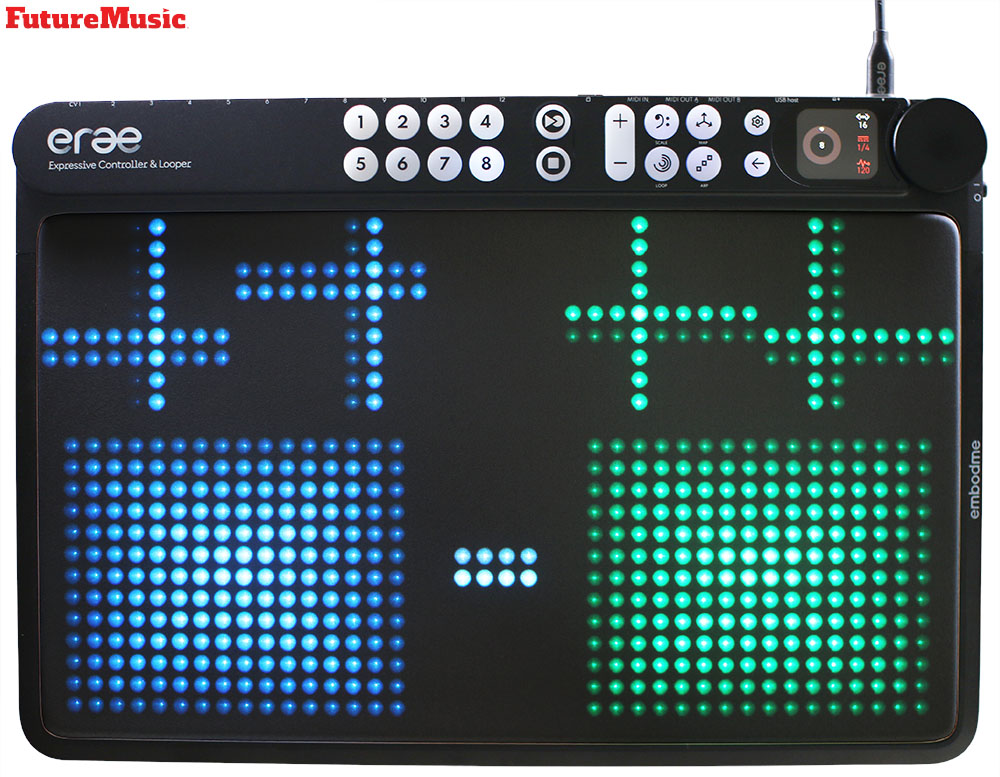
The single most defining trait of the Erae 2 is that it has no fixed shape, because the entire playing surface is a blank canvas that the player draws upon in the Erae Lab software. Using a drag and drop editor that behaves like a modular construction kit, you place and size whatever musical and control elements you need on the surface area. “It’s a bit like digital Lego,” remarked one tester.
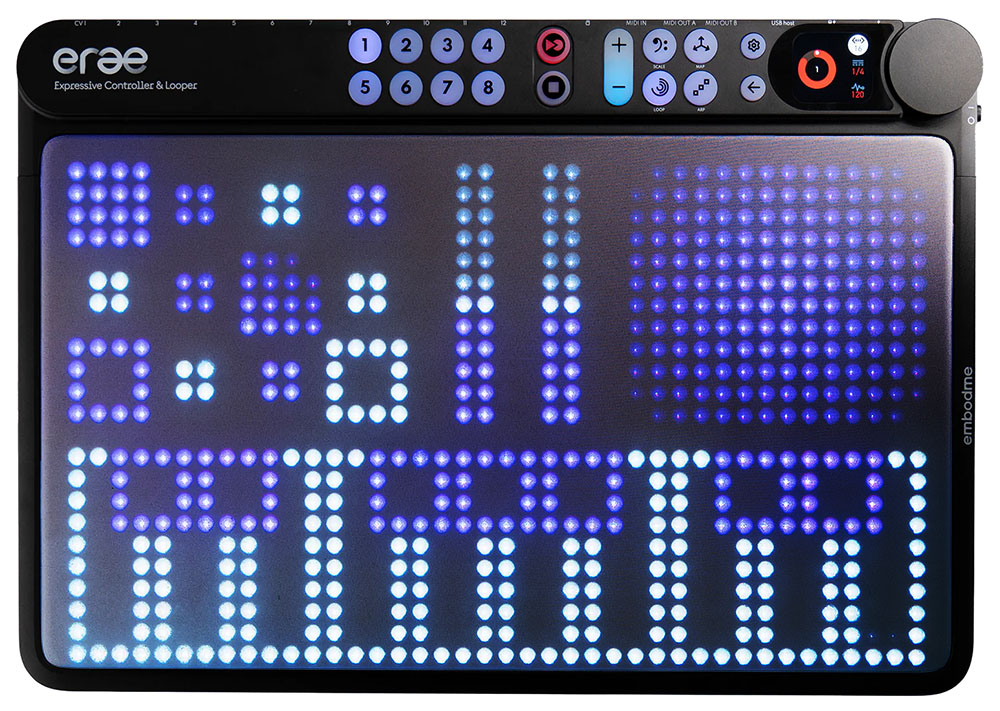
You can lay down a chromatic piano keyboard for melodic work, an isomorphic note grid in the manner of a LinnStrument for fourths based fingering, an 8 x 8 matrix of drum pads for finger drumming, banks of faders for mixing, assignable buttons for transport or clip launching, dedicated X/Y modulation pads for two dimensional control, continuous note rows, trigger zones and even sequencer areas, all of which can be combined freely within a single layout.
Thanks to the 42 by 24 LED matrix which illuminates each zone, the surface visually redraws itself to match whatever you have designed in Erae Lab. Up to eight complete layouts live in the hardware scene buttons at once, so a live performer can jump from an expressive keyboard to a drum grid to a full mixer with a single button press, and each element can output MIDI, MPE or control voltage independently, meaning one pad can send a gate while its X and Y positions drive two separate modulation destinations at the same time. This is what separates the Erae 2 from a Push or a Launchpad, since you are not selecting from preset modes but authoring the instrument’s entire interface “to fit your music.”

The easiest way for electronic musicians to get their music onto Spotify, Apple Music, iTunes, Amazon Music, Tidal, Instagram, Facebook, TikTok, Pandora, Twitch & much more! Click the banner above or the Go Button to save 7% off of your signup! GO!
What breathes life into all of those zones is the surface underneath them, and this is where the 16,000 force sensors of Embodme’s patented Force Multi-Touch technology come into play. Every point on the pad reads not just whether it was touched but how hard, tracking pressure, position, direction and speed continuously and from a very low threshold force, so the softest feather touch and the hardest percussive strike sit at opposite ends of a smooth dynamic range rather than triggering an on or off switch. That continuous sensing is what makes finger sliding so expressive, because as you glide across the surface the instrument follows your movement with roughly 100 micrometer X/Y accuracy in both absolute and relative modes, letting a lateral slide open a filter, a vertical slide add timbral movement and a small circular motion produce vibrato, all without lifting the finger. Put this way by one reviewer, “the Erae 2 is one of the only controllers that actually understands hand technique.” This attribute “should not be taken lightly.” In the right hands, “it’s jaw dropping.”

Erae 2 is one of the only controllers that actually understands hand technique…
Paired with an MPE capable sound source, each of those gestures is polyphonic and per note, so one held chord can have every finger bending pitch, shifting timbre and swelling in pressure independently, which is precisely the kind of articulation an acoustic player takes for granted and a typical keyboard or controller cannot offer. The gently springy skin, whether the velvety fabric surface or the more robust silicone, gives the finger something to dig into and press against, and our reviewers alike have described the result as “feeling less like operating a controller and more like playing an instrument that responds to every gesture and nuance.”
The Erae 2’s integrated looper is one of its most overlooked strengths. Rather than presenting eight conventional mixer-style tracks, it provides eight independent MIDI loopers, with one assigned to each of the instrument’s eight layouts. More importantly, it captures far more than note events. Because every touch on the Erae surface generates expressive MIDI and MPE data, each loop records the complete performance: finger position, pressure, slides, pitch bends and other gestures. “This isn’t your Daddy’s looper.”
Each of the looper’s layouts offers independent controls for loop length, quantization and synchronization, making it possible to layer phrases of different lengths into evolving polyrhythmic performances. Recording is handled directly from the hardware using dedicated Start, Record and Stop buttons alongside the LCD and rotary encoder, while switching layouts instantly recalls the corresponding loop. The workflow encourages performance rather than programming: record a rhythmic foundation, overdub expressive melodies or percussion, then continue building the arrangement in real time without ever reaching for a computer.
Where the looper truly distinguishes itself is in playback. Those recorded performances are not confined to MIDI alone, they can also drive the Erae 2’s configurable CV and gate outputs, allowing expressive loops to control an entire modular system with the same pressure, pitch and gestural detail originally performed on the surface. Very few expressive controllers offer this level of integration between MIDI and Eurorack.
So is the looper a net positive or a net negative in the context of everything else the Erae 2 offers?
To its credit, Embodme has treated the looper as a flagship feature rather than a static addition, steadily expanding its capabilities through firmware. Version 1.1.2 increased maximum loop length to 256 steps while adding instant doubling and halving shortcuts for rapid arrangement changes, and version 1.1.3 further streamlined loop editing during playback while extending footswitch support for hands-free performance control. Early firmware revisions did “exhibit a handful of looper quirks,” but Embodme has addressed them through continuous updates, and the pace of development suggests the company views the looper as a feature that’s here to stay.
So is the looper a net positive or a net negative in the context of everything else the Erae 2 offers? On balance, it is a decisive net positive. The reason has less to do with feature count than with identity. The Erae 2 was designed to be a self-contained expressive performance hub, capable of replacing several dedicated devices in a hybrid studio or live rig. Its integrated eight-track looper, with one independent MIDI loop assigned to each of the eight layouts, completes that vision. Without it, the Erae 2 remains an exceptional expressive controller that depends on an external sequencer or DAW to capture performances. With it, the instrument can build layered performances, drive modular systems with evolving expressive CV, and perform independently in ways that very few controllers at any price can match.

Read Next: The TRS MIDI Debacle
FutureMusic Special Report: How the music technology industry abandoned 40 years of interoperability, let manufacturers run wild, and turned a simple connector swap into a crisis of confusion, incompatibility, and lost trust… The TRS MIDI Debacle
Connectivity is where the Erae 2 pulls decisively ahead of nearly everything else in its class.
The trade-off is complexity. The looper adds another powerful subsystem to an instrument that already rewards study and serious practice. Musicians who work exclusively in Ableton Live’s Session View or rely on dedicated loopers may never use it. Even so, because it is deeply integrated into the instrument’s architecture rather than bolted on as a marketing feature, it strengthens the Erae 2’s core proposition far more than its learning curve detracts from it. For modular musicians and expressive live performers, the looper is not merely a bonus feature, it is “one of the Erae 2’s defining strengths.” For everyone else, it remains an optional but welcome capability.
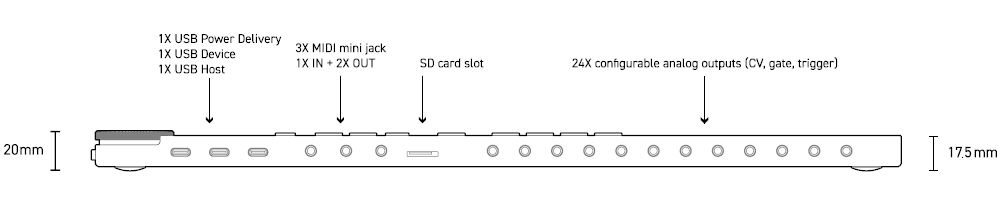
Connectivity is where the Erae 2 pulls decisively ahead of nearly everything else in its class. The twenty four control voltage, gate and trigger outputs let it drive an entire modular system with no additional interface required. Next to these outputs are a MIDI input, two MIDI outputs, a USB-C port capable of host or device duty, and a micro SD slot. In a hybrid studio, this allows the instrument to become “a genuine central hub, replacing the separate boxes” that would otherwise be needed to handle MIDI, control voltage and looping. The manufacturer’s claim of sub millisecond latency, that hasn’t been independently verified by a third party lab, does hold up to scrutiny in use, since even dense streams of MPE data track the hand without any perceptible lag.
Embodme Erae 2 Features and Specs:
- Fully customizable, 16,000-point FSR matrix interface
- Innovative MPE MIDI controller and looper
- 3D touch-sensitive surface for detailed expression
- Drag-and-drop controller elements via the Erae Lab app
- 8-track looper with overdubbing and length options
- Pressure-modulated arpeggiator for dynamic phrasing
- Interchangeable Fabric + Silicone skins for different applications
- 24 configurable CV/Gate outputs for modular control
- Intuitive interface with backlit buttons and LCD display
- Open API for advanced customization and control
- Integrates fully with the Erae Sound software
- Dimensions: 15 x 11 x 0.8 in / 402 x 277 x 20mm
- Weight: 5.5 lbs / 2.5 kg
- 1x USB Type-C power
- 2x USB Data Type-C (host + device)
- 1 x 3.5mm TRS MIDI In / 2x 3.5mm TRS MIDI Out
- 24 x 3.5mm Configurable analog outputs

Support Ambient Music
StretchMetal and the Atmospheric Music Alliance are raising $5000 to support ambient music events taking place across the United States, and virtually with the Atmospheric Music Alliance. Contributions will go directly toward artist and venue fees, production support and the continued development of AMA. Please consider donating today!
Embodme Erae Sound Review
For most of the Erae 2’s life, the controller depended on other MPE-enabled synths to supply the sonic juice. Meaning, Embodme had built one of the most expressive surfaces ever made, yet it required every buyer to hunt down compatible plug-ins and then configure the surface into a playable layout for each one. Not any more. After hyping it at SuperBooth this year, Embodme officially released Erae Sound, their own digital synth, last month (June 2026). It is worth being accurate on how it’s actually implemented since early internet chatter, stating Embodme was baking a synth engine directly into the controller’s firmware, had it wrong.
To be precise, Erae Sound is a software plug-in rather than an onboard hardware engine, running as a standalone application and as a VST3 and AU plug-in, and while it is optimized for the Erae 2, it is compatible with any MPE controller and works across the major DAWs including Ableton Live, Logic Pro and Bitwig. At its heart sits a virtual analog engine built from two dual oscillator sections with continuous waveform morphing, a wavefolder, dual morphing filters and FM. Its most compelling idea is that every one of its presets ships with its own matching Erae layout, so that choosing a sound automatically reshapes the surface to suit it. The launch library contained 84 presets and layout pairings, but that has now been expanded to 101 presets, suggesting that Embodme may continue to expand the presets as new updates emerge.
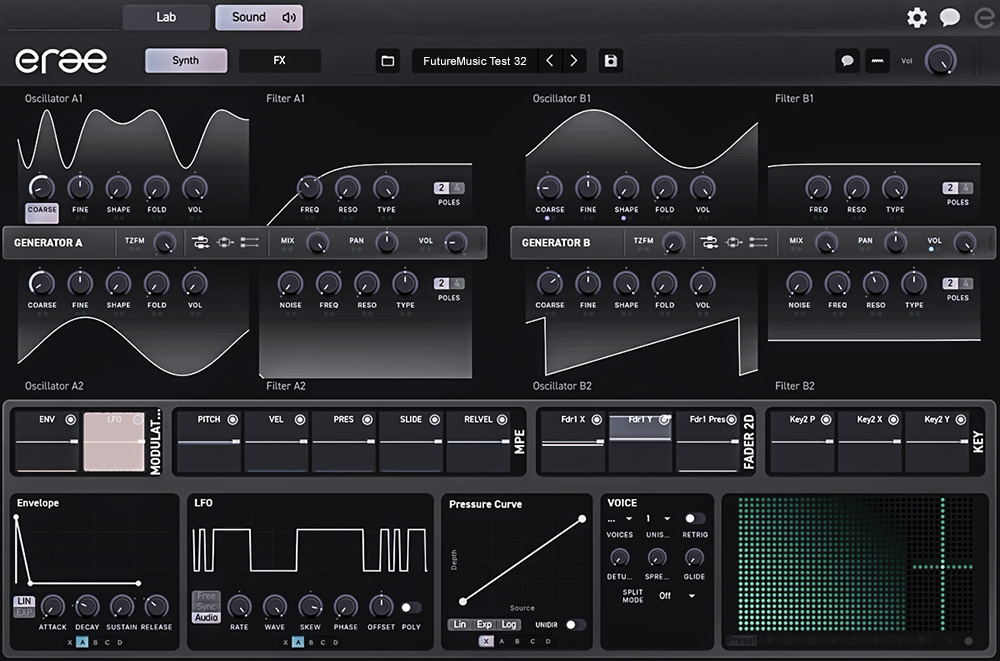
As mentioned above, Erae Sound’s strongest atrribute is the tight integration between the hardware and software. That is the crux of the appeal. Because each preset arrives as a complete instrument, with its own voice, its own feel and its own arrangement of the surface, the friction that used to sit between the Erae 2 and a satisfying sound simply evaporates. The engine’s specs are full bodied and the sound mostly holds up in practice, with a modulation system that is refreshingly free of the usual constraints, since every parameter carries its own ADSR and LFO that can run free, tempo-synced or at audio rate, with polyphonic LFOs, waveform morphing and link groups, and no fixed modulation matrix or slot limits to hem the player in.
More impactful is that the software is aware of layout choices on the hardware thanks to bidirectional sync. Meaning, adding modulation sources such as an XY pad or a fader to a layout makes it appear as an assignable modulation source inside the synth. A four slot effects section offers nine quality processors spanning distortion, chorus, flanger, phaser, delay, reverb, shimmer, compressor and parametric EQ, with per generator wet sends and every parameter open to modulation. Our two testers impressions were mixed. One felt it “could be more inspiring” and “some of the presets sound quite dated.” He compared its character to Roli’s Equator and FXpansion Strobe 2, two synths that are proficient, but “won’t have Xfer Records (Serum) looking over its shoulder.” Our other tester thought that Erae Sound was enough of a solid foundation to warrent the entrance fee. It’s “one-page interface with zero menu diving, and clever communication with the hardware, created an environment that was instantly playable and beautifully integrated.” On balance, “it’s a win for Embodme” but the French company “won’t be able to rest on its foundational laurels” and will need to “continually update the synth to meet expectations.”
Erae Sound is a software plug-in rather than an onboard hardware engine, running as a standalone application and as a VST3 and AU plug-in, and while it is optimized for the Erae 2, it is compatible with any MPE controller and works across the major DAWs including Ableton Live, Logic Pro and Bitwig.
The clearest misstep with Erae Sound is not the synth itself, but the price point. Embodme should have made the synth free to current hardware owners, or available at a steep discount. Selling the Erae Sound for $29 to Erae hardware owners and retailing it at $99 would have not only demonstrated that Embodme was “giving back” to early adopters, but also showcased the overall value proposition.
Worse, is the five minute timeout on the demo version per session. This limited time span can’t even begin to promote Erae Sound’s features. In fact, our more demanding evaluator outlined how the timer expired while they were still configuring settings and attaching their controller, leaving them unable to actually hear the instrument before the demo locked them out. A five minute window is simply too short to evaluate a synthesizer, and it risks turning curious players away before they ever get their arms around the synth’s attributes. The suggested remedy is a sound one, namely a free player version that lets anyone play the full preset library and charges only for the ability to edit and design new sounds, which would both showcase the instrument properly and lower the barrier to entry. Or simply expanding the time limit to something more reasonable.
Overall, Erae Sound is a solid first shot across the bow for Embodme, but it’s a bit immature.
FutureMusic Erae Sound Rating: 82%
Back To The Erae 2 Review: The Erae Lab software is the connective tissue that makes all of this coherent. Every zone on the surface can be assigned freely, mixing pads, faders, X/Y fields, note rows, triggers and sequencer areas into a single layout, and up to eight complete layouts can be stored and recalled from the hardware scene buttons.
Switching from an eight-by-eight drum grid to a multi track mixer to a full expressive keyboard becomes a matter of a single press of a dedicated button, and the backlighting keeps every zone visible even on a dark stage. This “flexibility is intoxicating once it clicks,” but it is also the source of the instrument’s steepest demand on the player. There is no pretending otherwise, since this is a device that must be fully understood before it rewards you. “It’s not a complicated interface, but patience is definitely required at the jump,’ noted one reviewer. “However, those who invest the time will have the satisfaction of playing an instrument of their own design rather than operating a machine.”
The Erae 2’s flexibility is intoxicating once it clicks, but this is a device that must be fully understood before it rewards you…
For all its accomplishment, the Erae 2 arrived with rough edges that a critical review cannot ignore, and most of them cluster around software maturity rather than the hardware itself. The device shipped as a genuinely new product, and it behaved like one. Our first testers reported minor firmware bugs around control voltage routing and around certain USB devices failing to connect cleanly. The looper, one of the marquee features, also came in for early criticism for small quirks, and some advanced configuration zones such as the API area were not initially available. Embodme has clearly been chasing these issues, and the 1.1.3 update in January 2026 addressed a great deal, tightening arpeggiator timing, loading projects automatically at startup, restructuring saving to prevent accidental overwrites and raising the number of elements a single layout can hold. That responsiveness is admirable, yet the very fact that so many practical improvements were still landing more than a year after launch tells you the instrument reached buyers “before it was truly ready to rock.”
Conclusion
The Erae 2 is one of those rare instruments that changes how a musician thinks about the physical act of playing. It is not for everyone, and it does not pretend to be, but for the producer or performer willing to meet it halfway, it offers a depth of expression and a breadth of connectivity that almost nothing else in its price range can touch. Eurorack users will find the CV connectivity and the expressive surface to the answer to their dreams. Highly Recommended.
Embodme’s Erae 2: $899
Erae Sound: $89
Black Silicone Skin: $149
Silicone Skin: $89
Fabric Skin: $45
Protective Cover: $54**
Price Note: Prices are quoted in US dollars and are different in other countries and geographical locations.
** Embodme Erae 2’s Protective Cover Was Not Tested By FutureMusic.
Cheers:
+ Exceptionally sensitive and responsive playing surface with a natural, organic pressure response
+ Enormous Analog I/O options with twenty four configurable CV, gate and trigger outputs, ideal for modular and hybrid rigs
+ Deeply configurable layouts through the powerful Erae Lab software, with eight instantly recallable scenes
+ Premium aluminum build quality with a genuinely useful onboard interface, LCD and encoder
+ True MPE depth that makes synth lines feel organic rather than programmed
+ Integrated eight track looper, smart arpeggiator and polyphonic aftertouch in one unit
+ Swappable skins that adapt the surface for fingers or sticks
+ Active development with substantial free firmware updates continuing well after launch
Jeers:
— Early firmware bugs and occasional standalone boot issues (Gradually resolved through updates…but patience required. —Ed.)
— Somewhat awkward skin swapping
— Fabric skin can wear quickly if not cared for…
— High price that represents a real investment for most musicians (But well worth it! —Ed.)
— The learning curve can be unsuitable for anyone wanting instant plug and play gratification
The Future: Looking ahead, the single most valuable thing Embodme could deliver in the next iteration is a genuinely welcoming on ramp that preserves the instrument’s depth while dissolving its intimidation, meaning a library of guided, ready to play templates and an interactive tutorial layer built straight into Erae Lab. This way, the controller will feel inspiring within minutes rather than daunting for hours. Next would to re-evaluate the skin replacement system that lets players swap fabric and silicone freely without exposing adhesive or fearing damage. We would continue the firmware hardening so that standalone boot reliability and looper behavior become invisible non issues. If the company is feeling truly ambitious, maybe bake in Erae Sound into the hardware, so it doesn’t need to be tethered to a computer.
Interview With Edgar Hemery
FutureMusic: Can you please tell us about your background?
Edgar Hemery: Started music at the age of 6 (Saxophone, Piano and Doublebass), finished Music School (Concervatoire) at 19Yo, had a rock bands (guitar, pedals) since 13yo and got into computer music at 16yo. I was recording my demo version Ableton Live Session on my tape recorder in 2005.
FutureMusic: What was the inspiration for starting Embodme and developing the Touch?
Edgar Hemery: During my PhD in gesture-sound mapping, I wanted to create a tabletop surface that senses gesture, not only touch but also mid air. Then met Mathieu – CTO – who had the industrial solution for touch. Mid-air was broken down and still under development, but hard to make it right.
FutureMusic: The Erae 2 seems to straddle two worlds, one as a performance looper and one as a MIDI controller. Both work as advertised, but as you went from the Erae 1 to the Erae 2, were you faced with a decision at any point to focus on one or the other?
Edgar Hemery: We always wanted to do a product that serves both studio and performance situations. Like a guitar or a piano, like an instrument. Erae is a controller to be played And you can use it to “control” sending triggers, changing parameters to your DAW or synths with sliders, fully configurable buttons etc. We do not feed the need to differentiate the two functionalities perform and control as they can work in the same environment. It’s faster and more fluid than using several different machines. The looper is more oriented toward live use, but wait until you see its integration with the upcoming sequencer element… Also, it’s really nice to use the looper to control automations when you sound design and produce.
FutureMusic: What was the single biggest criticism of the original Erae that directly influenced the design of Erae 2?
Edgar Hemery: It was actually an internal decision, the lack of immediacy and one-to-one operations such as changing a scale, a mapping, a layout, haveing more visual feedback and control over the various parameters.
FutureMusic: How many different sensing technologies did you evaluate before settling on the final surface?
Edgar Hemery: We are all engineers and musicians in the core team. The sensor technology has been the same one from day one, but we kept on refining it, researching and modifying the chemistry of sensing liquids used in the sensor cells, changing the electronics in order to get the shorter paths, the less distorition, the widers dynamics, the finer resolution.
FutureMusic: Which feature took the most engineering effort relative to how simple it appears to the user?
Edgar Hemery: The jog wheel, it’s still somewhat a joke how complex it is for a relativley low perceptual output. It uses a IR emitter/receiver to sense the distance and decide whether it clicks or not.
FutureMusic: Was there ever serious discussion about adding haptic feedback or physical tactile guidance to the surface?
Edgar Hemery: Yes, we actually packed a haptic actuator as an eastern egg in the controller. Enable it and launch the metronome, you’ll sense it. We wanted to do more, but it takes time and it would increase the price. Work in progress…
FutureMusic: Looking back now, what was the most difficult compromise between expressiveness and usability?
Edgar Hemery: The lack of physical knobs limits some operations, the slider element works, but it’s not the same. Packing the notch with knobs would be have complexify the product’s design and increase the price. That’s the compromise.
FutureMusic: What feature almost made it into Erae 2 but was ultimately cut from the final release?
Edgar Hemery: None, that’s the problem.
FutureMusic: (Laughs) What component caused the biggest supply chain headache during development?
Edgar Hemery: The smallest components such as resistors, the ones that are badly stored or lost, that you don’t really expect to cause an issue, but they do big time.
FutureMusic: As a small company, how did you decide which components deserved premium investment and where you could afford compromises?
Edgar Hemery: The aluminum casing, its coating, the surface material, everywhere you put your hands on. We want our customers to feel they play an instrument, not a piece of plastic.
FutureMusic: Reflecting on your Embodme journey, what manufacturing decision are you most proud of?
Edgar Hemery: We aren’t necessarily proud of moving the assembly to our offices, but it gives us a tighter connection to our product that we feel every day.
FutureMusic: What lead to the decision to create your own soft synth?
Edgar Hemery: Mapping a controller, especially MPE with an external plug-in is almost like engineering. And you need to do that with as many plug-ins as there are out there, all with different mapping methods and their limitations. Now, open the Erae Lab and play with the expressive controls, that’s it.
FutureMusic: What features does Embodme Sound contain that take advantage of the Erae 2 that no other soft synths contain?
Edgar Hemery: Instant mapping of any gesture to any sound parameter – everything is direct, on the front page, no right click, no sub menus, no lists.
FutureMusic: If you had unlimited resources, what Embodme product would you create in the future?
Edgar Hemery: Perhaps a touch+mid-air sensing interface with full 3D haptics and titanium built in…