Torso Electronics T1 Sequencer Review
Copenhagen’s crowdfunded sequencer wants you to explore note generation in its convoluted environment, and makes you work much harder than it should…
Torso Electronics is a small Copenhagen company established in 2018 by a group of friends whose first collaboration is the T-1 sequencer. When it was unveiled in December 2019, Torso described a 16-track polyphonic MIDI sequencer with Turing-inspired pseudo-random modulation on every parameter that could be locked into loops. Instead of a detailed and informative screen, Torso provided multicolor keypads and clickable knobs. The company claimed it wanted to go beyond the limits of a traditional sequencer while keeping the interface simple, user-friendly and free of menu diving. That didn’t exactly work out.
The Kickstarter campaign that paid for production ran from June 8 to July 8, 2020, hit its goal in about fifteen minutes, and closed with 429 backers pledging DKK|1,272,530 against a DKK|160,000 target. That money changed the hardware. Reaching the CV stretch goal meant the T-1 would ship with USB-C, CV and gate connectivity, in addition to a power jack, three 3.5 mm MIDI jacks for In, Out and Thru, and higher-quality detented knobs. Torso pitched it to backers as several machines in one: a Euclidean rhythm sequencer, a melody and harmony generator, an advanced arpeggiator, a randomizer, a performance instrument and a MIDI effect processor. Delivery was planned for December 2020, and shipping actually began in the spring of 2021, not a bad delay, considering other JunkStarter campaigns such as Tangible Instruments Arpeggio, Boaz One modular guitar and the Artiphon Orba to name a few (…and why FutureMusic never reports on KickStarter projects prior to delivery. Ed.)

For a limited time only! Up to 80% off all Waves Bundles. PLUS click the banner above or the Go button for an additional 10%! This is Waves best deal yet! Get yours today before this special ends! Go!
Two significant updates followed in the first year, which demonstrated that Lars Buchholtz Jensen and his “team” (no other employees are mentioned or cited to this day, and emails to the company have gone unanswered. —Ed.) were intent on fixing bugs and adding features, but that early elation quickly diminished when updates fizzled out. Firmware 1.1, released at the start of September 2021, added multitrack editing, global pattern editing, relative changes across cycles, pattern chaining, parameter copying, a track and pattern clipboard, and tempo visualization. Firmware 1.2 arrived on March 24, 2022 with a detailed changelog and an updated user manual,. It added MIDI CC tracks whose knobs can be modulated by the pseudo-random engine, a tail mode for repeats that run free of the clock, and repeat counts from 0 to 48 plus infinite. It also brought a new Ramp voicing style, up and down modifiers for every style, 1.2V/oct support for Buchla systems, a clock latency setting, steadier MIDI and analog clock sync, the ability to drive Link devices from incoming MIDI or analog clock and improved CV outputs.
Being a dedicated sequencer, the T-1 makes no sound of its own. It contains 16 tracks per pattern, 16 MIDI channels, polyphony on every track, 16 patterns per bank and 16 banks. The big feature is a Euclidean rhythm generator with step editing, an advanced note repeater and arpeggiator, a melody generator, seven musical scales plus one user scale per track, harmonic pitch control, and random modulation on every parameter. The panel carries 18 endless rotary encoders that also click, and 23 RGB backlit silicone keypads. The 16 pads on the left handle sequencing, while the right side covers navigation and starting and stopping. Among those right-hand keys, seven pads take care of muting, bank selection and the other master functions. The feel of the pads won’t win any awards and the non-adjustable backlights are quite dim by today’s standards.
The encoders are quite solid and fall into four sections that reflect how the machine works…
The encoders are quite solid and fall into four sections that reflect how the machine works. Shape sculpts the rhythmic cycle, adds note repeats and builds arpeggios and melodic movement. Groove sets base velocity and sustain and changes the feel through timing and accent. Tonal adds and changes notes, scrolls through harmonies and locks pitches to scales, while Setup holds the basic settings and the random modulation that reaches every parameter.
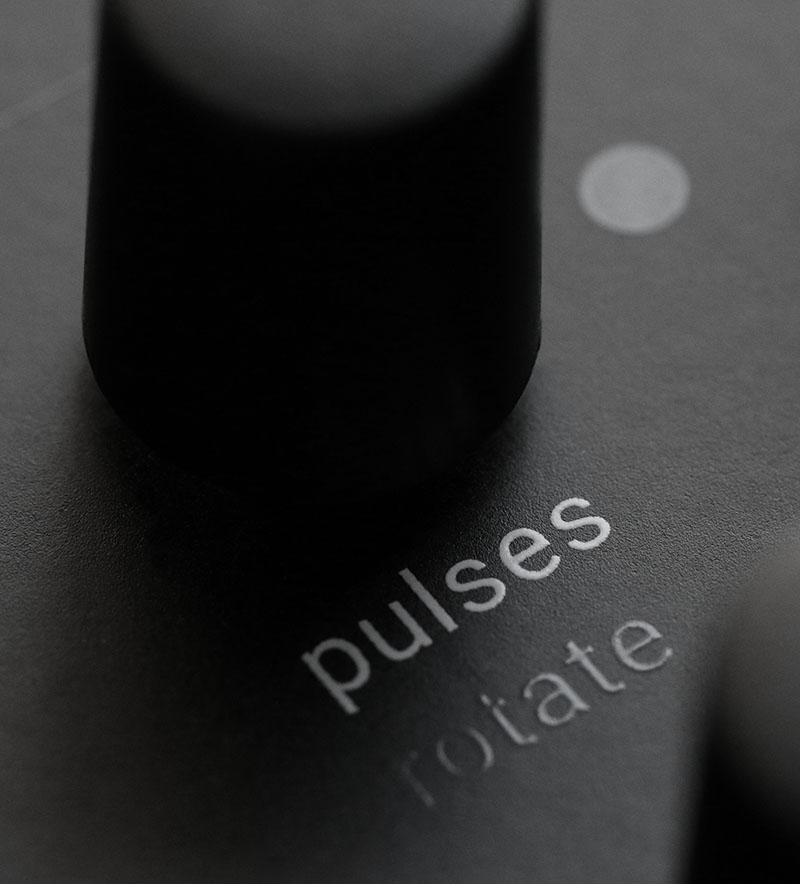
A track starts with Steps, which sets the length of the cycle, and Pulses, which spreads notes evenly across it. Press and hold the Pulses encoder while turning and you can watch the pulses light up orange and slide into new positions. Rotate offsets the start of the cycle, and up to 16 cycles can be chained so they play one after another. The Temp button lets you hold it, make changes, and return to your defaults when you let go. Underneath all of this, a voice-leading algorithm supplies a wide range of voicings designed to make chord changes sound smooth, but sometimes stumble over itself.
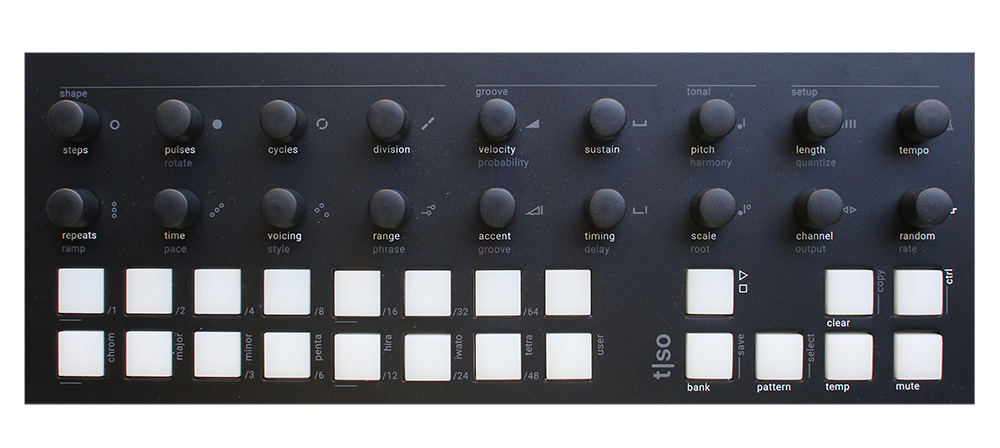
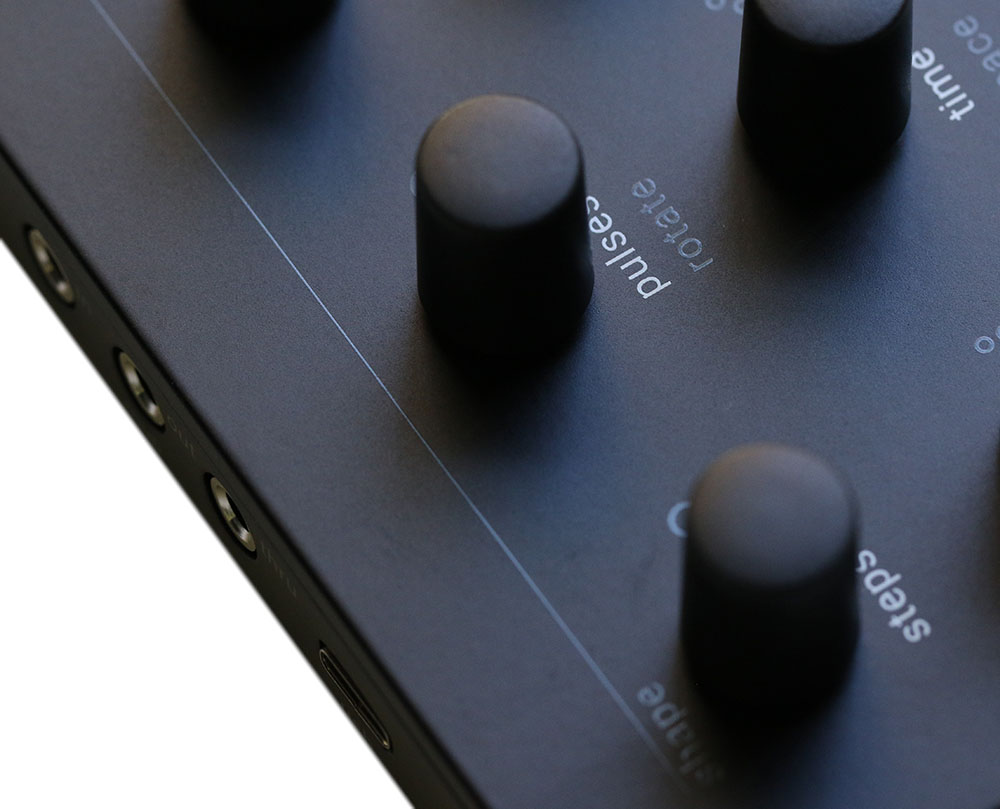
The Torso Electronic T1 Sequencer is a dust magnet and even in bright natural light the silk-screened control names are not easy to read.
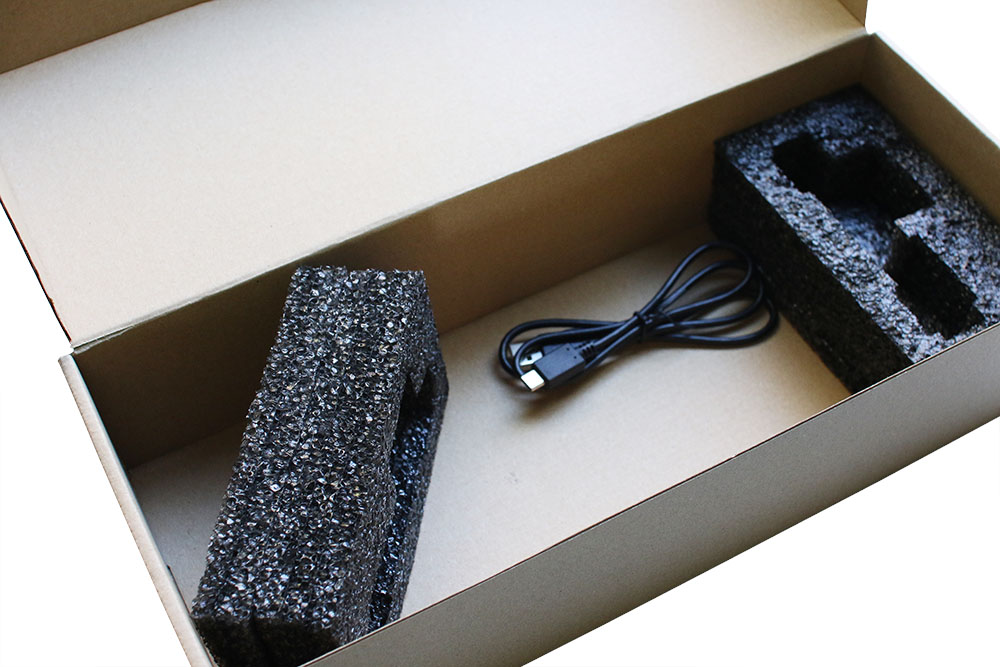
As previously mentioned, the connections provide MIDI In, Out and Thru use 3.5 mm TRS Type A jacks, and a TRS to MIDI DIN adapter comes in the box. The USB-C carries both MIDI and power. The analog side offers two gate outputs, four CV outputs, a CV input, and clock and reset jacks as both inputs and outputs. Ableton Link runs over Wi-Fi. Firmware updates and settings such as clock latency are handled in Torso’s T-1 Config software on a computer. The matte black aluminum case measures 304 x 114 x 39 mm and weighs 815g. There is no battery and no power switch, the unit turns on as soon as it is connected. In the box you get the T-1, a USB cable and a TRS to MIDI DIN (Type A) adapter.
The rival closest in ambition is the OXI One, running four independent sequencers. Each can work in Multi mode with eight tracks of its own, Chord mode with a palette of chord types, Poly mode with up to seven voices, or Mono mode, so running all four in Multi mode gives you 32 tracks. It also offers storage for 15 projects with up to 16 patterns each, up to 128 steps per sequencer, and eight configurable CV and eight gate outputs, plus a CV input that doubles as a clock input, Bluetooth MIDI, and power from batteries or USB. At heart it is a grid-based sequencer for placing and playing notes, with random generation, random performance and a harmonizer built on top.
The T-1 flips that script. You do not place notes. You twiddle a rhythm as a ratio of pulses to steps and let the Torso place the notes. Randomness infects most aspects of the process. Because the random sequences can be locked into loops, the result is variation that repeats. Harmony is generated as well: choose a few notes, lock them to a scale, and the voicing and harmony controls build progressions from that pool. Sixteen polyphonic tracks are always available, with no modes to switch between.
The T-1 has Link over Wi-Fi and dedicated clock and reset jacks in both directions…
The T-1 has Link over Wi-Fi and dedicated clock and reset jacks in both directions, and since 1.2 it can tie a Link session to an incoming MIDI or analog clock. The OXI’s wireless route is Bluetooth MIDI, and its single CV input also has to serve as its clock input. The OXI wins on breadth with more CV and gate outputs, battery power, longer sequences and a note grid that suits players understand the direction their musical journey is going.
Let’s just get this out of the way, the first few hours with a T-1 is pure frustration. Torso boasts: set a step count, add pulses, pick a scale and press Play, and you have rhythmic and melodic material.
It sounds super simple, but in reality trying to grasp what is happening in the beginning is mind boggling.
Torso promised an interface without menu diving, and every main parameter does have its own encoder. In practice, much of the depth sits behind a second layer reached by holding Ctrl and turning an encoder. The T-1 takes an investment of time to unlock its capabilities, and users are mandated to memorizing its controls since the names are unreadable in low light. Even if you do take the effort to learn the controls, the T1 is not intuitive, especially since many functions are hidden.
All our evaluators lambasted Torso for their terrible panel graphics…
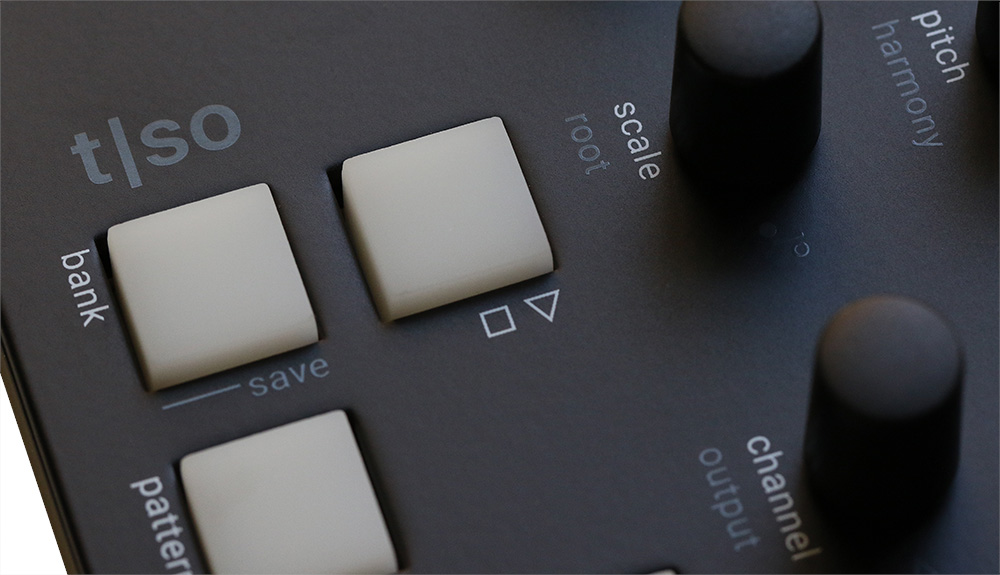
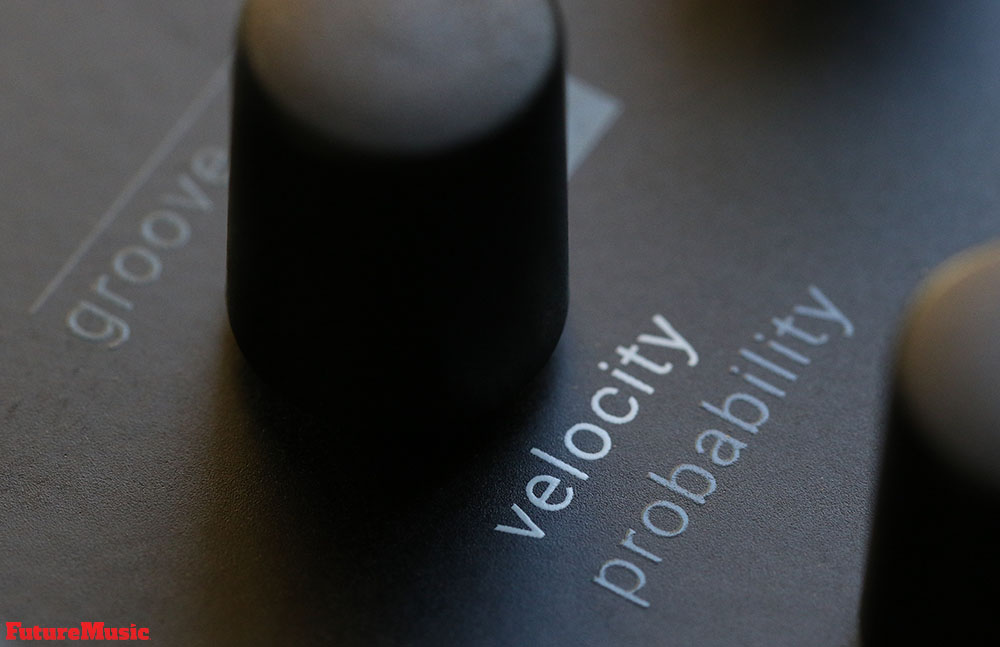
All our evaluators lambasted Torso for their terrible panel graphics, which makes using the T1 much harder than necessary. Primary encoder functions are printed in white and secondary functions in gray, and as mentioned are difficult to read even in bright light, which is just a complete fail. “It’s almost like Torso is looking to torture their users,” commented one reviewer. What’s worse is that on the matte black panel, which is a magnet for dust, that awful gray second layer is where much of the depth of the T1 resides. On the dim stages that color choice becomes a real issue and why our testers ended up putting white tape horizontally across the unit and writing down the functions by hand. On a instrument that touts its performance capabilities, that is a complete design failure, not a simple cosmetic nitpick.

MIDI Designer Is Now Free!
MIDI Designer Pro X is now free to download! MIDI Designer Pro X is a professional-grade MIDI controller platform for iPhone, iPad and Mac. User-contributed layouts let you control everything from Ableton to Yamaha out of the box. Go beyond hardware and express your musical vision. Check out out now!

The easiest way for electronic musicians to get their music onto Spotify, Apple Music, iTunes, Amazon Music, Tidal, Instagram, Facebook, TikTok, Pandora, Twitch & much more! Click the banner above or the Go Button to save 7% off of your signup! Go!

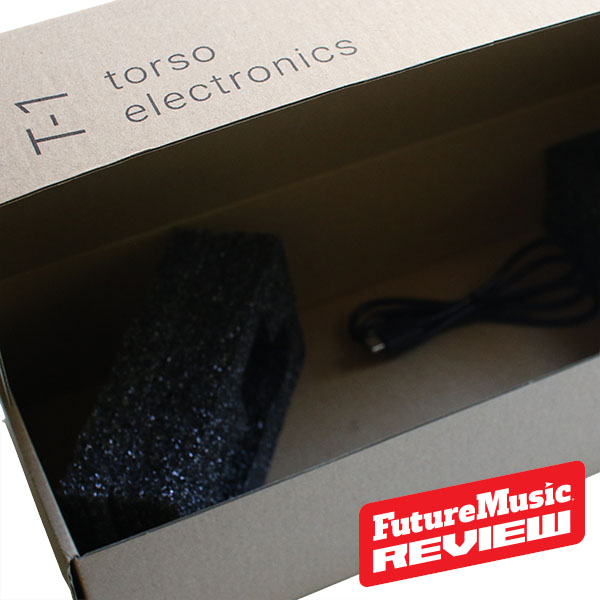
The documentation makes the problem worse and it’s just a low effort affair. The flimsy box contains only the unit, a cheap USB cable and a TRS to MIDI adapter, so you must head to Torso’s website for the manual. But that’s where the next torture begins. The manual is downright terrible with very little initiative was put forth to showcase, in an easy-to-understand manner, what the T1 can achieve. Torso does in fact “revise” the manual with each update, but on a instrument that’s not intuitive and has no screen, it lives or dies with the manual, especially since the T-1 has its own vocabulary. The functionality with repeats and offset, time and pace, voicing and style, and melody and phrase controls mean nothing until it is explained clearly. The most telling judgment on the original manual came from Torso itself. When firmware 2.0 shipped in December 2022, it brought a completely revised T-1 user manual written by SynthDawg. It was certainly better, but still comes up wanting.
Underneath, the engine has significant issues that competing sequencers have addressed. Step editing here means manually editing the rhythm on top of what the algorithm generates. There are no per-step parameter locks. Only with firmware 2.0 did Torso make it possible to edit all of the algorithms and lock parameters to any step. The release also added non-quantized division, internal track routing, stepped-to-slewed random modulation, cycle looping, and a playable keyboard.
The build quality of the Torso is above average with an aluminum chassis, nice-sized, detented encoders, solid minijacks around back and a weighty presence. The backlight pads are basic and convey the only visual information on the unit’s current status. Power comes from USB-C, which handles both MIDI and power, and that is the only option. With no battery and no power switch, the T-1 always needs a host or a supply, while the OXI can run from batteries.
Torso built the T-1 on the premise that a screen gets in the way of music creation and performance…
Torso built the T-1 on the premise that a screen gets in the way of music creation and performance. While we salute the effort, the reality is that only works if every other source of information is phenomenal, and two of them here are just terrible. The legends need a redesign that puts contrast first, with the secondary functions bright enough to read under stage lighting and clearly distinct from the primary ones. A Quick-Start Guide and Function Reference card should be included in the box. Second, the manual, while certainly improved, still needs to fire on all cylinders to education, as well as define The T1’s unique vocabulary. It should also include panel diagrams that show exactly which keys to hold.
Even with the T1’s value proposition, the sequencer should include the per-step control that rival boxes treat as standard. Parameter locks would let you pin a single note’s pitch, voicing or division without disturbing the rest of the cycle, and they would sit naturally beside the existing step editing. Free divisions, internal track routing and slewed random modulation would extend the engine without diluting it. And for the love of everything true and beautiful, a methodology to back up every bank to a computer is overdue for an instrument that Torso wants electronic musicians to take on stage.
Conclusion
Judged on its core premise, its engine and its build, the T-1 does deliver value, especially since it certainly reimagines how a sequencer should create rhythm and harmony. But that’s where the party ends. Several significant things pull the score down, aside from the high cost. The low-contrast legends and poor documentation leave a instrument without a display much harder to learn than should be required. With persistent patience and a very long investment in memorization, the T1 can be rewarding, but for those without major dedication, it can be a frustrating and irritating experience. Not Recommended.
Torso Electronics T1 Rating: 72%
Cheers:
+ Concept
+ Euclidean engine produces musical, evolving rhythms
+ Random modulation on every parameter
+ Up to 16 cycles per track turn a single pattern into a developing phrase
+ Sixteen polyphonic tracks across 16 MIDI channels, with 16 patterns per bank and 16 banks
+ Voice-leading harmony and scale locking, with seven scales plus a user scale per track
+ Temp button and relative multitrack editing are genuine performance tools
+ Strong clock hub: Link over Wi-Fi, clock and reset in and out, and Link driven from external MIDI or analog clock
+ 1.2V/oct support for Buchla systems alongside standard CV
+ Sturdy matte black aluminum case at 815g, with detented encoders
Jeers:
— Steep learning curve built on hidden secondary functions and pad color codes
— No screen, and no value readout when turning an encoder
— Secondary functions printed in gray on black, which is hard to read even in good lighting conditions
— Lame Online-only manual, with no printed quick-start guide or reference card in the box
— No per-step parameter locks
— Promised MIDI effect processing not delivered
— No way to back up banks to a computer
— Settings and firmware updates depend on the T-1 Config software, which blows
— USB power only, with no battery and no power switch
— Only four CV and two gate outputs
— Overpriced
— Flimsy Box won’t protect the unit when traveling

Torso Electronics T1 costs $699 / €599 / DKK4568 and is available now.
The Future: The next T-1 should keep the Euclidean engine, the looping random system, the cycles and the build exactly as they are and fix everything else. That starts with panel legends designed for contrast and readable on a dark stage and a manual that teaches real usage with clear diagrams. The instrument itself should show values on the pads whenever an encoder moves and handle its own settings without a computer. In the engine, we want per-step parameter locks, free divisions, internal track routing and full bank backup, and above all the MIDI effect processing promised on Kickstarter, so that played parts can run through the T-1’s algorithms. The next incarnation should add battery power and a power switch, along with more CV and gate outputs. Four CV and two gate outputs look anorexic beside the OXI One’s eight and eight. A small display or numeric readout would certainly not betray the design philosophy and it would lower the barrier to entry for musicians who find the No Display approach annoying.