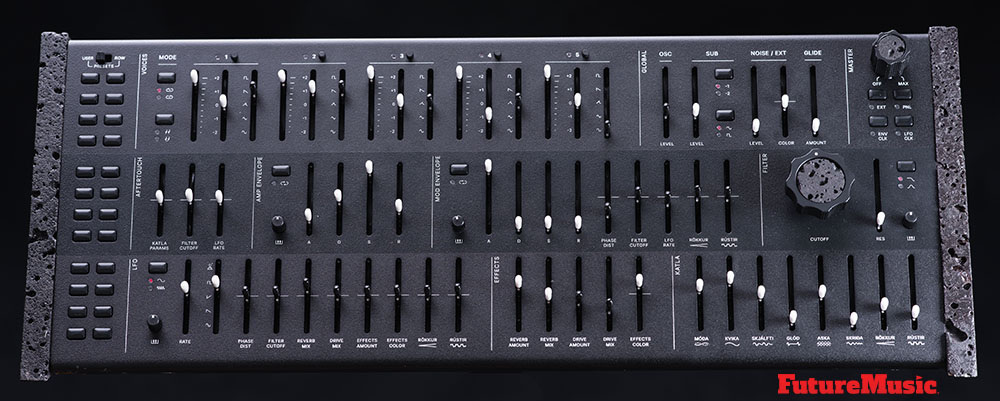
Genki Instruments has premiere Katla, a Voice Rotating Polyphonic Synthesizer made with lava rock. The very attractive synth reminds one of Black Corporation’s Dekard’s Dream, but takes the aesthetic to the next level with side panels and knobs made out of lava rock.
The Reykjavik-based instrument developer wanted to take their volcano inspired synth and infuse it with organic, unpredictable behavior that generates rich, evolving, multi-layered textures, where each note stirs, swells, and erupts in its own distinct way.
Genki Instruments Katla

The easiest way for electronic musicians to get their music onto Spotify, Apple Music, iTunes, Amazon Music, Tidal, Instagram, Facebook, TikTok, Pandora, Twitch & much more! Click the banner above or the Go Button to save 7% off of your signup! GO!
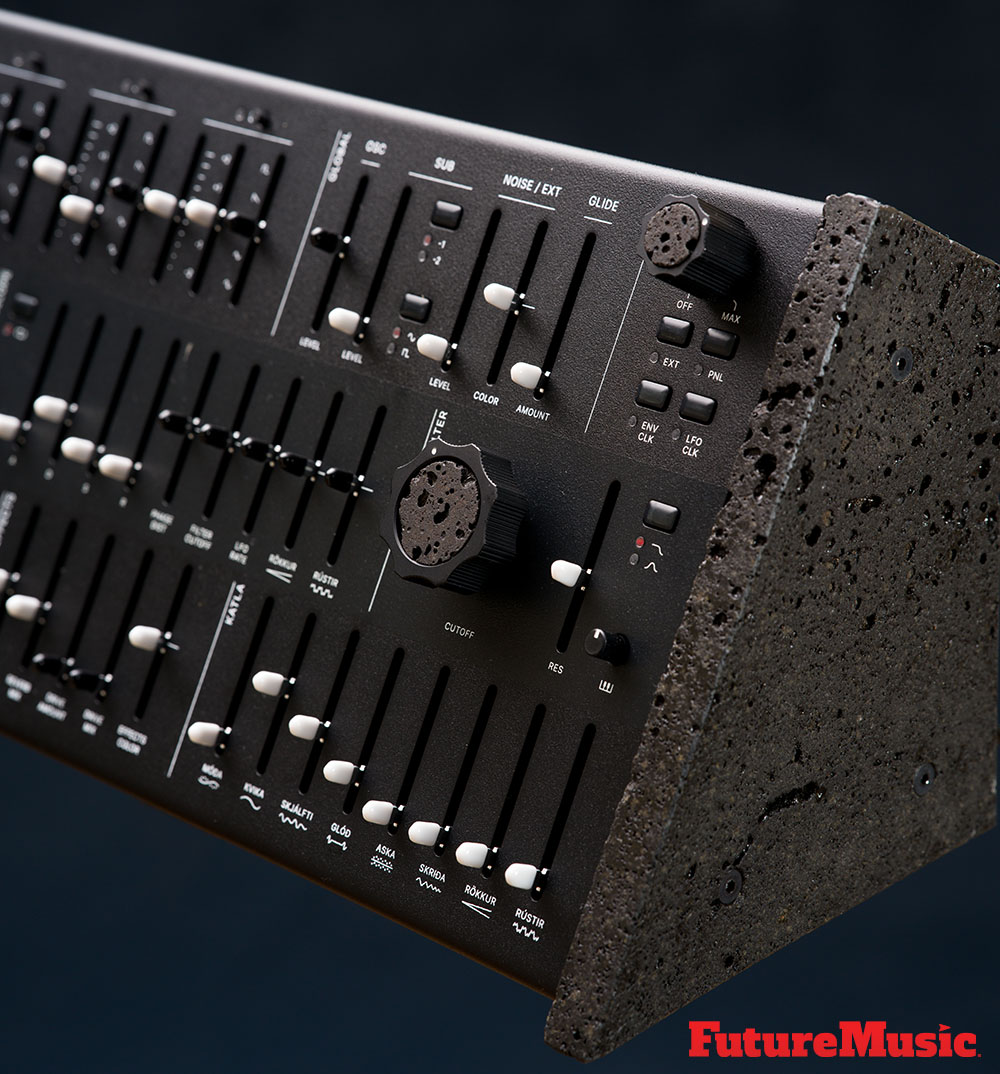
Gatla is framed by side panels and knobs forged from authentic Icelandic lava, giving each instrument a tangible connection to the volcanic forces that inspired it. Genki Instruments infused Katla with four independent distortion destinations, including a stereo CMOS (Complementary Metal Oxide Semiconductor) Drive effect, a saturation stage, pushing tones from warm and rounded to fractured and snarling.
Gatla is framed by side panels and knobs forged from authentic Icelandic lava…
Katla’s Voice Rotating Polyphonic Synthesizer features an engine that routes notes across five discrete voices, each with individually adjustable parameters. The Voices Mode features three round-robin attributes (with each note being assigned to one of the five voices in sequence, creating a rotating pattern of sound). The first cycles forward through the voices, the second cycles backwards, and the third selects voices at random. This is happening alongside three unison modes (with all active voices automatically assigned to the notes played and dynamically adjusted according to how many keys are held): Staccato, whereby envelopes re-trigger with every note trigger; Legato, whereby envelopes re-trigger only when all keys have been released; and Mono Mode, disabling polyphony and allocating all voices to the same note.

Meris Enzo X Review
The Enzo X guitar pedal synth is ambitious and versatile, its effects engine broad and musical, and its connectivity and control make it suitable for modern performance and production environments. Is it worth the your money? Find out! Meris Enzo X Review
Katla Features:
- Five Independent Voices – 5 voice polyphony, with individual filters, amplifiers, LFO’s and envelopes for each voice.
- Sub per-voice – Each voice is paired with its own dedicated sub-oscillator with global controls for waveform and octave.
- True Stereo – Notes can be spread across the stereo field, shaped by dedicated left and right distortion channels, and immersed in a spacious stereo reverb.
- Clock Sync – Katla can be synced to the BPM of your DAW or any external clocking device, allowing its modulation to lock tightly with your music. Envelope and LFO timings can be quantized to musical intervals.
- Keyboard Tracking – Keyboard Tracking adapts envelopes, LFO timing, and filter cutoff to the pitch of each note, making every key respond with its own unique character and movement.
- Looping Envelopes – Katla’s looping envelopes blur the line between envelopes and LFOs, allowing you to craft rhythmic, evolving patterns or tempo-synced modulation.
- LFO per-voice – LFO’s offer unique combinations of their minimum and maximum outputs which are used to modulate the stereo effects. These operations allow for interaction between LFOs, resulting in unique, non-repetitive modulations that feel alive and organic.
- Digital Plate Reverb – Lush stereo digital reverb inspired by classic 1980s hardware, designed to add depth and ambiance to your sound.
- Four Distortion Destinations – Katla’s Four Distortion Destinations let you shape tone at multiple stages, each adding unique color and texture.
- Row Presets – Preset buttons are divided into three rows, with each row controlling presets for specific sections, such as oscillators or LFOs.
- MPE compatible – Katla is fully MPE-enabled, with per-note response to pressure, pitch, timbre, and aftertouch.
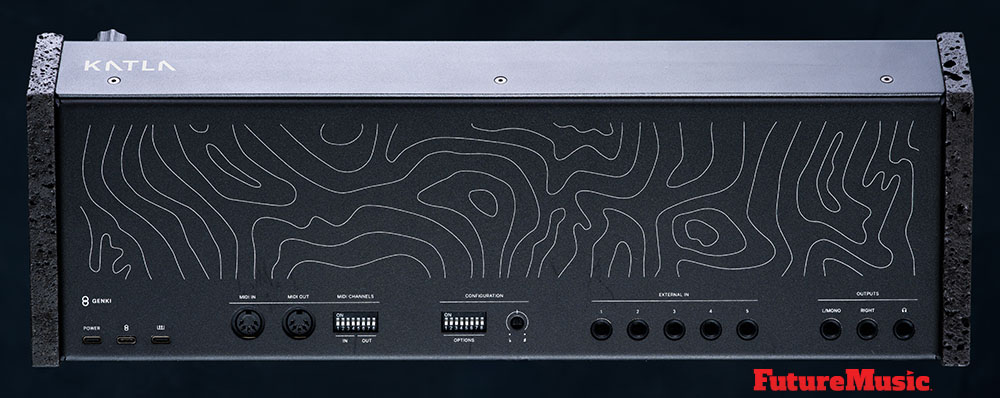
- External Inputs – Five external inputs, each routed to its corresponding voice. You can feed audio from any source, sequence between the inputs, and process the signals through Katla’s analog signal path, adding warmth, distortion, filtering, and character to your external sounds.
- Unison Grace Period – When in unison mode, all voices are allocated to a note. That means when releasing a chord one of the notes will linger slightly longer the rest, and all the voices will be assigned to that note, resulting in a monophonic release phase. When Unison Grace Period is enabled, a slight timing offset is introduced, allowing Katla to let all notes fade out smoothly and naturally.
- Dimensions: 466 × 137 × 134 mm
- Weight: 3.6 k
- Polyphony: 5 voices
- ARM Rockchip RK3588 Digital Oscillators with Analog Signal Path
- Sub-oscillators: 5 (one per voice)
- LFOs: 5 (one per voice) / Envelopes: 2×5 (loop and key track)
- Audio Output: Stereo (L/R) + Headphone
- External Inputs: 5 (one per voice)
- DIN MIDI: In / Out / Thru / USB-C (MIDI & Genki Link) / Clock Sync: External / DAW
- Power: USB-C 15W
- Hand assembled in Iceland
Katla Parameters
» MODA, a way of adding tuning instability by simulating an old synthesizer drifting out of tune to give a vintage character.
» KVIKA, applies slow pitch fluctuations per voice using a slewed random waveform, inspired by the wow modulation found in vintage tape machines.
» SKJALFTI, applies faster pitch fluctuations to each voice, reminiscent of the flutter characteristics found in vintage tape machines.
» GLOD, produces brief bursts of pitch modulation applied independently to each voice, similar to the effect of momentarily slowing a tape by pressing on the reel.
» ASKA, inserts random modulation on per-voice volume and filter cutoff, and also introduces short bursts of noise that result in a chaotic and unpredictable sound as the most complex of the KATLA parameters.
» SKRIDA, applies random values to the A (Attack), D (Decay), S (Sustain), R (Release) times of the Amp Envelope.
» ROKKUR, spreads notes across the stereo field, positioning voices 2 and 4 to the left, 3 and 5 to the right, with voice 1 remaining centered — think notes shaped by dedicated left and right distortion channels, immersed in a spacious stereo reverb.
» RUSTIR, Katla’s wavefolder generates harmonics by folding the signal back on itself.
Katla’s five independent voices, each paired with its own dedicated sub-oscillator with global SUB controls for waveform and octave, allow for five-voice polyphony, with individual filters, amplifiers, LFOs (Low Frequency Oscillators) offering combinations of their minimum and maximum outputs which are used to modulate stereo effects (including a lush stereo 1980s digital reverb). This enables non-repetitive modulations that feel organic and alive, while looping envelopes blur the lines between envelopes and LFOs, letting users craft rhythmic, evolving patterns or tempo-synced modulation. Katla can be synced to the BPM of a Digital Audio Workstation or any external clocking device, allowing all modulations to lock tightly to the music, while envelopes and LFO timings can be quantized to musical intervals, such as quarter notes, eighths, or triplets.
The keyboard tracking adapts envelopes, LFO timing, and filter cutoff to the pitch of each note, making every key respond with its own unique character and movement. Moreover, Katla is fully MPE (MIDI Polyphonic Expression) compatible, with per-note response to pressure, pitch, timbre, and aftertouch. And when in unison mode, all voices are allocated to a note, so when releasing a chord one of the notes will linger slightly longer than the rest, all the voices being assigned to that note, resulting in a monophonic release phase; alternatively, Unison Grace Period enabling introduces a slight timing offset, allowing Katla to let all notes fade out smoothly and naturally.
Finally, Katla features five external inputs, each routed to its corresponding voice, so users can freely feed audio from any source, sequence between the inputs, and process the signals through the Voice Rotating Polyphonic Synthesizer’s analog signal path, thereby adding warmth, distortion filtering, and character to external sounds.