The genesis of the Korg phase8 acoustic synthesizer begins not in a corporate boardroom in Tokyo, but in a hybrid studio-workshop on the edge of Berlin’s Görlitzer Park. In 2020, Korg’s noted hardware designer, Tatsuya “Tats” Takahashi — the mind behind the Minilogue and the Volca series — was given a unique mandate: to build a R&D “skunkworks” division that operated with the autonomy of a startup. This division, Korg Berlin, was tasked with exploring the fringes of musical technology. The core philosophy was “beyond electronics,” a direct response to a market Tats felt was oversaturated with feature-heavy digital and analog clones. The team wanted to create something that felt “alive” and organic, leading them to the concept of Acoustic Synthesis.
The Genesis: Skunkworks to Sound Waves

The easiest way for electronic musicians to get their music onto Spotify, Apple Music, iTunes, Amazon Music, Tidal, Instagram, Facebook, TikTok, Pandora, Twitch & much more! Click the banner above or the Go Button to save 7% off of your signup! GO!
The development was an arduous, iterative process that lasted over five years, perfecting the “plate geometries” of the internal resonators to ensure they produced pleasing, harmonically rich tones. In fact, each of the five lead developers was even encouraged to customize their own version, resulting in a variety of chassis designs before the team finally settled on the production aesthetic we see today. The instrument, known simply as the “Acoustic Synthesis_phase5,” first emerged as a mysterious prototype at Superbooth 2023. It wasn’t just a new product – it took the public by complete surprise since it was more of a mechanical marvel than a synthesizer. After more years of refinement and three more iterations—hence the name phase8—the finalized version made its official global debut at NAMM 2026.
How Acoustic Synthesis Works
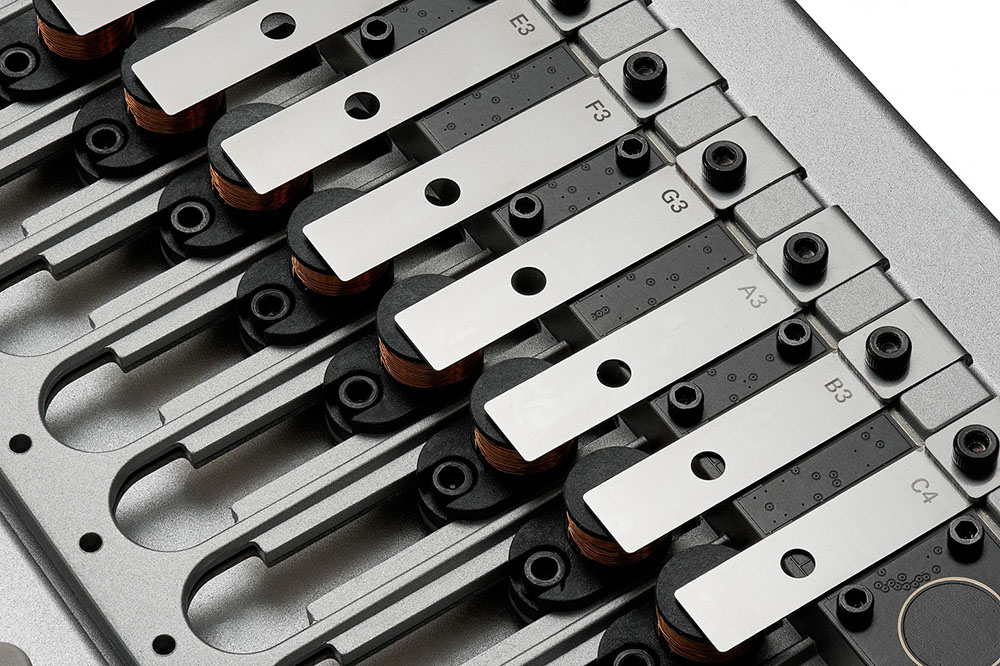
At its heart, the phase8 is an eight-voice electromechanical instrument. Unlike a traditional synthesizer that uses oscillators to generate electrical waveforms, the phase8 generates sound through physically vibrating steel resonators. When you trigger a note, an electromagnetic pulse activates a tiny hammer that strikes a metal tine, much like a piano or a kalimba. However, where a piano’s sound ends at the soundboard, the phase8’s journey is just beginning. A specialized capacitive pickup captures the vibration of the steel, feeding it back into an electronic system where it can be manipulated with the precision of a modern synthesizer.

Meris Enzo X Review
The Enzo X guitar pedal synth is ambitious and versatile, its effects engine broad and musical, and its connectivity and control make it suitable for modern performance and production environments. Is it worth the your money? Find out! Meris Enzo X Review
Experimental soul, modern tech…
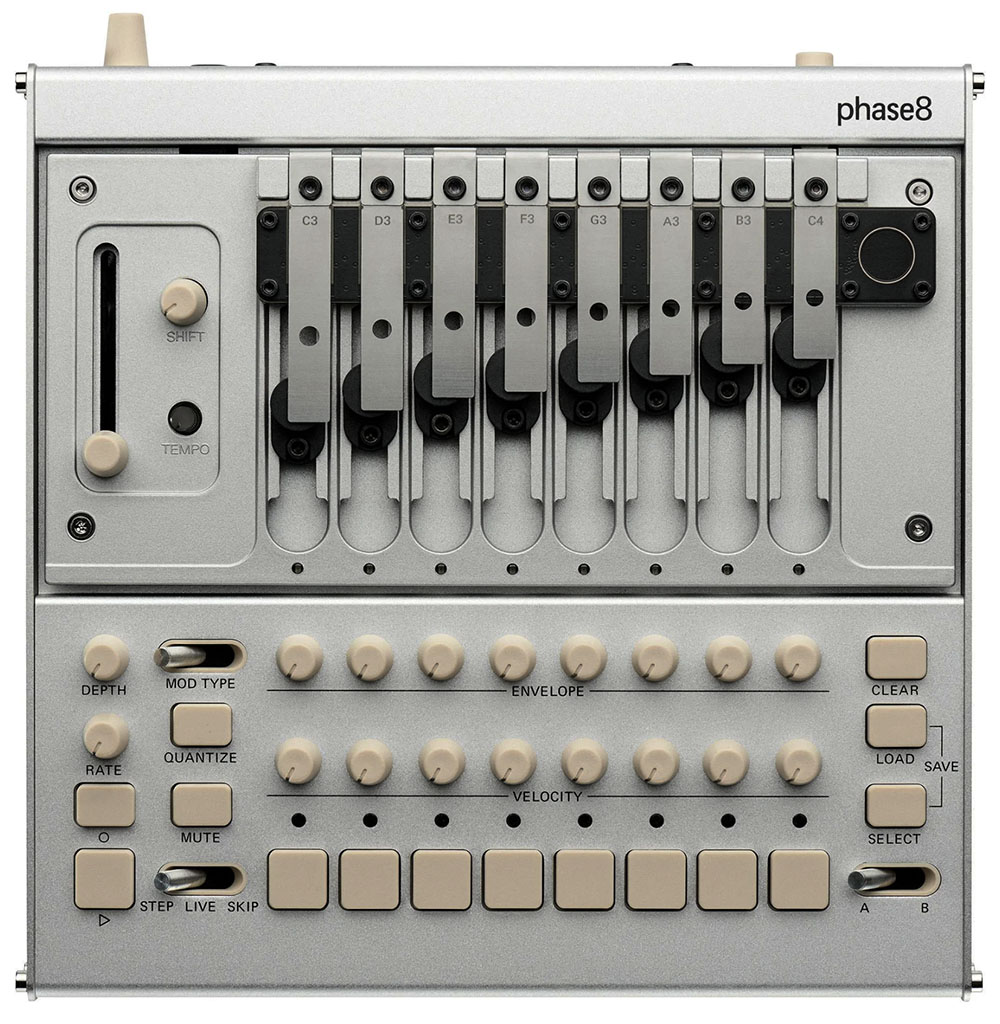
The instrument is designed for high-level customization and physical interaction. It ships with 13 chromatically tuned resonators, but only eight can be employed at once, allowing users to define their own scales and tonal characters. The front panel features an AIR slider, which is perhaps its most futuristic control. It adjusts the prominence of the acoustic response, essentially “opening” the instrument up to its environment. Because the resonators are exposed, players are encouraged to “get John Cage-y” by plucking, tapping, or placing objects like coins or magnets directly onto the vibrating metal to create strange and unpredictable textures.
Despite its experimental soul, the phase8 is built to play nicely with a modern studio rig. It is a compact desktop unit, measuring 231 x 236.5 x 46 mm and weighing in at a lightweight 1.71 kg. The sequencer is a standout feature, supporting both rigid step programming and non-quantized live recording. Borrowing a bit of the Volca’s DNA, it includes parameter automation, allowing you to record knob movements directly into the sequence. Each voice features a “step skip” function, allowing for complex polyrhythms that evolve over time.

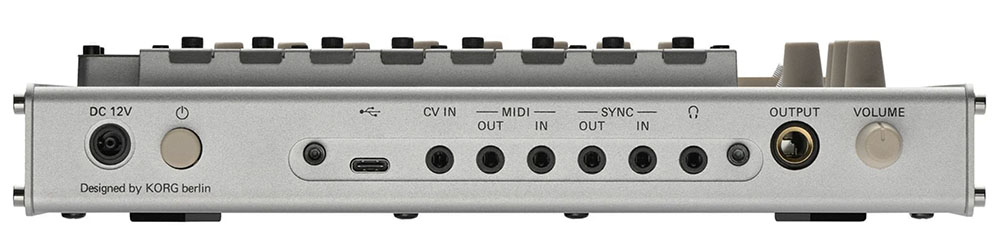
Connectivity is surprisingly robust for such a niche device. It features MIDI TRS-A In/Out, USB-C for MIDI and firmware updates, and Sync In/Out for connecting to other Korg products. There is also a CV input (+/-5V), allowing modular enthusiasts to modulate its internal parameters with external gear. For sound shaping, Korg included three distinct amplitude modulation modes: a standard tremolo and two audio-rate, pitch-dependent modes — one of which can be harmonically quantized to keep the chaotic metallic textures musically relevant. The “Launch Edition” of the synth even included three exclusive limited-edition resonators with irregular shapes for further sonic exploration.
Korg phase8 Features & Specifications:
- Swapable and tunable steel resonators
- Polymetric rhythm sequencer
- Three amplitude modulation effects: tremolo and two audio rate, pitch-dependent modulation types
- Parameter automation: All controls on the phase8’s panel can be automated over a sequence
- Trigger delay
- Real-time interaction
- Robust connectivity
- Analog Mono 1/4″ Output
- Headphones: 1 x 1/8″ TRS
- MIDI I/O: 2 x 3.5mm (In/Out), USB
- CV/Sync I/O: 1 x 1/8″ CV In, 2 x 1/8″ Sync (In/Out)
- USB: USB-C (MIDI, firmware)
- Power Supply: 12V AC Adapter (included)
- Height: 1.81″ / Width: 9.09″ / Depth: 9.31″
- Weight: 1.71 lbs
The reaction from the synth community has been a provocative study in “luxury vs. utility.” With a street price of US$1,150, the phase8 has sparked a lively Internet debate. On one side, purists and ambient composers have hailed it as a “game changer,” praising its tactile, haptic nature and the “bonkers” sounds that digital emulations simply cannot replicate. Korg seeded popular YouTubers like Loopop and Bobeats who highlighted it as one of the most unique instruments released in a decade, but these pay-for-play “reviews” never actually showcase actual musicians and workflows, so the real public response hasn’t been determined.
However, the biggest complaint is the phase8’s high price-to-feature ratio. Some users on forums like Reddit have argued that it is essentially an “overpriced thumb piano,” noting that for the same money, one could buy a high-end polyphonic analog synth with hundreds of voices and effects. Others cited the synth’s eight notes and a specific tonal palette limitations. That said, the phase8 wasn’t designed to be a do-it-all workstation; it was built to be a specific, living entity that bridges the gap between the physical and the electronic.
The Future
The Korg phase8 represents a calculated pivot, targeting a aficionado demographic increasingly fatigued by the infinite, screen-bound possibilities of software and an over abundance of synthesizers and Eurorack modules. In a market saturated with digital emulations, the phase8’s value proposition lies in its physical unpredictability. It is an instrument that requires tactile engagement and rewards the user with organic, non-linear harmonic textures that mathematical modeling cannot easily replicate. For the high-end studio owner or the avant-garde composer, the price tag is a justifiable investment in a “character piece” that serves as a unique sonic signature, positioning Korg Berlin as a boutique prestige label rather than a mass-market manufacturer.
While it will undoubtedly achieve cult status and find a place in well-heeled “DAWless” social media aesthetics, its commercial success will be defined by its niche appeal rather than volume, since it’s clearly not a mass market instrument. Its long-term viability depends on whether Korg fosters an ecosystem of interchangeable resonators, transforming a specialized mechanical curiosity into a modular platform for physical sound design, or utilizes the “phase” philosophy as the foundation for more dynamic synthesizers.