Interview With DJ & Producer Marie Vaunt
Special Feature
Marie Vaunt’s ascent in the global techno landscape is less a traditional career climb and more a deliberate, cross-cultural alchemy. Born in the United States as Bobbie Merveille and raised in Japan, Vaunt spent nearly two decades navigating the electronic music scene under her DJ Heavygrinder moniker before her metamorphosis into the Marie Vaunt persona in 2018.
This pivot marked a profound artistic shift from the plasticity of the LA dance music scene into an authenticity more suited to who she was as an artist. By anchoring her sound in the primal aspects of Techno, most notably via the raging squelch of the Roland TB-303, she has effectively catalyzed an acid techno revival that feels both retro and futuristic. Her recent dominance on the Beatport charts, including the milestone #1 for “Dark Room” on Drumcode, suggests a creative evolution defined by a refusal to compromise on the physical impact of her DJ sets.

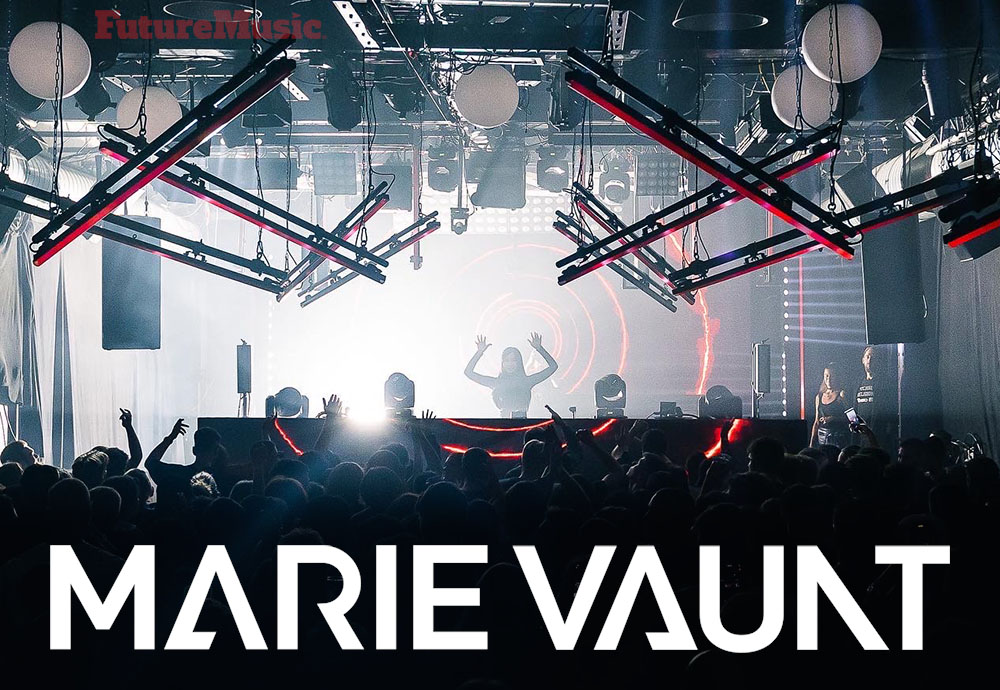
In the booth, Vaunt functions as a high-priestess of visceral frequency, blending the drama of cheeky spoken word drops to flat out hard acid mayhem. Her fashion sense on the stage is a blend of witchy Stevie Nicks and a goth vocabulary that signals from the jump that you’ve now entered the Church Of Vaunt.
To understand why an artist would choose to bury a two-decade legacy like Heavygrinder, we have to look at the psychological weight of trying to escape a creative prison of their own making. Even though the Heavygrinder persona still has a website and social media action, Merveille was reluctant to discuss her prior creative output. (Merveille even appeared in the 2012 movie “The People I’ve Slept With” as Heavygrinder.) There’s often a valuable takeaway to learn when artists have pivoted from one genre to another, but we have respect her desire not to reach back in time.
That said, the rejection of that history isn’t just about a change in genre, it could be a reclamation of agency, as well as a genuine spiritual awakening. By asking the the world to almost forget Heavygrinder, she is essentially performing an exorcism on the “product” she used to be, ensuring that the reincarnation of Bobbie Merveille as Marie Vaunt isn’t viewed through the cynical lens of a marketing rebrand.

For a limited time only! Up to 80% off all Waves Bundles. PLUS click this link for an additional 10%! (even if the item is already on sale!) This is the best Waves deal you can get! Score yours today before this special ends! GO!

FutureMusic: What was your first musical memory?
Vaunt: The earliest musical memory I can recall is dancing to Prince as a toddler. I guess even back then I had an appreciation for timeless grooves. It’s funny how those “purple” rhythms stay with you.
FutureMusic: You’ve had quite a geographical journey, born in Seattle, moved to Japan and then back to the States when you were 14 years old. Being an American with multinational parents, how did you fit in when you were in Japan?
Vaunt: To be honest, growing up as a “hafu,” which is the term used in Japan for mixed-race people, was very challenging. I faced my fair share of discrimination and bullying from both children and adults. However, it wouldn’t be fair to paint my entire experience as negative. I grew up surrounded by the golden age of Japanese pop culture and formed friendships that are still a huge part of my life today. These days I absolutely love spending time in Japan and I’m so glad to see it becoming a more inclusive place.
FutureMusic: How has your Japanese upbringing, and Japanese culture influenced you, and how has it worked for your and against you?
Vaunt: From a personal standpoint, those early struggles gave me a thick skin and prepared me for almost any challenge life can throw at me. I see it as a net positive. Culturally, Japan is deep in my DNA. It shaped my aesthetic and my discipline as an artist, and I love weaving my Japanese heritage into my music and visuals every chance I get.

FutureMusic: How did you get into producing and do you remember your first studio setup? What gear did you have?
Vaunt: I first dabbled in production around 2006 because I felt the urge to create my own bootlegs and edits for my DJ sets. My studio back then was just a Sony Vaio laptop running Sony Acid and Sound Forge. It was a very humble beginning, but you’ve got to start somewhere!
FutureMusic: As you were developing your production talent, do you remember a major moment of clarity or realization that took your tracks to the next level?
Vaunt: I don’t think there was one specific lightbulb moment. For me, the craft is a gradual and never-ending process of refinement. I tend to believe my latest track is always my best one yet. I think that’s a healthy mindset for an artist because it keeps you looking forward rather than resting on your laurels.
FutureMusic: Which Acid box(es) are you currently using to create your brand of Acid Techno? Do you have a favorite?
Vaunt: My hardware acid arsenal is lean but mean! I’m currently using the Behringer TD-3 and the TD-3-MO, and I love them both for their hands-on grit.
I’m actually hunting for a reconditioned original Roland TB-303 right now, but it has to be a workhorse. I’m not interested in studio decorations, I want gear I can actually use.
FutureMusic: For the distortion on your acid lines, can you tell us what outboard effects, guitar pedals, and plug-ins you’re using?
Vaunt: My go-to is the MXR Distortion+ pedal. It produces a rounded saturation that pairs perfectly with both the TD-3 and VSTs. When I need something more aggressive, I reach for the Pro Co RAT.
Recently, a fan gifted me two limited-edition Randy Rhoads MXR pedals. They have a unique gain profile that I’ve been experimenting with on some new tracks.

FutureMusic: What gear is currently in your studio today?
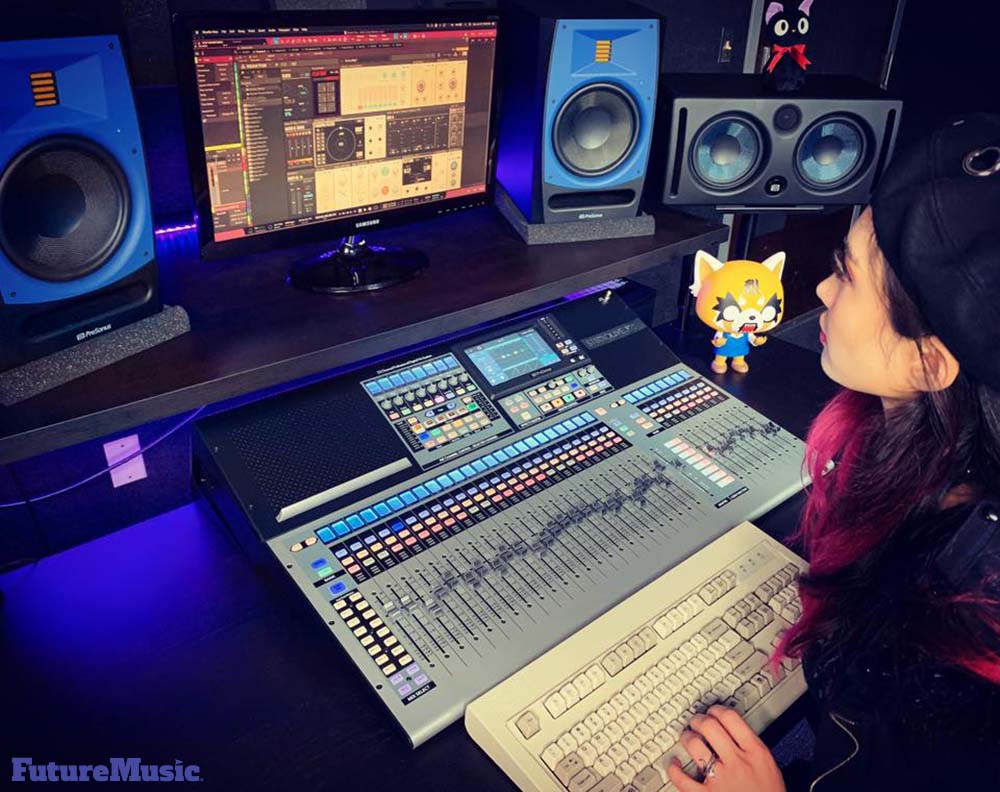
Vaunt: The heart of everything is my M4 Max MacBook Pro. It’s an absolute beast for handling heavy projects, and honestly, I can’t imagine life without it.
For my interface, I use the PreSonus Studio 1824C when I’m in the studio, but I always keep a Quantum ES 4 in my bag for when I’m on the road. When it comes to monitoring, I rely on a pair of PreSonus R80 V2 monitors, though I also spend a lot of time in my LayficTone headphones.
On the hardware side, I’ve got a bit of an obsession with distortion. I keep three MXR Distortion+ pedals around, along with a Pro Co RAT and a BBE Sonic Maximizer rack unit. For synths, my main toys right now are the Arturia MatrixBrute, a 12-voice DSI Prophet Rev2, and a Moog SubFatty. And of course, I have my Behringer TD-3 and TD-3-MO for those signature acid lines.
I’m always looking for new gear to add to the collection, so the setup is never really finished!
FutureMusic: Do you have a way to produce music when you’re touring as a DJ?
Vaunt: Definitely. Given my schedule, mobile production has become my default way of working. I always bring my laptop and headphones with me wherever I go. Some of my most popular tracks actually started as ideas sketched out in hotel rooms!
FutureMusic: How do you usually start a track? Is it an acid line, drums…or Is it a sound, a melody, or a vibe you’re trying to capture?
Vaunt: It almost always starts with the acid line. I love the process of programming sequences directly on the TD-3. The interface, which is identical to the TB-303, is famously inconvenient, but those limitations force you to rethink every note and step.
That’s how a lot of my tracks come to life, even if I eventually re-do the line as MIDI to use with a VST later on.
FutureMusic: Can you walk me through a specific track where you felt like you broke new ground creatively? What was the aha moment, and how did you capture it?
Vaunt: Most of my tracks give me that feeling of achieving something new, but I suppose “Kiss My Acid” and “That Acid” were the ones that really galvanized my sound and what I’m known for…
FutureMusic: Your music often blurs the lines between chaos and order. Do you see your creative process as an act of imposing structure on chaos, or unleashing chaos on a structured framework?
Vaunt: I’m definitely in the camp of unleashing chaos on a structured framework. It’s very important for me to have a solid arrangement and a specific set of emotions in place before I go hard with the acid lines and kicks!
FutureMusic: What’s the most challenging part of your process, and how do you overcome it?
Vaunt: The hardest part is knowing when a track is finished. There’s always one more thing to tweak or an idea that didn’t make the final cut. I often find myself making “post-release” edits to play in my sets, so see if you can spot the differences!
You eventually develop a sense of when enough time has been spent on a track and it’s time to move on.
FutureMusic: Do you have methodologies for pushing yourself outside of your comfort zone creatively?
Vaunt: I wouldn’t call it a strict method, but I try to let outside influences seep in. It could be an anime I just watched or a conversation that sparked a vocal idea. I just go with the flow and see what comes out, and so far it’s been working well.
FutureMusic: You’re part of a new wave of female producers making waves in techno. What do you think is the biggest misconception about women in the genre, and how do you think that’s changing?
Vaunt: My fellow queens are absolutely crushing it right now, and I’m honored to be part of this wave.
The biggest misconception is still the outdated idea that women are somehow less technically capable. We’re here, we’re doing the engineering, we’re playing the main stages, and we’re proving the naysayers wrong every single night.
FutureMusic: You’ve collaborated with artists from various genres. What’s the most surprising thing you’ve learned from working with musicians outside the techno sphere?
Vaunt: The most striking thing I’ve learned is that music is its own language. It doesn’t take much to communicate through different genres or even cultures. A solid hook and kick-ass drums will resonate with anyone, anywhere!
FutureMusic: Your DJ sets are a masterclass in tension and release. What’s your thought process when crafting a tracklist that takes audiences on a journey?
Vaunt: I actually don’t pre-plan my sets at all. Every performance is organic and the tracks are decided on the spot. It’s impossible to predict what a crowd will be like, so I prefer to wing it and have an “energy conversation” with the room. The journey is just the natural result of that conversation.

The easiest way for electronic musicians to get their music onto Spotify, Apple Music, iTunes, Amazon Music, Tidal, Instagram, Facebook, TikTok, Pandora, Twitch & much more! Click the banner above or the Go Button to save 7% off of your signup! GO!
FutureMusic: Your Acid Techno sound is a far cry from the genre’s early days. How do you feel the genre has evolved, and where do you see it headed?
Vaunt: Even though my sound has a modern texture, it still harkens back to the genre’s origins. I feel like I’m one of those Olympians keeping the flame alive and I hope it never goes out. Acid is having a big moment right now, but it’s a timeless sound that can stand on its own even when the trends change.
FutureMusic: As AI tools become more prevalent in music production, how do you think they will change the way artists approach creativity, and will this shift lead to new sonic territories or homogenization?
Vaunt: Anything to do with AI is speculation at this point, but I believe it might eventually eat itself. Since generative AI learns from work that already exists, the result could end up being regurgitated “AI slop” rather than something new. It takes humans, with all our struggles and qualities, to push boundaries and create something authentic. I do think AI will create tools that help us work faster, which is exciting, but we’re not quite there yet.
FutureMusic: Do you see AI as a collaborator or a tool in the music making process, and how do you think this distinction affects the way we think about authorship and ownership?
Vaunt: I think its strength will be as a collaborative tool rather than a replacement for writers. As for who owns the output, I think that’s a legal and ethical question I’m happy to not be in charge of. From a moral standpoint, the people whose data was used to train the AI are the true owners in my eyes.
FutureMusic: Are there any concerns you have about the potential for AI generated music to displace human musicians or producers, or do you think it will create new opportunities?
Vaunt: It might displace some stock music, but I have my doubts about it having a lasting effect on real performers. Music is only one part of what makes an artist who they are.
I’ll start getting worried when AGI robots have to travel across the Atlantic at 4 AM without breakfast on a full flight just to make their gig on time!
FutureMusic: What’s next for the amazing Marie Vaunt?
Vaunt: Where do I even start? I’m working on a bunch of new releases for Kurai Records and Arcane, as well as some amazing collabs with a few of my favorite artists. I’ll also be performing at Tomorrowland Winter and Beyond Wonderland in the coming months, so there’s a lot on the horizon.
I can’t wait to see all of you out there raging to some acid!
Marie Vaunt is currently on tour, so make sure you catch her unique brand of Acid Techno live!