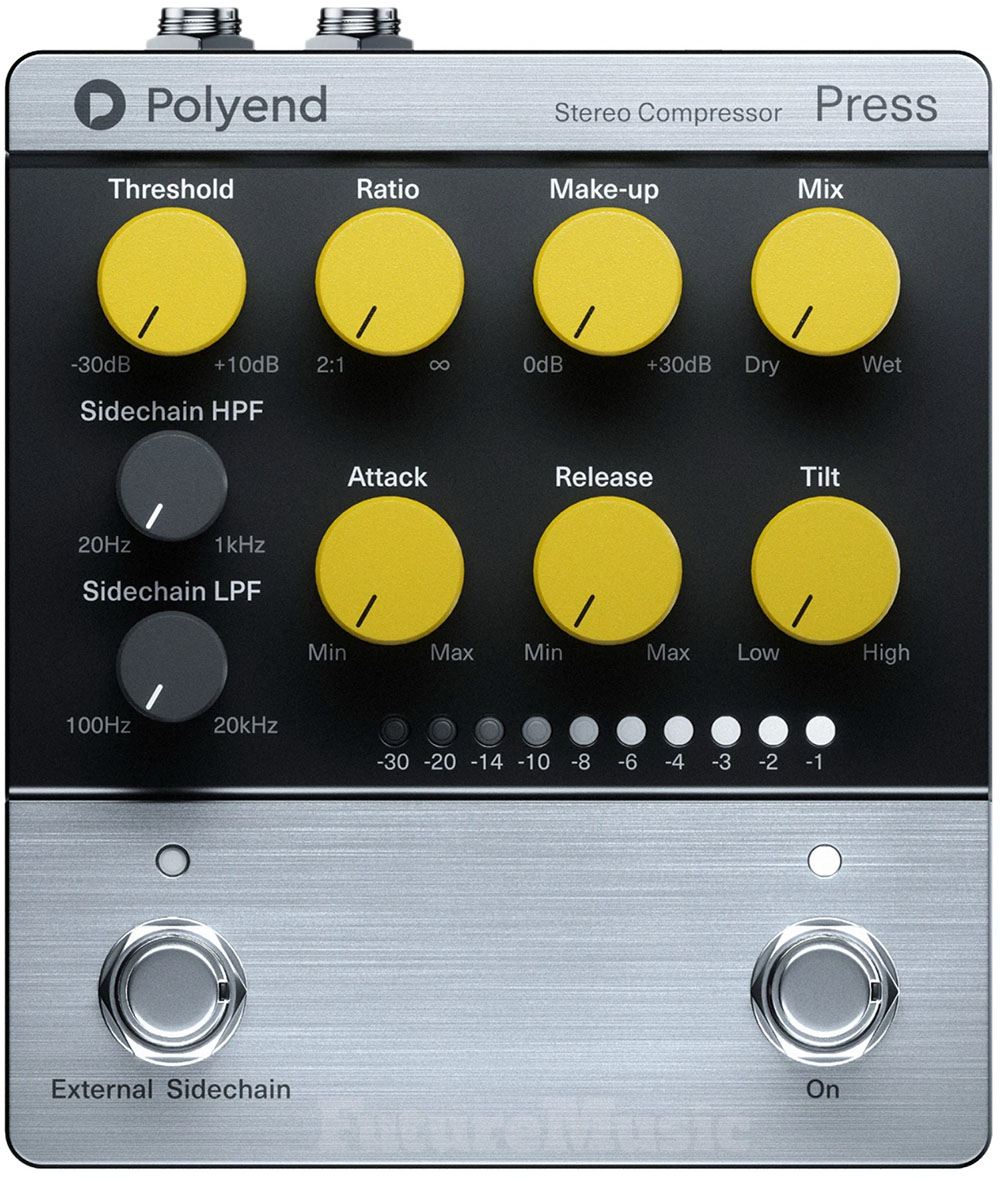
Polyend’s Press stereo compressor is part of their next generation of products with a bold new aesthetic. The sleek aluminum chassis, the beefy, bright yellow knobs and the build quality makes a statement even before you connect it to your pedal board or studio rig. We subjected the Press to a long-term test with five reviewers, two guitarists and three electronic musicians to see how it performed in working music environments – evaluators impressions are in quotes below.

For a limited time only! Up to 80% off all Waves Bundles. PLUS click the banner above or the Go button for an additional 10%! This is Waves best deal yet! Get yours today before this special ends! Go!
On top of the unit, you’ll find nine knobs, seven yellow and two gray, as well as two footswitches. From left to right, you have Threshold, Ratio, Makeup and Mix across the top and Attack, Release and Tilt below. The two gray knobs are for controlling the Sidechain’s Low Pass Filter and High Pass Filter. An elegant, white LED bar graph from -1 to -30dB showcases the Gain Reduction. One footswitch is to activate the External Sidechain, and the other is simply an On/Off affair. As you can see merely from the controls, Polyend provides full sculpting control over your mono or stereo signal, no matter what your application. Let’s delve further into the architecture of the Press to determine if this is worth your hard-earned money.
The Press is a fully analog, VCA-style compressor that can provide delicate compression or full-blown limiting…
The Press is a fully analog, VCA-style compressor that can provide delicate compression or full-blown limiting. The Mix knob allows parallel compression to push your source material without punishing the dynamics. The ratio can go from 2:1 to Unlimited – fully clockwise – for dialing in the compression flavor you want by ear. However, the real action of the Press is the Tilt knob. It’s basically an EQ that can boost the high frequencies or cut the lows, providing yet another methodology for getting the sound you desire. All our evaluators cited Tilt after spending time with the unit, which they found to be “the magic sauce,” but more on this later.
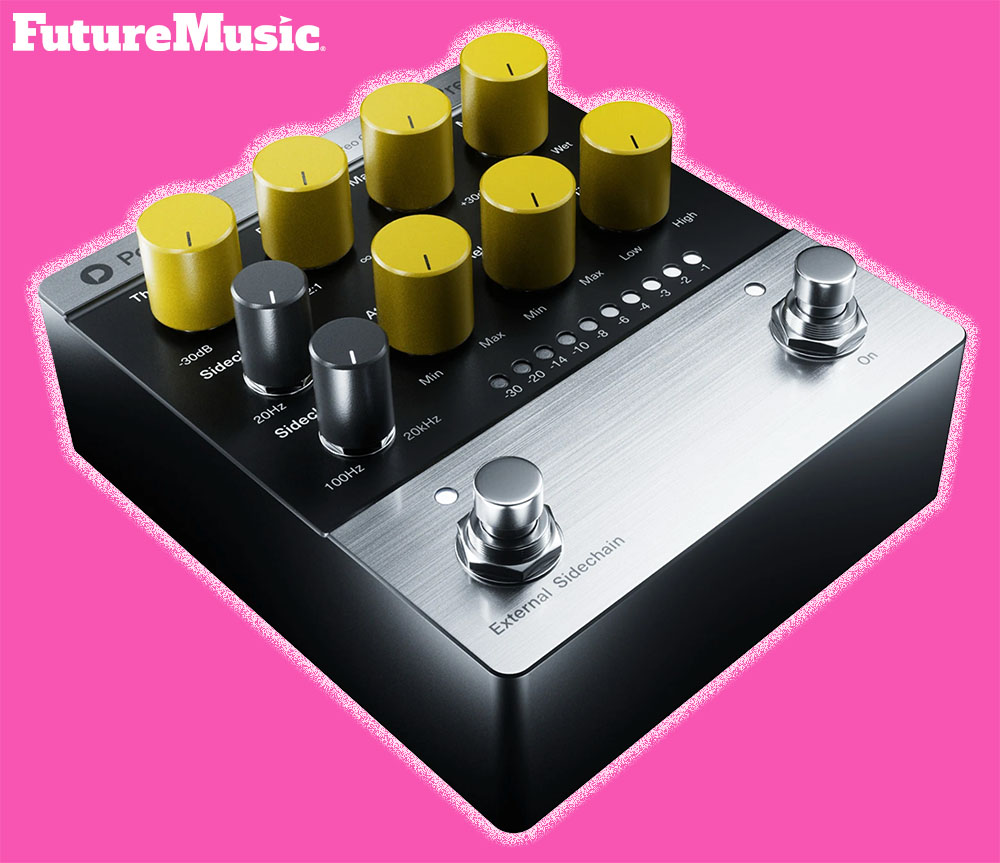
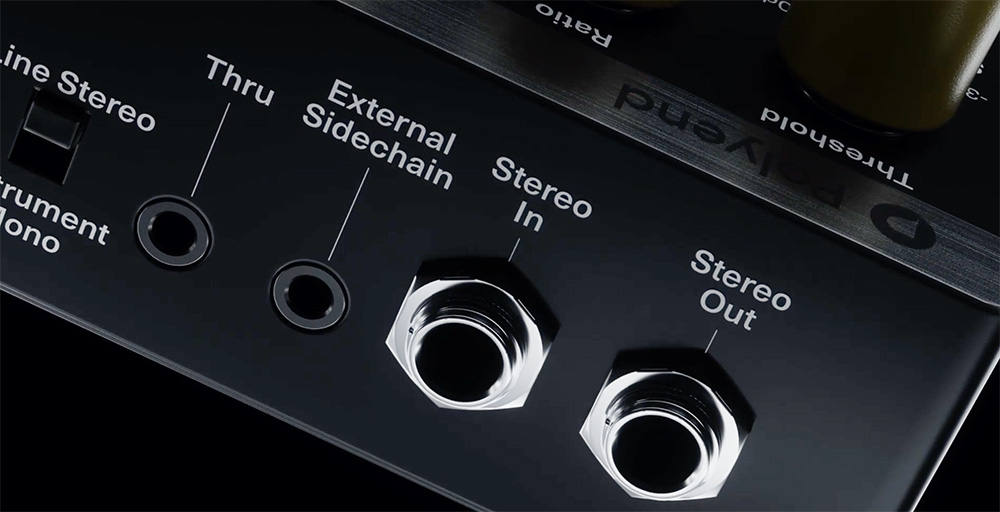
Another substantial feature of Polyend’s Press is the sidechain functionality. In fact, many sophisticated rack compressors we’ve reviewed previously don’t even have these extensive sidechain capabilities, not to mention this is the first time we’ve seen this type of potency in a pedal form factor. The HPF has a spread of 20Hz to 1kHz, while the LPF spans from 100Hz to 20kHz. “The sidechain filters are special and allow you to precisely shape the compression’s conduct and demeanor,” one of our reviewers recounted. The HPF and LPF work on either the External Stereo Sidechain Thru or the Stereo Input, allowing you to eliminate unwanted frequencies from triggering the gain reduction.

The External Stereo Sidechain input can be utilized as a source for those breathing, throbbing ducking effects. In addition, one of our guitarist testers used it as a way to make space for vocals when in full shoegaze mode. However, if you combine the sidechain action with the Tilt EQ, there are even more applications.

MIDI Designer Is Now Free!
MIDI Designer Pro X is now free to download! MIDI Designer Pro X is a professional-grade MIDI controller platform for iPhone, iPad and Mac. User-contributed layouts let you control everything from Ableton to Yamaha out of the box. Go beyond hardware and express your musical vision. Check out out now!
For our electronic musicians, the Press “worked amazing” on drum machines and drum synthesizers like the Roland TR-1000, Moog DFAM and the Behringer Edge. “[Press] can define drums, provide clarity and add a distinctive punch,” cited one evaluator. Our testers found Press works especially well to sculpt Kick drum sounds, since you can filter out frequencies in the low end to tighten the compressor’s response on high end transients. Now dial in Tilt’s EQ controls and in a matter of seconds, you “have supercharged your kicks for pure Techno smack, or Drum ‘n’ Bass gut punch.”

The easiest way for electronic musicians to get their music onto Spotify, Apple Music, iTunes, Amazon Music, Tidal, Instagram, Facebook, TikTok, Pandora, Twitch & much more! Click the banner above or the Go Button to save 7% off of your signup! Go!
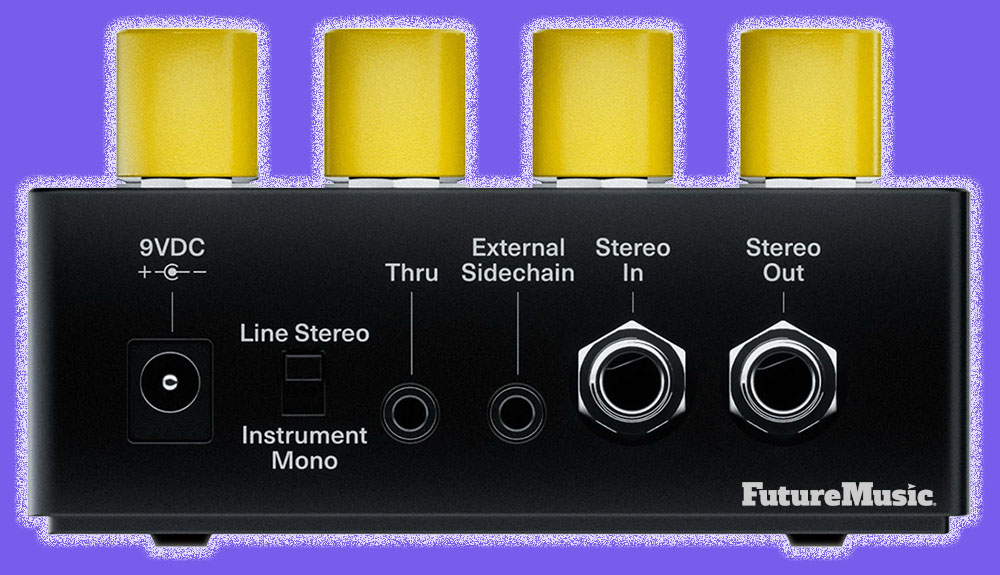
Polyend Press Features:
- Full analog VCA-style stereo compressor
- Solid aluminum pedal chassis
- Easily accessible Threshold, Ratio, Attack, Release, and Make-up knobs provide full control
- Ratio of 2:1 – Infinity provides subtle compression to full-blown limiting
- Mix knob provides parallel compression
- Tilt EQ is the “magic sauce” that delivers sound-shaping power
- Comprehensive sidechain capabilities with highpass, lowpass, and external options
- Balanced, yet slightly annoying, stereo I/O on TRS jack
- Power: 9 V / 350 mA (power adapter not included)
- I/O: Stereo/Mono In: jack 6.3 mm / Max Input Level: 8 Vrms (18 dBV – 20 dBu) / L-Out/MONO: jack 6.3 mm / R-Out: jack 6.3 mm / External Sidechain: mini-jack 3.5 mm / Sidechain Thru (Out): mini-jack 3.5 mm
- Impedance input: Line 20 kOhm/ Instrument 1 MOhm / Impedance output: 100 Ohm
- Distortion: <0.1% / Noise: <0.001%
- Weight: 1.32 pounds (0.600 kg)
- Height: 2.24 inches (5.7 cm) – with knobs / Width: 4.72 inches (12.0 cm) / Depth: 4.17 inches (10.6 cm)

Polyend Synth Review
FutureMusic spent considerable amount of time with Polyend’s new digital synthesizer, which they simply dubbed Synth, for this long-term review. Read our comprehensive Polyend Synth Review to find out more!
Our guitarists found that Press works remarkably well at their end of the signal chain. Again, the words “clarity” and “definition” came up in their reports, but also “articulation” and “clean.” According to one of our guitarists, Press had the ability to “scrub overly dense BigSky [reverb] washes to bring out the essential elements to cut through mixes.” Another felt it had the ability to “filter out mud, unlike any other [compression] pedal” he has used in the past.
Polyend touts that Press can act like a glue compressor, and it can certainly serve that purpose, as mentioned above. However, it’s less the famed SSL G-Buss, since “it’s more heavy-handed” and “more of a way to promote character.” What it does best in this regard is the ability “to dial in a distinctive, clean flavor that sounds very present.” For live performers, this would be “a godsend when forced to play through mediocre sound systems.” In this regard, it can compete quite well with the OTO Machines Boum analog compressor with Press retailing at almost half the price. Taking this further, Press will allow live musicians and DJs to separate themselves from other performers in a multi-artist event by tuning the compressor to the room and system
We do need to mention a couple of deficits. First and foremost, we did encounter “a ghost in the machine” that would cause the Press “to go schizo” if left on for an extended period of time (see video). Press would start audibly clicking with the gain reduction firing randomly. Disconnecting the power would reboot Press and it would then operate normally. However this is certainly not something that you’d want to happen during a live performance.
The second annoyance is the the stereo I/O is via TRS 1/4″ dual channel breakout cable and the sidechain input is a minijack. This results in the purchase of additional cabling that would be unnecessary if there were just 1/4″ outputs.
Conclusion
Polyend has certainly made an impression with their entry into the guitar pedal world. The build-quality of Press is substantial and certainly looks like it can take a beating in the harsh world of gigging. For studio musicians, the bold aesthetic means that the Press can sit front and center in your rig where you can get your hands on the oversized knobs. The weird “schizo” issue could just be an issue with our particular pedal, but it take away from Press earning a Power Award. Recommended.
Polyend Press Rating 88%
Cheers:
+ Outstanding Build Quality
+ Plenty Of Hands-On Control
+ Sound Quality
+ Sidechain Functionality
+ Tilt EQ
+ DJ Rig “Finalizer”
+ Phenomenal For Kick Drums
Jeers:
– Additional Cable Requirements
– Can Go “schitzo” and glitch
Polyend’s Press costs $399 / €399.
The Future: We’re not sure what is causing the Press to glitch, but all of our testers experienced the phenomenon, and it’s something that Polyend should investigate.