Klevgrand Walls Reverb Plug-In Review
Klevgrand’s Walls is one of those reverb plug-ins that may have flown under the radar this year, but it’s definitely worth downloading the demo, especially if you’re partial to the character of spring reverbs. Walls features a deceptively simple interface, anchored by a clever visualizer and a sonic character possessing a truly unique flavor.

For a limited time only! Up to 80% off all Waves Bundles. PLUS click the banner above or the Go button for an additional 10%! This is Waves best deal yet! Get yours today before this special ends! Go!
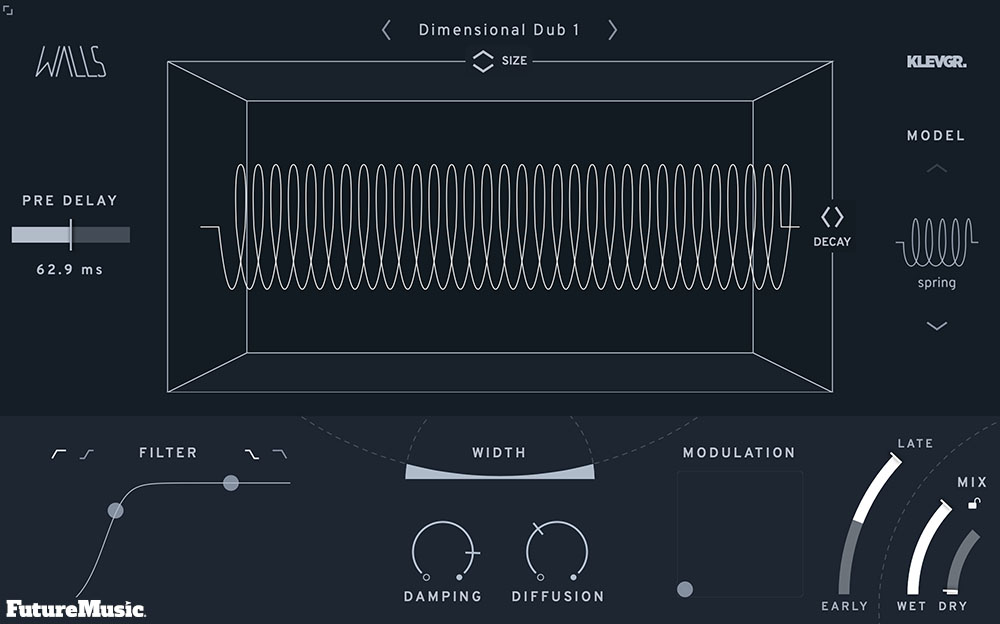
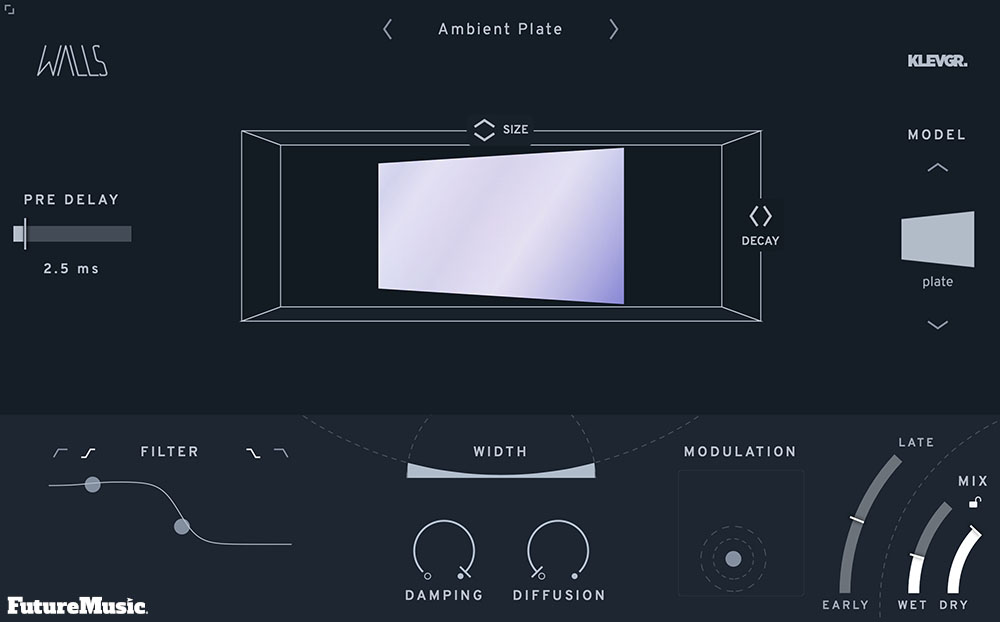
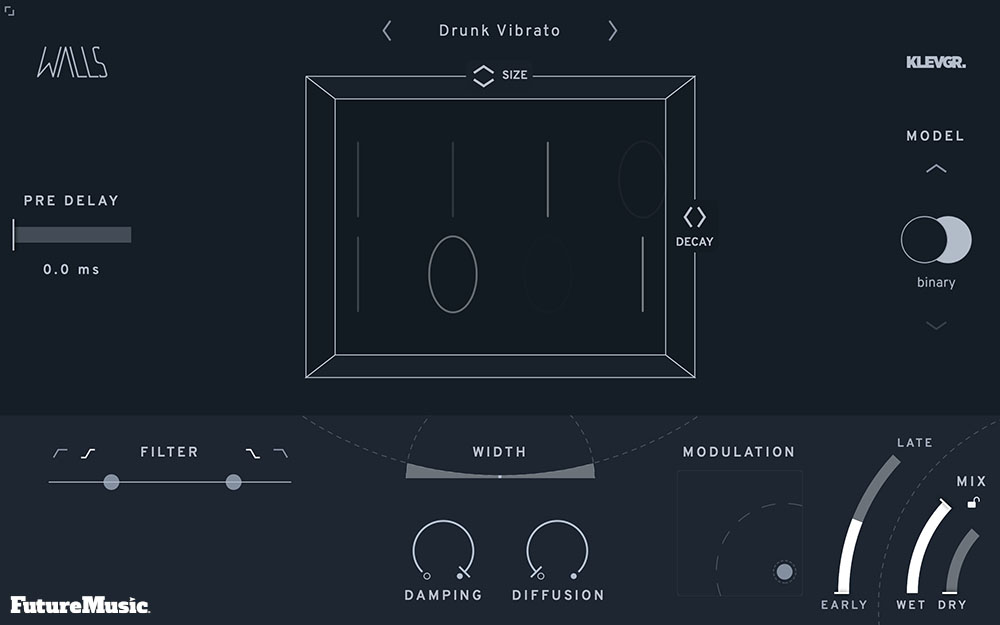
Walls houses six distinct reverb algorithms: Cosmic, Hex, Binary, Plate, Hall, and Spring. The front panel includes a predelay slider spanning 0 to 250ms, a two-band filter for taming the low and high frequencies, and a stereo width attribute. Beneath these are dedicated dampening and diffusion rotators. Next is the Modulation X/Y pad, which occasionally provides a welcome wobble effect while at other times having little discernible influence on the sound. On the bottom right of the interface are individual Wet and Dry sliders, and a control to transition reflections from Early to Late.
The focal point of the interface is the vector-based visualizer…
The focal point of the interface is the vector-based visualizer. It not only showcases the currently selected algorithm but also allows the user to stretch the “environment” to control the Decay time or increase the perceived height of the room. It’s engaging, effective, and can even undulate, flex, and pulse in real-time based on the incoming signal. Speaking of input, there aren’t a ton of presets available compared to other reverb plug-ins that flood you waist-deep with options. However, in Walls, presets serve merely as a jumping-off point for dialing in the precise reverb characteristic you desire.
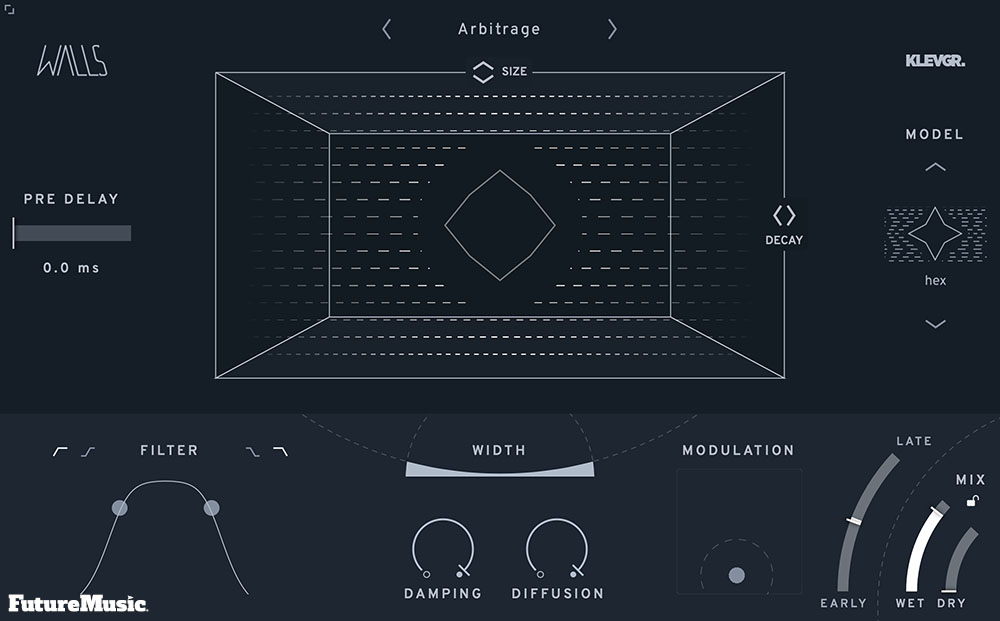
Klevgrand states that Walls boasts “up to 40 modulation LFOs with individual frequency [controls] and a unified and intuitive control system.” However, the user lacks the ability to dive under the hood and directly adjust these underlying parameters – a feature we’d strongly advocate for in future versions.
That said, all accessible parameters can be fully automated within any DAW (Digital Audio Workstation), enabling precise control over how the plug-in influences the source material.


MIDI Designer Is Now Free!
MIDI Designer Pro X is now free to download! MIDI Designer Pro X is a professional-grade MIDI controller platform for iPhone, iPad and Mac. User-contributed layouts let you control everything from Ableton to Yamaha out of the box. Go beyond hardware and express your musical vision. Check out out now!
Of the six algorithms, our testers gravitated toward Hex and Spring, with Spring being the crowd favorite and Hex reserved for more experimental excursions. Klevgrand has effectively modernized the Spring, rendering it less about grit and mechanical artifacts, and more about interplanetary space without sacrificing essential clarity.

The easiest way for electronic musicians to get their music onto Spotify, Apple Music, iTunes, Amazon Music, Tidal, Instagram, Facebook, TikTok, Pandora, Twitch & much more! Click the banner above or the Go Button to save 7% off of your signup! Go!
Klevgrand Walls Features:
- Six different acoustics algorithms: Plate, Hall, Spring, Cosmic, Hex, Binary
- Based on a hybrid between a Feedback Delay Network and Diffusion system
- Interactive visualizations for each algorithm
- Damping filter
- Two-band EQ/Filter
- Early and Late reflections mixer
- Up to 40 modulation LFO’s with individual frequency
- Stereo width control
- Variable diffusion depth
- Variable room size
- Requires macOS 10.10 or later (optimized for the M1-processor), Windows 7 (SP1) or later, running a AU, VST or AAX compatible 64-bit host.

Polyverse Filterverse Review
Polyverse’s Filterverse is a multi-filter plug-in for Mac and PC that is built for exploration, as well as turning even the most mundane sound sources into something unique and special. Read our comprehensive Polyverse Filterverse Review to find out more!
Conclusion
For under 50 beans – and even less during a sale – Klevgrand’s Walls is a definite winner. While the Spring algorithm is the real star of the show, even the basic Plates and Halls are quite useful and don’t tax your CPU. Recommended.
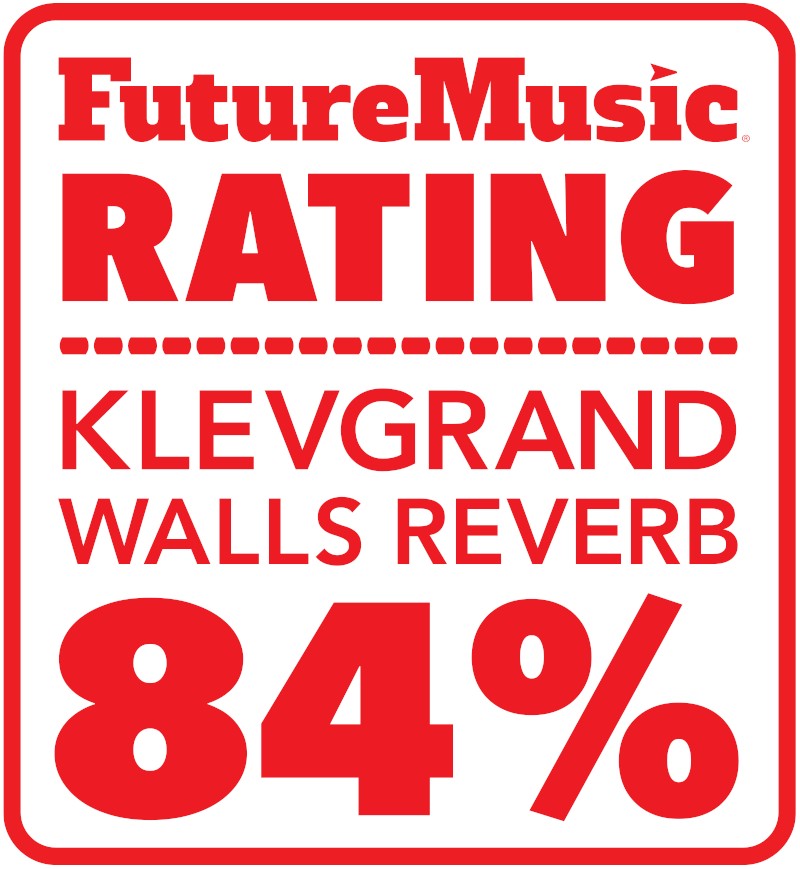
Klevgrand Walls Rating 84%
Cheers:
+ Simple, Clean Effective Interface
+ Quality Of Results
+ Bang-For-The-Buck
+ Low CPU Tax
+ Ease Of Use
+ Automation
Jeers:
– Can’t Control Modulation
– Can’t Sync LFOs
Klevgrand’s Walls will set you back $49 / €49.
The Future: While the Modulation X/Y Matrix can yield positive results, without the ability to actually control these parameters, it comes up wanting. We’d love to see this fleshed out in version 2.0 with a breakout panel that allows deeper and more fluent control.