FutureMusic spent considerable amount of time with Polyend’s new digital synthesizer, which they simply dubbed Synth, for this long-term review. Since it offered a new methodology for playing and creating music, we enlisted five different reviewers to spend about a month each with Synth to see how it fared in their workflow. (Their comments in quotes below). While the naming of the product would not be considered groundbreaking, our evaluators found the concept to be a “fresh approach,” “a lot of fun,” and the quality of the results “were excellent.” However, as the firmware has matured, another common thread emerged, Synth “sounds great.”


For a limited time only! Up to 80% off all Waves Bundles. PLUS click the banner above or the Go button for an additional 10%! This is Waves best deal yet! Get yours today before this special ends! Go!
Our review unit originally came with eight different digital synth engines, which Synth allows you to play three simultaneously, but when Polyend updated the firmware to 1.3, they added a new one, DWA, a dual wavetable synthesizer developed for more experimental sonic flavors. The original engines include ACD, based on a combination of the Roland SH-101 and the TB-303, but more 101; FAT a three oscillator synth with slight detuning that hits its sweet spot with the SuperSaw waveform; WABS features two wavetable oscillators with a morph function; VAP is a Virtual Analog Polyphonic synth model based loosely on the Prophet-5; Wavetable FM is, you guessed it, a FM Synth with morphing capabilities; PMD is a Physical Modeling synth; PHZ is a Phase Distortion Synth based on the Casio CZ series; and finally, Grain is a granular synth to tackle more textured and visceral sounds.
Polyend is no stranger to a firmware update…
It’s not unusual for manufacturers these days to release products with the firmware not 100% perfect and Polyend is no stranger to a firmware update. However, unlike some companies, Polyend is not just squashing bugs or fixing usability problems, they’re also adding new features and re-evaluating their programming. This is one of the benefits of a long-term evaluation, we can actually track the improvements over time and see how it directly affects our reviewer’s experiences.
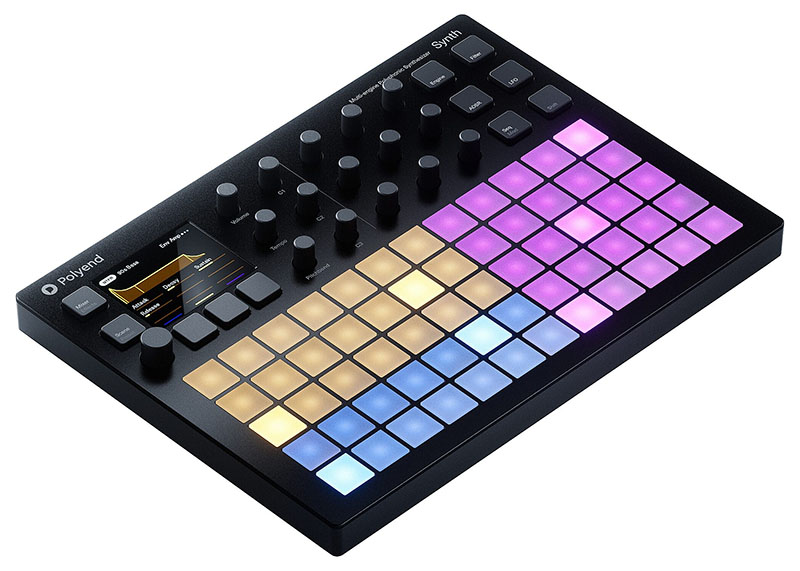
Polyend’s concept behind Synth is for the user to play and explore. Featuring a 60 pad interface with polyphonic aftertouch on each individual pad, each one of the three synthesizer engines can be assigned to one of several grid layouts supplied by Polyend. While the pads are small, they also offer novel velocity settings, allowing you to map up to five velocity settings to parameters for additional sound manipulation and movement.
Playing the pads is “fun, especially with the aftertouch and velocity mapping” and our testers found it to be a unique way for “non keyboardists to perform without having to worry about hitting wrong notes.” When launching a Scene, which is how Polyend describes a project containing all settings, you select a key, and Synth instantly maps the three engines to your selection. There is also an “awesome follower mode” that does have some limitations, but overall was well received. You designate one of Synth’s engine as the Chord Mode or Lead track that defines the key. Other Synth engines can then be set to Follower Mode. When notes or chords are played on the lead track (either live via the pads or from a recorded sequence), the follower tracks will automatically adjust their notes to stay in the specified scale or chord. For example, if a follower track has an arpeggiator running, that arpeggio will re-pitch itself to match the current chord being played by the lead.

Above the pads are fifteen touch-sensitive knobs, plus a larger Main Knob on the left. These are accompanied by eleven mechanical buttons (think gaming keyboards) that “have a satisfying click” when pressed. A “vivid” OLED display provides all the necessary info based on a page-based graphical user interface. Our evaluators all ramped up to learning the operating system “in no time” and found it “intuitive, flexible and logical.” The two mechanical buttons on the left allow your to jump right in and select the main functions, Scene, Preset, Mixer and Effects. The larger Main knob underneath drives the sub selections. Each synth engine contains an Effect, Mixer and Macro section with the C1, C2 and C3 macro knobs being able to control up to five parameters each. The nine knobs in the modulation matrix provide access to the modifier, the destination and the amount. The matrix adapts to each of the synth engines editable parameters, which vary widely. Some of the engines contain many parameters for tweaking, others just a few. The Mixer section provides “substantial control over routing and panning.”
While the Arpeggiators have plenty of features, the “Sequencer, if you can really call it that,” is quite limited, but does have some great attributes, including Groove, Humanize and Swing. Maybe Polyend didn’t want to cannibalize the extensive feature set from the recently released Mess, but every one of our reviewers found the core sequencer functionality to be the “weak link,” considering the rest of the features. Polyend’s objective was for the Synth to be physically played, so their motive was promote this tactile connection to the instrument, but with all the glorious pads and controllers, the sequencer “was a miss.” That said, the manner in which our evaluators Synth workflow changed over time, rendered this less of an issue. More on this in a moment…

MIDI Designer Is Now Free!
MIDI Designer Pro X is now free to download! MIDI Designer Pro X is a professional-grade MIDI controller platform for iPhone, iPad and Mac. User-contributed layouts let you control everything from Ableton to Yamaha out of the box. Go beyond hardware and express your musical vision. Check out out now!

Synth For Sound Design
One of the things that really needs to be emphasized, and probably hasn’t really gotten its due, is the sound design capabilities. For the money, you’d be hard pressed to find a comparable hardware synth on the market. The ASM HydraSynth Explorer comes to mind, as well as the new Meris Enzo X, but both are very different products. Featuring nine distinct engines, Synth stands out from other products in its class. But the ability to shape, tweak and modulate those engines truly sets Synth apart. For those willing to get under the hood and delve deeply into each engine, the rewards are many. Even engines like the granular Grain may seem flat upon first encounter, but upload your own samples, via the micro SD card slot, and things truly start to blossom. The unfortunate aspect is the our testers found most of the presets “to be uninspiring” and “not truly showcase what Synth can achieve,” so you may want to spend some time with the unit yourself to determine if it’s right for you. While the digital architecture does provide “a certain overall flavor,” Synth “comes alive with minimal effort.”

We have to salute Polyend for what they achieved with Synth…
One of the benefits from conducting long-term reviews with multiple evaluators is the ability to examine their experiences from their first sentiments to when they have to hand the product to the next tester. The initial impressions and workflow changed quite substantially over time for the majority of the five testers. All went into their assessments with the notion that they would be using the pads throughout their examination, but by the second week, four out of the five reviewers had abandoned the pad interface entirely and were accessing the Synth strictly through MIDI. The fifth continued to use the pads for his live ambient and experimental music excursions, running Synth through his arsenal of guitar pedal effects to create “full, fluid soundscapes.” The rest felt that Synth’s “full strengths” only emerged when connected to a DAW for “full sequencing, defined chord progressions” and “conventional studio workflow.”

The easiest way for electronic musicians to get their music onto Spotify, Apple Music, iTunes, Amazon Music, Tidal, Instagram, Facebook, TikTok, Pandora, Twitch & much more! Click the banner above or the Go Button to save 7% off of your signup! Go!

Polyend Synth Features:
- Multi-engine polyphonic synthesizer
- OLED Display
- Nine synth engines spanning analog style, FM, wavetable, monosynth, granular synthesis, and further varieties
- Architecture supports using up to three different engines simultaneously for a deep, customizable configuration of 8-voice performances
- Three available effects, modulation, delay and reverb
- Polyphonic arpeggiators for each synth engine
- 60 RGB-backlit performance pads include both velocity sensitivity and polyphonic aftertouch, with up to five simultaneous parameters able to be mapped to aftertouch
- Smart Grid offers customizable note, chord, scale, and additional parameters
- Scene files allow you to build entire live and studio setups that can be instantly saved, recalled and shared
- Nine Combo Knobs form a 3×3 matrix of assignable parameters to modulate each engine or all three simultaneously
- MIDI connectivity includes a 3.5mm TRS-B I/O and USB-C
- SD Card (up to 16GB)

Trap Door Electronics Active Acid Review
Trap Door Electronics latest guitar pedal Active Acid is equally at home as an effects processor for both guitarists and electronic musicians. Read our comprehensive Trap Door Electronics Active Acid Review to find out more!
Conclusion
We have to salute Polyend for what they achieved with Synth. With so many manufacturers just trotting out, yet another, digital synthesizer in the some habitual format, the Polish company branched out and brought something unique to the world. While there are some limitations (sequencer!), and the pad performance attributes may not be for everyone, the nine engines certainly make up for any deficits. With new firmware updates continually expanding Synth’s features, this synthesizer will find a cherished location in your studio or stage, no matter how you take advantage of its powers. Recommended.
Polyend Synth Rating 90%
Cheers:
+ Sound Quality
+ Sound Design
+ Build Quality
+ Usability
+ Value
+ Fun
+ Phase Distortion Engine
Jeers:
– CPU Power
– Some Presets Are Uninspired
– Can’t Modulate Timbre
– Hard To Read Back Panel Text
– Sequencer
– TRS MIDI
– Can’t Layer All Three Engines On Same Grid
Polyend Synth costs $599 / €599.
The Future: We’d love to see the sequencer expanded in the next firmware release. Although it’s not the core of Synth’s functionality, with a more substantial feature set and the ability to take advantage of the pad grid, there is a lot Polyend can do to invigorate Synth’s sequencer. Being able to layer two or more of Synth’s engines to the same pads can also bring new excitement and eliminate the need to play “Finger Twister.” Finally, we’d like to see every one of each engines parameters to be able to be modulated, instead of only a select few. A CPU upgrade in the next version should also be considered in order to take full advantage of Synth’s features.